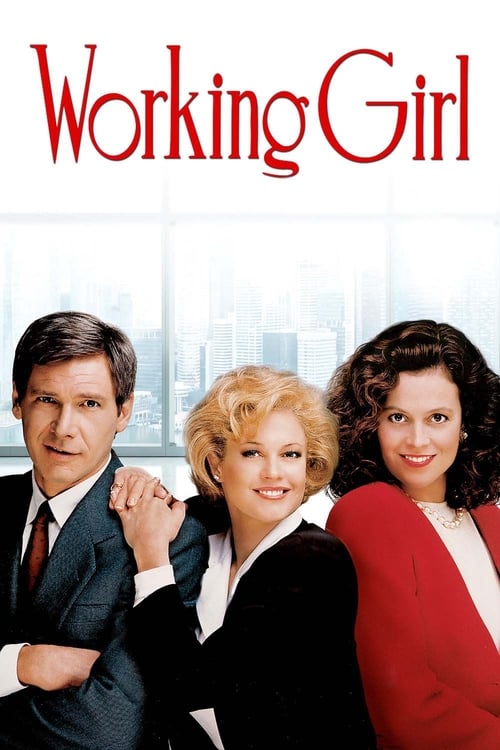
Working Girl (1988)
Directed by Mike Nichols
No — Working Girl is not especially woke, scoring 23 out of 100 on our wokeness meter.
Working Girl arrives from 1988 carrying a briefcase full of ambition and a Staten Island accent it cannot quite shake.
Consciousness Markers
The plot is explicitly about a woman battling sexist corporate gatekeepers and claiming credit for her own business idea; female empowerment is the film's central engine.
The film has a female-heavy principal cast and a working-class protagonist, but it is otherwise almost entirely white and heteronormative in a pre-diversity-era Hollywood way.
The film carries a clear feminist and class-conscious message, but it is delivered through romantic-comedy plotting rather than direct preaching.
It gestures at class resentment between Staten Island and Manhattan elites, but ultimately celebrates success within the corporate merger system rather than challenging capitalism.
There are no LGBTQ+ characters, themes, or subtext.
The film does not engage with race or racial inequality; its corporate world is uniformly white.
There are no environmental or climate-related themes.
There are no body-positivity themes; the makeover plot leans on conventional beauty and wardrobe transformation.
There are no neurodivergent characters or themes.
The film is not a historical work and makes no revisionist historical claims.
Why it received this score
Working Girl arrives from 1988 carrying a briefcase full of ambition and a Staten Island accent it cannot quite shake. Melanie Griffith plays Tess McGill, a secretary with a night-school business degree and a boss who steals her merger idea and then breaks her leg skiing, which is the sort of plot convenience that exists only in movies about women who deserve better. Mike Nichols directs with the smooth, unbothered competence of a man who knows exactly which buttons to press. The film's central engine is a woman fighting sexist gatekeepers for credit that is rightfully hers. This is female empowerment as narrative spine, not decoration.
The class resentment is present but polite. Staten Island against Manhattan, sneakers against heels, the secretary who reads the room better than the partners who ignore her. Yet the film never turns its gaze toward the system itself. Tess does not want to dismantle the merger-and-acquisitions machine. She wants a desk inside it, preferably with a window. The makeover sequence, in which she borrows her hospitalized boss's wardrobe, treats transformation as a matter of tailoring and borrowed blazers. Conventional beauty standards are not questioned here. They are accessorized.
What the film does not do is equally instructive. Its corporate Manhattan is uniformly white, and race never enters the frame as a subject. There is no LGBTQ presence, no environmental conscience, no curiosity about neurodivergence, no interest in bodies that deviate from the sample size. The message about women and work is real and it is central, but it travels through romantic-comedy mechanics, through Harrison Ford being charming in a towel, through the reliable rhythm of a third-act rescue. The sermon is there. It is simply wearing a power suit and asking us to admire the cut.
Analysis generated by our Consciousness Algorithm


Synopsis
When a secretary's idea is stolen by her boss, she takes a risky chance to reclaim it by impersonating him and running the project from his position.
Questions about Working Girl
Is Working Girl woke?
No — Working Girl is not especially woke, scoring 23 out of 100 on our wokeness meter. That earns it a verdict of Based.
Does Working Girl have any woke elements?
1 of the 10 markers register at 30 or above, led by Feminist Agenda (70). On Feminist Agenda: The plot is explicitly about a woman battling sexist corporate gatekeepers and claiming credit for her own business idea; female empowerment is the film's central engine.
How does Working Girl compare to other 1988 movies?
It ranks #7 of the 73 films from 1988 we've scored; their average is 10. The wokest is Stand and Deliver (58).
How is the Woke Score calculated?
An AI-assisted process researches the film and its reception, scores it 0–100 on ten markers, then combines those into one 0–100 Woke Score. It measures a specific set of 2020s cultural themes, not film quality.