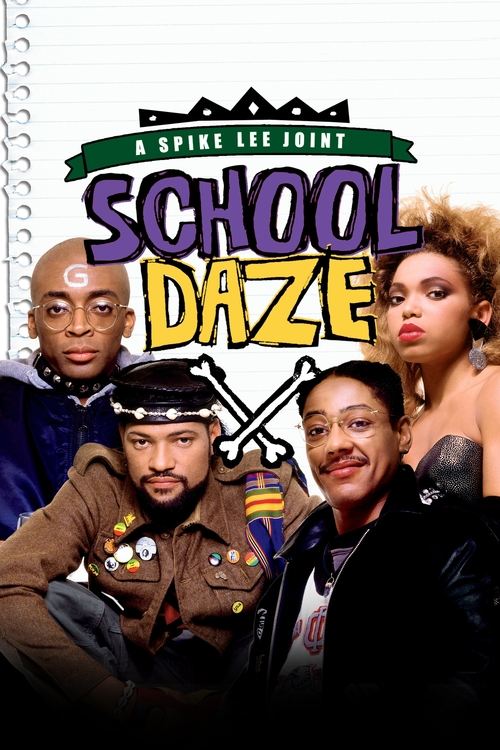
School Daze (1988)
Directed by Spike Lee
Partly · Woke-Adjacent
How we score movies →Consciousness Markers
Strong engagement with colorism, classism, and intraracial Black politics, though framed through 1980s Black radical discourse rather than 2020s identity frameworks.
Some preachy elements about activism and Black consciousness present, but balanced with comedy, musical performance, and character-driven narrative.
Class commentary present through exploration of economic stratification within the HBCU, but not framed as systematic critique of capitalism or wealth redistribution.
Female characters exist and some commentary on female self-esteem appears, but no systematic feminist framework or contemporary gender consciousness.
All-Black cast reflects the HBCU setting authentically, but lacks the contemporary diversity framework that defines modern casting consciousness.
No LGBTQ+ themes, characters, or representation present in the film.
No environmental themes or climate consciousness present in the film.
No body positivity discourse or body-conscious representation present in the film.
No representation of neurodivergence or disability consciousness in the film.
No historical revisionism present, though apartheid activism is referenced as contemporary political commitment.


Synopsis
Fraternity and sorority members clash with other students at a historically black college during homecoming weekend.
Why it received this score
School Daze is a late-1980s artifact of Black cultural self-examination, a film that takes genuine social fractures within the African American community seriously enough to satirize them. Spike Lee's second narrative feature explores colorism, class stratification, and political consciousness through the compressed social world of a fictional HBCU homecoming weekend. The film's satirical energy comes from its insider perspective, examining how Black students police each other across lines of skin tone, economic background, and ideological commitment. Lee does not lecture from outside this world but rather inhabits it, allowing contradictions and hypocrisies to emerge through character and performance rather than authorial commentary. This approach yields moments of genuine insight about intraracial dynamics that remain relevant decades later. The film's weakness lies in its dated sensibility. What registers as 1988 Black radical consciousness does not map cleanly onto contemporary progressive frameworks. The film lacks any engagement with LGBTQ+ identity, climate consciousness, or neurodivergence. Its feminism is incidental, its anti-capitalist content peripheral. The all-Black casting reflects historical reality rather than contemporary diversity metrics. Lee's activism around apartheid represents a pre-2015 internationalist left consciousness, not the identity-focused progressivism that would crystallize after 2015. School Daze remains a valuable document of Black intellectual and political life at a specific historical moment, but it operates in a register entirely distinct from modern progressive sensibilities. It is a film about Black self-determination, not a film designed to signal progressive values to a contemporary audience.
Analysis generated by our Consciousness Algorithm
Critic Reviews
“Although the film has big structural problems and leaves a lot of loose ends, there was never a moment when it didn’t absorb me, because I felt as if I was watching the characters talk to one another, instead of to me. ”
“The fact that Columbia Pictures produced this is hugely significant. It’s not only that School Daze is written and directed by an African-American filmmaker; it’s that it offers a black perspective outside of genre (blaxploitation) or historical fiction.”
“And though School Daze isn't as successful as the more modestly scaled "She's Gotta Have It," in the end, it may be even more rewarding and promising. The movie's seemingly twisted view of higher education suggests a straight eye, a cool mind, a steady heart--and a great aim. ”
“As much as She's Gotta Have It exceeded expectations, School Daze sinks beneath them. This is one low- down flop of a movie. [12 Feb 1988, p.C5]”