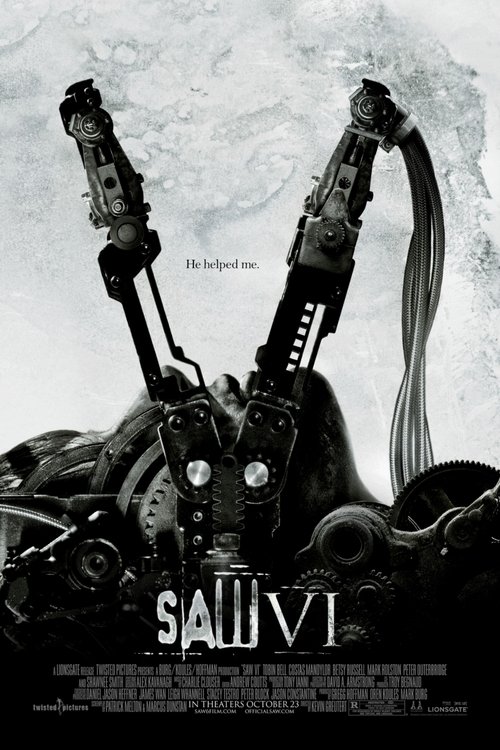
Saw VI (2009)
Directed by Kevin Greutert
No — Saw VI is not especially woke, scoring 25 out of 100 on our wokeness meter.
Saw VI arrives as the sixth installment in a franchise that has long since traded suspense for elaborate contraptions, and it brings with it a surprisingly specific set of grievances.
Consciousness Markers
The plot explicitly targets predatory mortgage brokers and a health insurance executive whose company denies coverage, functioning as a blunt post-2008 critique of corporate greed and the American healthcare industry.
Jigsaw’s moralizing games and the health-insurance satire give the film some sermonizing energy, but it remains subtextual horror rather than direct preachy lecturing.
The cast includes a few non-white performers, such as Tanedra Howard as Simone and Athena Karkanis as Agent Perez, but this is incidental rather than a deliberate inclusive-casting statement.
There are no LGBTQ+ characters, themes, or subtext in the film.
Female characters such as Jill, Amanda, and Perez are present, but the film does not engage with feminist themes or a feminist agenda.
The film does not explore race, racial injustice, or racial consciousness.
There is no environmental or climate-related messaging in the film.
The opening trap uses an overweight character’s body and self-mutilation for shock value, which is contrary to body-positivity themes.
The film does not feature neurodivergent characters or themes.
The film is a fictional horror sequel and does not revise or reinterpret historical events.
Why it received this score
Saw VI arrives as the sixth installment in a franchise that has long since traded suspense for elaborate contraptions, and it brings with it a surprisingly specific set of grievances. The plot pits a health insurance executive against a series of deadly games, his company having denied coverage to the original Jigsaw, while the opening trap dispatches two predatory mortgage brokers. This is a blunt, post-2008 critique of corporate greed, rendered in the usual viscera. The film does not lecture so much as it lets the machinery do the talking, though Jigsaw's moralizing has a sermonizing quality that stops short of outright preaching. The anger is directed at institutions, not at the audience.
That anger, however, is narrowly focused. The cast includes a few non-white performers, such as Tanedra Howard, a reality-show contestant awarded a role, and Athena Karkanis as an FBI agent, but their presence is incidental. The film has no interest in racial consciousness, feminist agendas, or LGBTQ themes. Its treatment of the body is regressive: the opening trap uses an overweight character's flesh as a punchline, the opposite of any body-positive sentiment. Neurodivergence and climate concerns are absent. The film's cultural awareness is a product of its moment, a time when economic populism could coexist with torture porn.
Ultimately, Saw VI is a sequel that knows its audience and serves them a plate of retribution against the insurance industry. It is not a film that seeks to educate or uplift. It seeks to punish, and it does so with a grim efficiency. The progressive sensibilities on display are limited to a distrust of corporate power, a sentiment that feels almost quaint in its directness. The film is a relic of a specific cultural moment, and it wears its grievances on its blood-soaked sleeve. We are left to classify it, and we do so without enthusiasm, but with the solemnity the task demands.
{"thematic_tags": ["sequel"]}
Analysis generated by our Consciousness Algorithm
Part of


Synopsis
Special Agent Strahm is dead, and Detective Hoffman has emerged as the unchallenged successor to Jigsaw's legacy. However, when the FBI draws closer to Hoffman, he is forced to set a game into motion, and Jigsaw's grand scheme is finally understood.
Questions about Saw VI
Is Saw VI woke?
No — Saw VI is not especially woke, scoring 25 out of 100 on our wokeness meter. That earns it a verdict of Based.
Does Saw VI have any woke elements?
1 of the 10 markers register at 30 or above, led by Eat the Rich (60). On Eat the Rich: The plot explicitly targets predatory mortgage brokers and a health insurance executive whose company denies coverage, functioning as a blunt post-2008 critique of corporate greed and the American healthcare industry.
How does Saw VI compare to other 2009 movies?
It ranks #32 of the 230 films from 2009 we've scored; their average is 14. The wokest is Home (79).
Is Saw VI the most woke Saw movie?
Yes. It scores highest of the 10 Saw films we've scored.