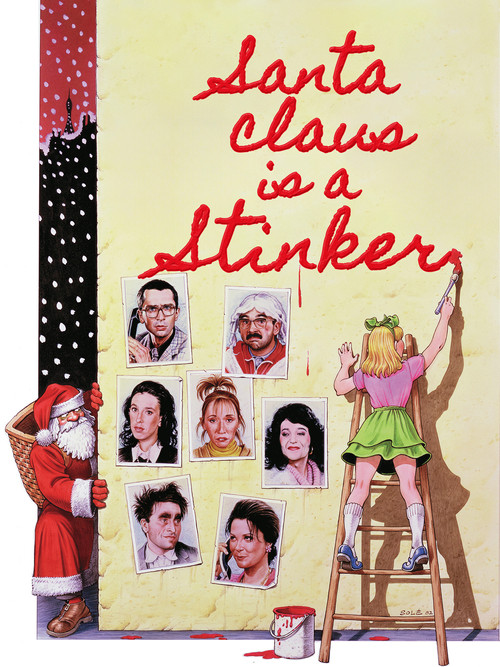
Santa Claus Is a Stinker (1982)
Directed by Jean-Marie Poiré
No — Santa Claus Is a Stinker is not woke, scoring 5 out of 100 on our wokeness meter.
Le Père Noël est une ordure arrived in 1982, three years after the Le Splendid troupe first staged it in a Paris theater, and it carries the fingerprints of the stage: a single set, a door that keeps swinging open, and a cast of misfits who cannot leave each other alone.
Consciousness Markers
A cross-dressing character (Katia) appears, but the transvestism is a 1982 comedic trope played for laughs rather than any affirmative LGBTQ+ theme or advocacy.
A pregnant woman fleeing an abusive fiancé and a female volunteer exist in the plot, but the film offers no feminist critique or agenda; the women are largely comedic foils.
The cast is an all-white ensemble of the Le Splendid troupe; no deliberate diverse or inclusive casting choices are present.
No racial themes, commentary, or consciousness of any kind appear in the film.
No environmental or climate-related content whatsoever.
No critique of wealth, capitalism, or class economics; the humor is purely situational and character-driven.
No body-positivity messaging; physical appearance is used for comedic effect rather than affirmation.
Though characters are described as 'neurotic' and staff a suicide hotline, this is comic characterization, not neurodivergence representation or advocacy.
The film is a contemporary farce with no historical subject matter to revise.
A black-comedy farce with no didactic or preachy messaging; it aims only to provoke laughter.
Why it received this score
Le Père Noël est une ordure arrived in 1982, three years after the Le Splendid troupe first staged it in a Paris theater, and it carries the fingerprints of the stage: a single set, a door that keeps swinging open, and a cast of misfits who cannot leave each other alone. Two volunteers staff a suicide hotline on Christmas Eve. The elevator is broken. Into this confinement wander a pregnant woman fleeing a fiancé who beats her, a melancholy cross-dresser with an unrequited crush, and a neighbor bearing pastries of uncertain origin. The film wants nothing from us but laughter, and it gets it.
The social inventory here is thin, and honest about being thin. Katia's transvestism is a 1982 comic device, played for the titters of a theater audience, with no interest in the interior life of the character beyond the joke. Josette is pregnant and on the run from a violent man, and the film treats this as a plot engine, not a grievance to be aired. The women are foils. The men are worse. Nobody learns anything, which is the point of a farce. The ensemble is the troupe itself, ten performers chosen for timing and chemistry instead of any representational ambition, and the picture is better for it.
The picture stays alive because it refuses to sermonize. There is no lesson, no cause, no ledger of virtue to be balanced by the closing credits. Preskovitch and his pastries exist because Josiane Balasko ate something strange in Croatia and thought it funny. That is the entire moral universe of this film, and it holds up better than most of what followed. A remake was attempted in America in 1994. It did not survive.
Analysis generated by our Consciousness Algorithm
Synopsis
Two neurotics, working for a suicide hotline on the night of Christmas Eve, get caught up in a catastrophe when a pregnant woman, her abusive boyfriend, and a cross-dresser visit their office.
Questions about Santa Claus Is a Stinker
Is Santa Claus Is a Stinker woke?
No — Santa Claus Is a Stinker is not woke, scoring 5 out of 100 on our wokeness meter. That earns it a verdict of Ultra Based.
Does Santa Claus Is a Stinker have any woke elements?
Very few. None of the 10 markers reaches 30, the level where a marker counts as present; the highest is LGBTQ+ Themes at 10.
How does Santa Claus Is a Stinker compare to other 1982 movies?
It ranks #24 of the 41 films from 1982 we've scored; their average is 7. The wokest is Gandhi (42).
How is the Woke Score calculated?
An AI-assisted process researches the film and its reception, scores it 0–100 on ten markers, then combines those into one 0–100 Woke Score. It measures a specific set of 2020s cultural themes, not film quality.