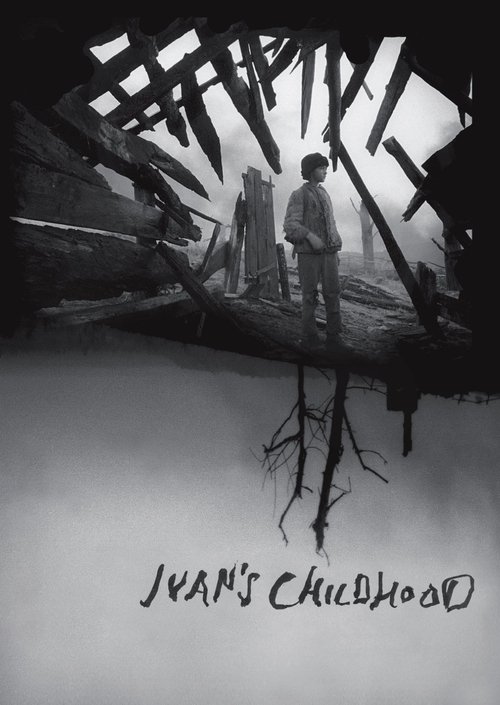
Ivan's Childhood (1962)
Directed by Andrei Tarkovsky
No — Ivan's Childhood is not woke, scoring 0 out of 100 on our wokeness meter.
Ivan's Childhood arrives from 1962, a Mosfilm production about a twelve-year-old boy running reconnaissance behind German lines after his family is killed.
Consciousness Markers
The cast is entirely Soviet/Russian, assembled from Tarkovsky's VGIK circle and Mosfilm regulars; there is no modern representation-casting agenda at work.
No LGBTQ+ characters, themes, or subtext appear anywhere in the film.
Masha exists as a nurse and object of the officers' attention, but the film advances no feminist critique or gender agenda.
The film concerns Soviet-German WWII conflict and contains no engagement with racial identity or racial justice themes.
Nature is a central poetic and symbolic presence, but it functions as witness to human violence, not as an environmentalist climate crusade.
Though a Soviet production, the film's anti-war humanism is not framed as a modern eat-the-rich or anti-capitalist polemic.
No body-positivity themes or messaging are present.
No neurodivergent characters or themes are depicted or referenced.
The film humanizes the cost of war rather than glorifying it, but it does not rewrite or reinterpret historical events in the modern revisionist sense.
Tarkovsky's stated hatred of war is conveyed through poetic imagery and dream sequences rather than didactic sermonizing; the film shows rather than lectures.
Why it received this score
Ivan's Childhood arrives from 1962, a Mosfilm production about a twelve-year-old boy running reconnaissance behind German lines after his family is killed. Andrei Tarkovsky's first feature is a war film that hates war, a distinction the era had not yet learned to make gracefully. The boy is small, the swamp is cold, the dreams are shot in a warmer register, and the whole thing ends with a dead tree and a memory of a beach. No messaging is layered over the top. The camera simply watches.
This is the difficulty. A viewer arrives braced for the machinery of contemporary social consciousness and finds none of it. The cast is Soviet, drawn from Tarkovsky's film school circle, and no representational arithmetic governs the choices. Masha the nurse drifts through the officers' quarters as an object of their attention, and the film offers no correction of this. Race is not a category the film engages, which is unsurprising given the conflict it depicts. Nature saturates every frame, but as a witness to violence, not as a platform. The anti-war sentiment is humanist and old-fashioned, rooted in grief instead of economics. Nobody is lectured.
Tarkovsky said he wanted to convey his hatred of war, and he does it with imagery: rain on ruined walls, a horse beside an apple cart, a boy's face gone hard. The sermon never arrives. We get a portrait of stolen childhood instead, and it lands harder for refusing to explain itself.
Analysis generated by our Consciousness Algorithm


Synopsis
In WW2, twelve year old Soviet orphan Ivan Bondarev works for the Soviet army as a scout behind the German lines and strikes a friendship with three sympathetic Soviet officers.
Questions about Ivan's Childhood
Is Ivan's Childhood woke?
No — Ivan's Childhood is not woke, scoring 0 out of 100 on our wokeness meter. That earns it a verdict of Ultra Based.
Does Ivan's Childhood have any woke elements?
No. All 10 markers score zero.
How does Ivan's Childhood compare to other 1962 movies?
It ranks #20 of the 23 films from 1962 we've scored; their average is 9. The wokest is The Exterminating Angel (47).
How is the Woke Score calculated?
An AI-assisted process researches the film and its reception, scores it 0–100 on ten markers, then combines those into one 0–100 Woke Score. It measures a specific set of 2020s cultural themes, not film quality.