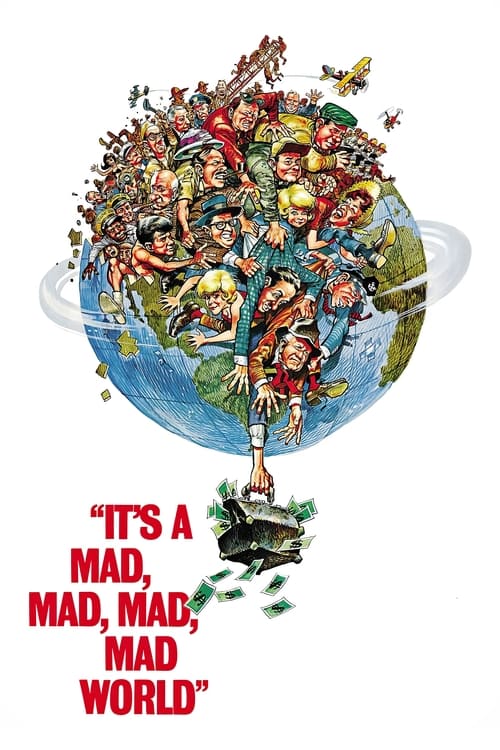
It's a Mad, Mad, Mad, Mad World (1963)
Directed by Stanley Kramer
No — It's a Mad, Mad, Mad, Mad World is not woke, scoring 3 out of 100 on our wokeness meter.
The great problem with Stanley Kramer is that he spent a career lecturing us about the human condition, and then he made this.
Consciousness Markers
Greed drives every character and ultimately ruins them all, but this is comedic moralizing about avarice rather than a systemic critique of capitalism.
The all-star ensemble is overwhelmingly white, drawn from the era's comedy roster, with no deliberate push for diverse representation.
Ethel Merman's domineering mother-in-law is a comedic caricature, not a feminist statement; women serve largely as foils and punchlines.
No LGBTQ+ characters, themes, or subtext of any kind appear in this 1963 slapstick chase comedy.
The film engages no racial themes or commentary whatsoever; it is a pure greed-and-chase farce.
No environmental or climate concerns appear; the desert and national park are mere backdrops for slapstick.
Physical comedy relies on pratfalls and injury gags with no body-positive messaging.
No neurodivergent characters or themes are present or explored.
The film is a fictional contemporary caper with no historical revisionism.
This is a broad, gag-driven comedy with no preachy or didactic messaging.
Why it received this score
The great problem with Stanley Kramer is that he spent a career lecturing us about the human condition, and then he made this. It's a Mad, Mad, Mad, Mad World arrives with the full apparatus of the epic: Ultra Panavision 70, a Cinerama screen, a running time approaching three and a quarter hours, and a cast list so long the opening credits had to be animated just to fit everyone in. The premise is elegantly stupid. A dying convict whispers the location of $350,000 to a handful of motorists, and four cars tear across California in pursuit of a suitcase. That is the entire film. The dying man is dispatched within the first ten minutes and the remaining three hours are devoted to the consequences of his generosity.
Kramer assembled the comedy roster of his era, alphabetically billed, and the resulting ensemble is as white as a country club in 1963. Ethel Merman plays the mother-in-law as a foghorn in a housedress, and the film's women exist mostly to be shouted at or ejected from moving vehicles. The humor is physical and relentless: cars are wrecked, a service station is demolished, a fire escape collapses under the weight of a dozen men. Greed is the engine, and the film says so plainly. Every character who wants the money is ruined by wanting it. This is moralizing, but it is the moralizing of Aesop, aimed at a single vice, and it does not extend a hand toward the systems that produce the vice.
Where progressive sensibilities are concerned, the picture is a vacuum. No racial themes, no environmental concerns, no questions of identity or embodiment cross that wide screen, and nothing is being revised, corrected, or explained to us. The one institution it glances at, the police pension, is resolved offhandedly so the final joke can land. The closing image is a banana peel and a room of injured men laughing, which tells you what the film believes comedy is for. It wants nothing from us except laughter, and it earns a fair amount of it. As a document of cultural awareness, this is a beautifully photographed zero.
Analysis generated by our Consciousness Algorithm


Synopsis
A group of strangers come across a man dying after a car crash who proceeds to tell them about the $350,000 he buried in California. What follows is the madcap adventures of those strangers as each attempts to claim the prize for himself.
Questions about It's a Mad, Mad, Mad, Mad World
Is It's a Mad, Mad, Mad, Mad World woke?
No — It's a Mad, Mad, Mad, Mad World is not woke, scoring 3 out of 100 on our wokeness meter. That earns it a verdict of Ultra Based.
Does It's a Mad, Mad, Mad, Mad World have any woke elements?
Very few. None of the 10 markers reaches 30, the level where a marker counts as present; the highest is Eat the Rich at 12.
How does It's a Mad, Mad, Mad, Mad World compare to other 1963 movies?
It ranks #12 of the 16 films from 1963 we've scored; their average is 7. The wokest is High and Low (28).
How is the Woke Score calculated?
An AI-assisted process researches the film and its reception, scores it 0–100 on ten markers, then combines those into one 0–100 Woke Score. It measures a specific set of 2020s cultural themes, not film quality.