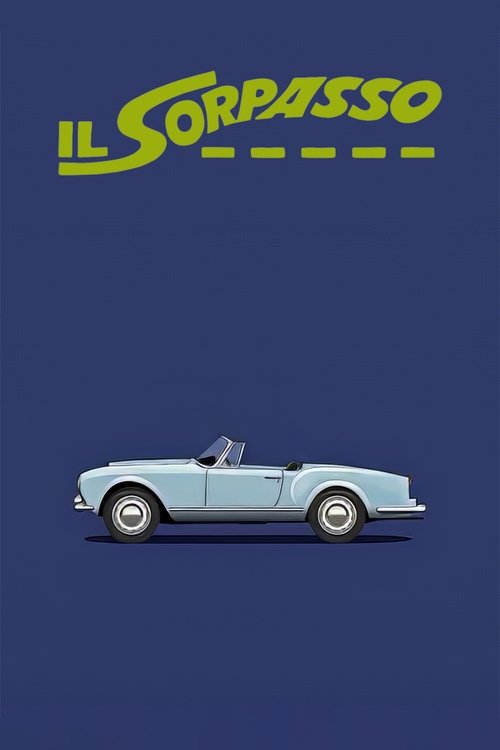
Il Sorpasso (1962)
Directed by Dino Risi
No — Il Sorpasso is not woke, scoring 3 out of 100 on our wokeness meter.
It is 1962, and Italy is enjoying an economic miracle.
Consciousness Markers
The commedia all'italiana tradition carries faint social satire — the industrialist Bibi, the bribery of a monsignor, the nouveau-riche backdrop of the boom — but this is incidental texture, not an anti-capitalist thesis.
The cast is entirely white Italian and European actors, with no diversity-conscious casting whatsoever; this is simply the natural composition of a 1962 Italian production.
There are no LGBTQ+ characters or themes; the film's sexual dynamics center entirely on Bruno's heterosexual womanizing and Roberto's crush on Valeria.
Women exist largely as objects of Bruno's advances or as domestic fixtures (Gianna, Lilli), and the film offers no feminist critique of its era's gender roles.
Race is entirely absent as a subject; the film concerns itself with class, personality, and the Italian economic boom, not racial identity.
No environmental or climate themes appear; the reckless driving and coastal settings are purely character and plot devices.
There is no body-positivity content; the film's focus on glamorous cars, fashion, and beachside leisure runs in the opposite direction.
No neurodivergent characters or themes are present; Bruno's impulsiveness is characterized as moral immaturity, not a neurological condition.
The film is a contemporary character study set in 1962 Italy, not a reworking of historical events.
The film is a breezy road comedy that shows rather than tells; it delivers its fatalistic ending through action, not moralizing monologue.
Why it received this score
It is 1962, and Italy is enjoying an economic miracle. Dino Risi's Il Sorpasso takes this boom for a spin down the Via Aurelia, and the scenery is entirely white, entirely Italian, and entirely unconcerned with the categories that occupy the modern classification apparatus. Bruno Cortona drives a Lancia Aurelia like a man fleeing his own biography. Roberto, a timid law student, is along for the ride. The sun is relentless, the convertible is loud, and the moral accounting is deferred until the final reel. What follows is a road comedy that ends in a corpse, which is the commedia all'italiana way.
The film's social conscience is faint and diffuse. There is a monsignor to be bribed, an industrialist named Bibi purchasing a fifteen-year-old bride with patience and a checkbook, and a nouveau riche texture that Risi observes without indictment. This is satire by ambient suggestion, not thesis. Bruno's womanizing is presented as appetite, not ideology. Women drift through as objects of pursuit or fixtures of domestic disappointment. Nobody in the frame is analyzing power, and the film would be baffled by a request to do so.
What remains is craft. The reckless overtaking of the title builds to a fatal swerve, and Risi delivers the moral through a shattered car and a man who cannot remember his dead friend's surname. No sermon, no lesson, just the easy life collecting its bill. Viewed through the lens of contemporary cultural markers, the film registers almost nothing. It is a relic of a specific national moment, morally curious, formally assured, and utterly indifferent to the anxieties of a later era. We classify it, and it shrugs. A quiet, cruel, wonderful thing, and no use to us at all as a document of present-day virtue. The sommelier sets down the glass and reaches for the next bottle.
{"thematic_tags": []}
Analysis generated by our Consciousness Algorithm


Synopsis
Roberto, a shy law student in Rome, meets Bruno, a forty-year-old exuberant, capricious man, who takes him for a drive through the Roman and Tuscany countries in the summer. When their journey starts to blend into their daily lives though, the pair’s newfound friendship is tested.
Questions about Il Sorpasso
Is Il Sorpasso woke?
No — Il Sorpasso is not woke, scoring 3 out of 100 on our wokeness meter. That earns it a verdict of Ultra Based.
Does Il Sorpasso have any woke elements?
Very few. None of the 10 markers reaches 30, the level where a marker counts as present; the highest is Eat the Rich at 5.
How does Il Sorpasso compare to other 1962 movies?
It ranks #16 of the 23 films from 1962 we've scored; their average is 9. The wokest is The Exterminating Angel (47).
How is the Woke Score calculated?
An AI-assisted process researches the film and its reception, scores it 0–100 on ten markers, then combines those into one 0–100 Woke Score. It measures a specific set of 2020s cultural themes, not film quality.