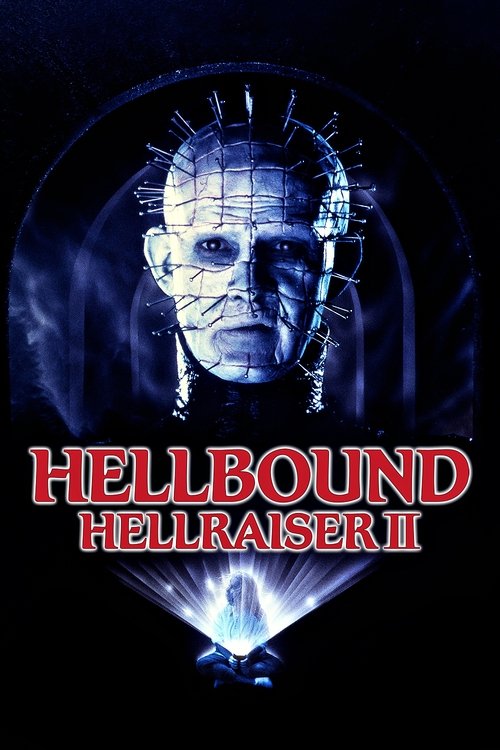
Hellbound: Hellraiser II (1988)
Directed by Tony Randel
No — Hellbound: Hellraiser II is not woke, scoring 4 out of 100 on our wokeness meter.
Hellbound: Hellraiser II arrives as the second entry in a franchise that has never pretended to be about anything other than hooks, skin, and the geometry of suffering.
Consciousness Markers
Kirsty and Tiffany are resourceful female leads who drive the rescue plot, but this is standard final-girl horror convention with no feminist thesis or commentary.
The cast is uniformly white British, with no deliberate diverse or inclusive casting choices. Characters exist as horror archetypes rather than representation statements.
No LGBTQ+ characters, themes, or subtext are present. The film's eroticism is strictly heterosexual and sadomasochistic in a horror register.
The film engages no racial themes or commentary whatsoever. The 1920s India prologue is pure exotic set-dressing for Pinhead's origin.
No environmental or climate themes appear. The film's concerns are entirely metaphysical and visceral.
No economic critique or eat-the-rich messaging. Dr. Channard's villainy is personal obsession, not a class allegory.
The film's treatment of bodies is the opposite of body positivity, reveling in flayed skin, mutilation, and grotesque transformation as horror spectacle.
Mental illness and mutism are deployed as gothic horror tropes (the asylum, the mute patient) rather than as neurodivergent-affirming representation.
No historical revisionism. The brief colonial-era prologue serves only to explain a character's transformation.
The film makes no attempt to lecture or moralize. It is a visceral, effects-driven horror entertainment with no didactic agenda.
Why it received this score
Hellbound: Hellraiser II arrives as the second entry in a franchise that has never pretended to be about anything other than hooks, skin, and the geometry of suffering. Tony Randel takes the directorial reins from Clive Barker, who stays on as executive producer and story writer, and the result is a louder, busier descent into the labyrinth. There is a prologue in 1920s India, a psychiatric hospital, a mute girl who solves puzzles, and a doctor who wants to see what the box does. None of it pauses to instruct us on how to live.
Two women carry the rescue plot, Kirsty Cotton and the young Tiffany, and both prove resourceful under pressure. This is final-girl convention, executed competently, nothing more. The film has no thesis about gender to advance, and it would be baffled by the suggestion. Its bodies are flayed, consumed, and reassembled as spectacle, which is the precise opposite of any contemporary doctrine of bodily affirmation. The eroticism on display is heterosexual and sadomasochistic, wrapped in latex and suffering, and it apologizes in no direction.
The mental hospital supplies gothic furniture, not a statement about neurodivergence. The colonial prologue exists to explain how a British officer became a Cenobite, not to interrogate empire. Dr. Channard is a monster of personal obsession, not a class allegory, and the film has no interest in economics, climate, or history. What it has is Bob Keen's effects work and Christopher Young's score, which smuggles the morse code for god into a horn blast. The film never lectures. It opens the box and lets the room fill with blood, and for a certain audience that remains sufficient. The seams in the plot are already showing, as the reviewers noted, but nobody came for the plot.
Classification confirms the obvious: a sequel, and a continuation of a literary source, with no other notable distinctions of theme or ancestry to record. The ledger stays clean, and the Cenobites remain what they always were, which is to say, extremely polite about the whole arrangement.
Analysis generated by our Consciousness Algorithm
Part of


Synopsis
Now confined to a mental hospital, young Kirsty insists her supposedly dead father is actually stuck in Hell following his wife’s betrayal. Few believe the young woman’s lurid stories aside from the thrill-seeking Dr. Channard. Kirsty is undeterred and, with the help of a fellow patient, heads to Hell for a rescue.
Questions about Hellbound: Hellraiser II
Is Hellbound: Hellraiser II woke?
No — Hellbound: Hellraiser II is not woke, scoring 4 out of 100 on our wokeness meter. That earns it a verdict of Ultra Based.
Does Hellbound: Hellraiser II have any woke elements?
Very few. None of the 10 markers reaches 30, the level where a marker counts as present; the highest is Feminist Agenda at 5.
How does Hellbound: Hellraiser II compare to other 1988 movies?
It ranks #41 of the 73 films from 1988 we've scored; their average is 10. The wokest is Stand and Deliver (58).
Is Hellbound: Hellraiser II the most woke Hellraiser movie?
No. It ranks #2 of the 5 Hellraiser films we've scored; the wokest is Hellraiser III: Hell on Earth (6).