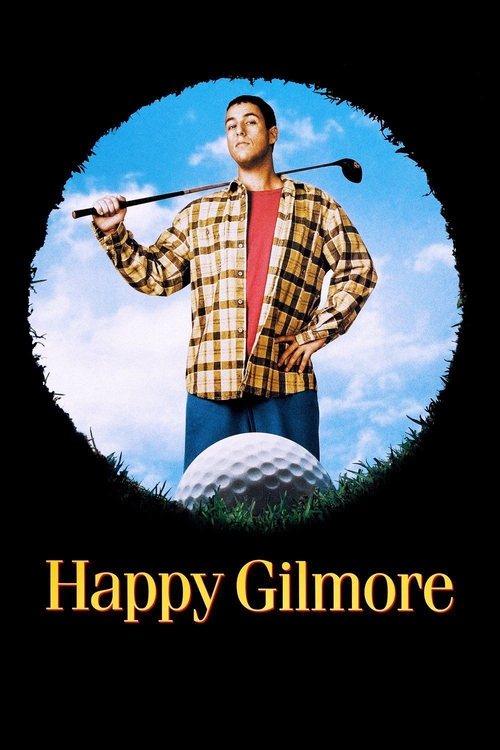
Happy Gilmore (1996)
Directed by Dennis Dugan
No — Happy Gilmore is not woke, scoring 0 out of 100 on our wokeness meter.
Happy Gilmore arrives from 1996, a broad sports comedy engineered around Adam Sandler's short fuse and a slapshot golf swing.
Consciousness Markers
The cast is predominantly white with a few minority actors in natural supporting roles; there is no deliberate diversity casting or commentary.
No LGBTQ+ characters, themes, or subtext are present.
Julie Bowen's character functions as a romantic interest and image consultant; the film offers no feminist agenda or gender critique.
Race is not a thematic concern, and no racial consciousness or commentary appears.
There is no environmental or climate-related content.
The film includes a rich snob villain and class differences, but it does not advance an anti-capitalist or eat-the-rich message.
No body positivity themes or messaging are present.
Happy's anger issues are played for comedy and are not framed as neurodivergence.
The film does not engage with or revise historical narratives.
This is a broad sports comedy with no preachy or lecture-like energy.
Why it received this score
Happy Gilmore arrives from 1996, a broad sports comedy engineered around Adam Sandler's short fuse and a slapshot golf swing. The plot is simple: a failed hockey player needs prize money to save his grandmother's house from the IRS, so he joins the PGA Tour and collides with the smug Shooter McGavin. The film's pleasures are juvenile, physical, and proudly unserious. It wants laughs, not converts.
The cast is mostly white, with minority performers in supporting roles that carry no thematic weight. Race is not a subject. Nor is sexuality, gender critique, environmental anxiety, or economic restructuring. There is a rich snob villain and talk of class differences, but the movie's answer is not to eat the rich. It is to beat them at miniature golf and retrieve the house. Happy's anger is a comic engine, not a diagnosis. His grandmother's retirement home is a grim sight gag, not a policy brief. The romance with Julie Bowen's publicist exists to soften his image and supply a third act, not to interrogate the male gaze.
The film remains a relic of a different comedic era, one where product placement, Bob Barker fisticuffs, and a homeless caddy named Otto can pass without a lecture. The film has no sermons, no representation checklist, no revisionist history, no climate crusade. It is content to let a man scream at a golf ball until the audience laughs. In our current climate of cultural instruction, such innocence feels almost archaeological. The movie is not offensive by design. It is simply uninterested in the questions that now dominate the discourse. The ledger is empty.
Analysis generated by our Consciousness Algorithm
Part of


Synopsis
Failed hockey player-turned-golf whiz Happy Gilmore — whose unconventional approach and antics on the green courts the ire of rival Shooter McGavin — is determined to win a PGA tournament so he can save his granny's house with the prize money. Meanwhile, an attractive tour publicist tries to soften Happy's image.
Questions about Happy Gilmore
Is Happy Gilmore woke?
No — Happy Gilmore is not woke, scoring 0 out of 100 on our wokeness meter. That earns it a verdict of Ultra Based.
Does Happy Gilmore have any woke elements?
No. All 10 markers score zero.
How does Happy Gilmore compare to other 1996 movies?
It ranks #84 of the 93 films from 1996 we've scored; their average is 11. The wokest is Bound (60).
How is the Woke Score calculated?
An AI-assisted process researches the film and its reception, scores it 0–100 on ten markers, then combines those into one 0–100 Woke Score. It measures a specific set of 2020s cultural themes, not film quality.