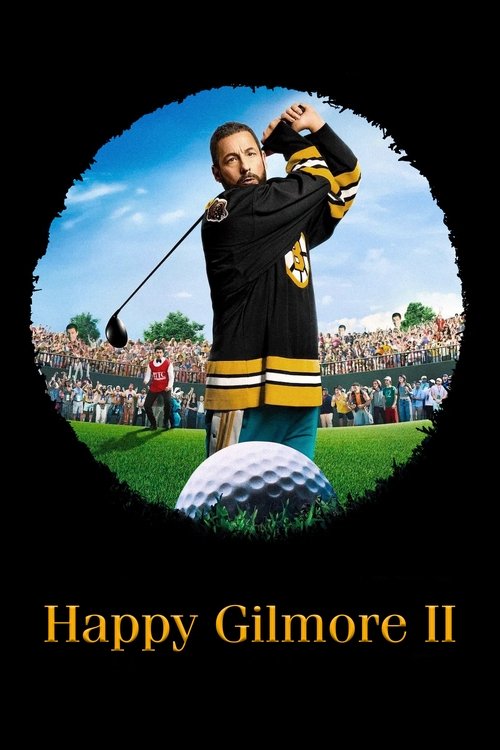
Happy Gilmore 2 (2025)
Directed by Kyle Newacheck
No — Happy Gilmore 2 is not woke, scoring 16 out of 100 on our wokeness meter.
Adam Sandler returns to the putting green roughly three decades later, and the results are exactly what a reasonable person would anticipate: a Netflix sequel that reassembles the old gang, removes Julie Bowen from the story in the first act for motivational purposes, and rewards the faithful with several dozen celebrity cameos.
Consciousness Markers
The cast is notably diverse for a Sandler comedy — Bad Bunny as Happy's caddy Oscar, Lavell Crawford as Slim Peterson, Reggie Bush, Boban Marjanović, Kym Whitley, Kid Cudi and Marcello Hernandez all appear — but these are natural ensemble roles in the Happy Madison house style rather than casting made as a statement.
Frank Manatee is a scheming energy-drink CEO who severs his players' ligaments for distance and rigs the course — a cartoonish corporate villain whose comeuppance (ruin, hiding, product discontinued) carries a mild eat-the-rich flavor, though it's played for laughs rather than polemic.
Vienna's ballet ambitions give the plot a daughter-pursuing-her-dream thread, but the film's engine is Happy's redemption, and the wife is killed off in a golfing accident to motivate him — hardly a feminist text.
This is a broad, silly nostalgia comedy that never stops to deliver a moral lesson; the closest it comes is a mild anti-corporate jab, delivered as a punchline.
The diverse cast exists without any racial commentary or consciousness; race is simply not a subject the film engages.
Shooter McGavin's psychiatric institutionalization and Happy's alcoholism treatment program touch on mental health, but they are comedic plot devices rather than neurodivergence advocacy.
The only environmental gesture is a throwaway gag about Happy forgetting to charge his electric Rolls-Royce; Maxi Energy Drink is a corporate-villain prop, not a climate statement.
No LGBTQ+ characters, relationships, or themes appear anywhere in the film.
No body-positivity themes or messaging of any kind.
No historical revisionism; the film is a contemporary sports comedy with no historical subject matter.
Why it received this score
Adam Sandler returns to the putting green roughly three decades later, and the results are exactly what a reasonable person would anticipate: a Netflix sequel that reassembles the old gang, removes Julie Bowen from the story in the first act for motivational purposes, and rewards the faithful with several dozen celebrity cameos. The plot concerns a daughter's ballet tuition, a scheming energy drink magnate, and a relapse into alcoholism. It is a sports comedy. It knows it is a sports comedy. Nobody involved appears to have entertained a loftier ambition, and there is something restful about that.
On the matter of social consciousness, the film is largely inert. The ensemble is more varied than the Happy Madison house style usually permits, with Bad Bunny as a caddy, Lavell Crawford as the son of Chubbs, and Reggie Bush, Boban Marjanović, and Kym Whitley scattered through the margins. None of it is offered as a statement. Race is not a subject the screenplay cares to raise, and neither is sexuality, which never surfaces at all. The closest thing to a thesis is the villain, an energy drink CEO who severs his players' ligaments for extra yardage and rigs the course. He ends the picture in ruin, which carries a faint whiff of populist satisfaction, though the film is too busy chasing punchlines to press the point.
Shooter McGavin's stint in psychiatric care and Happy's treatment program brush against mental health, but only as scaffolding for jokes. A forgotten electric Rolls-Royce supplies the lone environmental gag. The picture wants nothing more than to put you back in your happy place, and it manages that modest goal without ever pausing to instruct anyone along the way.
Analysis generated by our Consciousness Algorithm


Synopsis
Happy Gilmore isn't done with golf — not by a long shot. Since his retirement after his first Tour Championship win, Gilmore returns to finance his daughter's ballet classes.
Questions about Happy Gilmore 2
Is Happy Gilmore 2 woke?
No — Happy Gilmore 2 is not woke, scoring 16 out of 100 on our wokeness meter. That earns it a verdict of Ultra Based.
Does Happy Gilmore 2 have any woke elements?
2 of the 10 markers register at 30 or above, led by Representation Casting (38) and Eat the Rich (32). On Representation Casting: The cast is notably diverse for a Sandler comedy — Bad Bunny as Happy's caddy Oscar, Lavell Crawford as Slim Peterson, Reggie Bush, Boban Marjanović, Kym Whitley, Kid Cudi and Marcello Hernandez all appear — but these are natural ensemble roles in the Happy Madison house style rather than casting made as a statement.
How does Happy Gilmore 2 compare to other 2025 movies?
It ranks #133 of the 217 films from 2025 we've scored; their average is 26. The wokest is STRAW (92).
How is the Woke Score calculated?
An AI-assisted process researches the film and its reception, scores it 0–100 on ten markers, then combines those into one 0–100 Woke Score. It measures a specific set of 2020s cultural themes, not film quality.