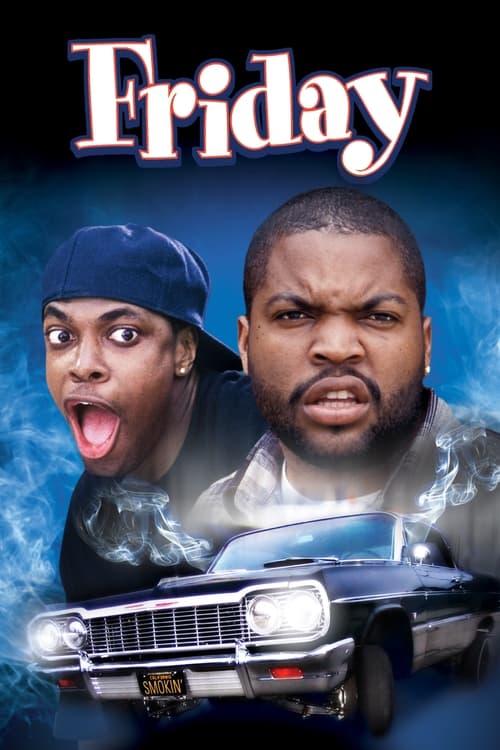
Friday (1995)
Directed by F. Gary Gray
No — Friday is not woke, scoring 18 out of 100 on our wokeness meter.
Friday arrives from 1995 with a curious distinction: it was one of the few Hollywood productions of its era with an all-Black principal cast and crew.
Consciousness Markers
A landmark for its era: an all-Black principal cast and crew, with Ice Cube and DJ Pooh writing, F. Gary Gray directing, and a predominantly Black ensemble. This is genuine, deliberate representation casting rather than incidental diversity.
The film deliberately counters the violent 'hood film' portrayals of Boyz n the Hood and Colors by showing everyday Black life with humor, and its all-Black production was notable. However, it presents Black life naturally without explicit racial commentary or social-justice messaging.
Women like Debbie and Dana have agency and Debbie physically confronts Deebo, but the film is a male-centric buddy comedy with no feminist thesis or gender critique.
Craig's unemployment and the drug-debt plot touch on economic precarity, but there is no systemic critique of capitalism or wealth.
The film is a stoner comedy with essentially no didactic or preachy messaging; it aims to entertain, not instruct.
No LGBTQ+ characters, themes, or subtext anywhere in the film.
No environmental or climate themes whatsoever.
No body-positivity messaging; Deebo's physique is used for intimidation, not affirmation.
No neurodivergent characters or themes.
No historical revisionism; the film is a contemporary fictional comedy.
Why it received this score
Friday arrives from 1995 with a curious distinction: it was one of the few Hollywood productions of its era with an all-Black principal cast and crew. Ice Cube and DJ Pooh wrote it, F. Gary Gray directed it in his feature debut, and the ensemble (Chris Tucker, Nia Long, Regina King, John Witherspoon, the imposing Tiny Lister) carries the whole enterprise. This was deliberate construction, not incidental diversity, and it earns the film a genuine place in the ledger of representation.
The film's cultural posture is quieter than its reputation suggests. Cube and Pooh set out to answer Boyz n the Hood and Colors, which had framed South Central as a killing field, by showing a neighborhood where people argue about money, flirt, and smoke too much. Black life appears here without a thesis attached, which is precisely why the racial register stays modest. There is no lecture, no closing sermon, no lesson about the systems that produced Craig's unemployment. The film wants to amuse, and it does.
Gender gets a light touch. Debbie has agency, and she throws a punch at Deebo before Craig finishes the job, but the movie remains a male buddy comedy with its gaze fixed on the porch. Economic precarity hovers at the edges, the drug debt and the lost job, without hardening into a critique of capital. The rest of the modern checklist goes untouched: no LGBTQ characters, no environmental anxiety, no body-affirming message, no neurodivergent arc, no rewriting of history. What remains is a stoner comedy of real craft, content to be funny and to leave the sermonizing to others. A modest vintage. Decanted carefully, it still holds.
Analysis generated by our Consciousness Algorithm


Synopsis
Craig and Smokey are two guys in Los Angeles hanging out on their porch on a Friday afternoon, smoking and drinking, looking for something to do.
Questions about Friday
Is Friday woke?
No — Friday is not woke, scoring 18 out of 100 on our wokeness meter. That earns it a verdict of Ultra Based.
Does Friday have any woke elements?
2 of the 10 markers register at 30 or above, led by Representation Casting (60) and Racial Consciousness (35). On Representation Casting: A landmark for its era: an all-Black principal cast and crew, with Ice Cube and DJ Pooh writing, F.
How does Friday compare to other 1995 movies?
It ranks #19 of the 108 films from 1995 we've scored; their average is 12. The wokest is Total Eclipse (60).
How is the Woke Score calculated?
An AI-assisted process researches the film and its reception, scores it 0–100 on ten markers, then combines those into one 0–100 Woke Score. It measures a specific set of 2020s cultural themes, not film quality.