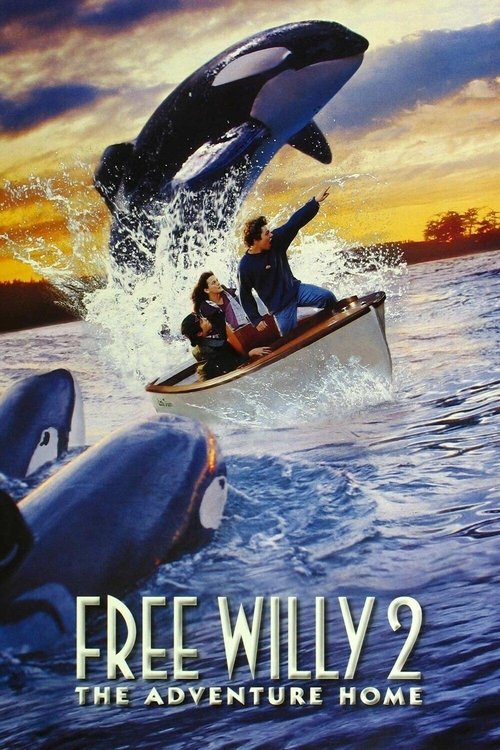
Free Willy 2: The Adventure Home (1995)
Directed by Dwight H. Little
No — Free Willy 2: The Adventure Home is not woke, scoring 18 out of 100 on our wokeness meter.
Free Willy 2: The Adventure Home arrives two years after the original, which in studio arithmetic means three years of development meetings and one animatronic whale.
Consciousness Markers
The oil spill and pollution of the orcas' habitat is a genuine environmental theme, though it is framed as a family-adventure obstacle rather than a climate-change crusade.
Benbrook Oil's CEO is a corporate villain who schemes to sell and imprison the whales, giving the film a mild anti-corporate streak, but it lacks systemic 'eat the rich' rhetoric.
The cast includes Mykelti Williamson, Elizabeth Peña, and August Schellenberg, but these are natural, unremarked roles typical of 1990s family cinema rather than modern representation casting.
Critics noted the film's 'subtle approach' to its environmental message, keeping the moralizing light and subordinate to family drama.
Indigenous Haida culture is present via Randolph's prayer and traditional remedy, but it is treated as local color rather than a vehicle for racial consciousness or social critique.
No feminist agenda; female characters (Annie, Nadine, Dr. Haley) exist in conventional supportive roles without any gender-conscious framing.
No LGBTQ+ characters or themes of any kind appear in the film.
No body positivity themes; the film does not engage with body image or size acceptance.
Elvis is characterized as talkative and mischievous, but the film never frames him through a neurodivergence lens.
No revisionist history; the film is a straightforward fictional family adventure with no historical reworking.
Why it received this score
Free Willy 2: The Adventure Home arrives two years after the original, which in studio arithmetic means three years of development meetings and one animatronic whale. The plot is serviceable. Jesse, now a teenager, reunites with Willy and his pod, watches an oil tanker called the Dakar run aground on Lawson Reef, and spends the back half of the picture guiding three orcas past a burning slick. The environmental theme is genuine but modest, an oil spill deployed as an obstacle course for children on a boat. Benbrook Oil's chief executive schemes to sell the whales into captivity, which supplies a faint anti-corporate pulse without ever reaching for systemic argument. He is a villain because he is greedy, not because the film holds a thesis about capital.
The cultural inventory is thin by modern standards, and it was never trying to be otherwise. August Schellenberg returns as Randolph, whose Haida prayer and traditional remedy for the ailing Luna give the film its most distinctive texture. The movie treats this as regional color, a warm detail in a family adventure, not a platform. Mykelti Williamson and Elizabeth Peña appear in supporting roles that are simply roles, cast in the ordinary manner of mid-1990s studio filmmaking. There is no gender-conscious framing around Annie or Dr. Haley, no queerness anywhere in the frame, and no engagement with body image. The film has other things to do.
What remains is a gentle sermon about pollution, delivered softly enough that critics at the time praised its restraint. Elvis, the talkative half-brother, is a mischievous boy and nothing more. The film never reaches for a diagnostic vocabulary. This is a sequel that won a Kids' Choice Award for its animal star and lost a Stinkers award for existing at all. It is earnest, harmless, and almost entirely innocent of the cultural preoccupations that would arrive in later decades. The orca, at least, is not asked to have an identity.
Analysis generated by our Consciousness Algorithm
Part of


Synopsis
Jesse becomes reunited with Willy three years after the whale's jump to freedom as the teenager tries to rescue the killer whale and other orcas from an oil spill.
Questions about Free Willy 2: The Adventure Home
Is Free Willy 2: The Adventure Home woke?
No — Free Willy 2: The Adventure Home is not woke, scoring 18 out of 100 on our wokeness meter. That earns it a verdict of Ultra Based.
Does Free Willy 2: The Adventure Home have any woke elements?
1 of the 10 markers register at 30 or above, led by Climate Crusade (35). On Climate Crusade: The oil spill and pollution of the orcas' habitat is a genuine environmental theme, though it is framed as a family-adventure obstacle rather than a climate-change crusade.
How does Free Willy 2: The Adventure Home compare to other 1995 movies?
It ranks #19 of the 108 films from 1995 we've scored; their average is 12. The wokest is Total Eclipse (60).
How is the Woke Score calculated?
An AI-assisted process researches the film and its reception, scores it 0–100 on ten markers, then combines those into one 0–100 Woke Score. It measures a specific set of 2020s cultural themes, not film quality.