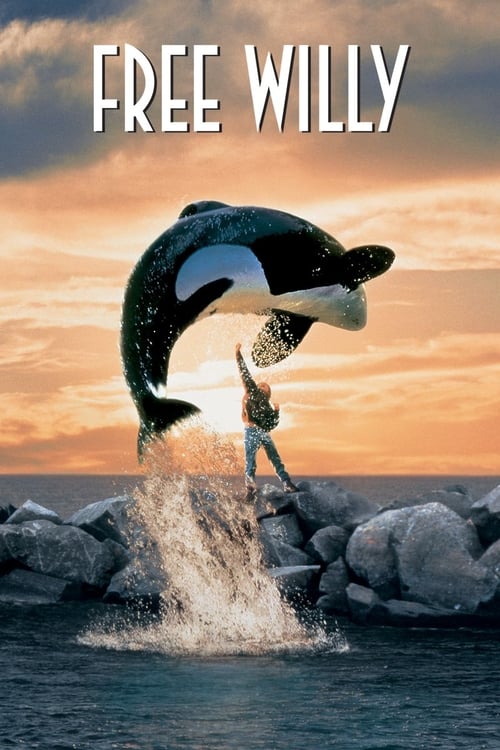
Free Willy (1993)
Directed by Simon Wincer
No — Free Willy is not especially woke, scoring 20 out of 100 on our wokeness meter.
Free Willy arrives from 1993 with a harmonica, an orphan, and a 7,000 pound orca, and it asks very little of the culture wars.
Consciousness Markers
The villain Dial is a greedy park owner who plots to kill Willy for a $1 million insurance payout, a textbook profit-over-life antagonist that gives the film a clear anti-greed, eat-the-rich streak.
The cast includes August Schellenberg, a First Nations (Haida/Métis) actor, as the caretaker Randolph, and Black actor Mykelti Williamson as the social worker Dwight, giving the film a modestly diverse ensemble for 1993. However, this is naturalistic casting rather than a deliberate representation-forward statement.
The film's central concern is animal captivity and freedom — freeing a captive orca from an amusement park — which carries environmental and animal-welfare weight, though it is framed as animal rights rather than a climate crusade.
The film carries a gentle message about animal captivity and compassion, but it delivers this through sentiment and adventure rather than preachy sermonizing.
Randolph's Haida heritage and the Natsilane prayer/story give the film a touch of Indigenous cultural specificity, but race is never a subject of commentary or consciousness in the narrative.
Lori Petty's Rae is a competent trainer, veterinarian, and aspiring marine biologist, a mildly progressive professional role for a woman in a 1993 family film, but the story is driven by the boy-and-whale bond rather than any feminist thesis.
There are no LGBTQ+ characters, themes, or subtext anywhere in the film.
No body-positivity themes or messaging of any kind are present.
No neurodivergent characters or themes appear; the original script's mute protagonist was explicitly rewritten out.
The film is a fictional story and makes no revisionist claims about historical events.
Why it received this score
Free Willy arrives from 1993 with a harmonica, an orphan, and a 7,000 pound orca, and it asks very little of the culture wars. Its most legible political content is a straightforward contempt for greed. Dial, the park owner, schemes to kill the whale for a one million dollar insurance payout, which makes him a villain of the profit-over-life school and gives the picture its single most pronounced ideological streak. The captivity theme carries genuine animal welfare weight, though it stops well short of any broader environmental sermon. The whale wants out of the tank. The tank is not a metaphor for emissions.
The human ensemble is quietly varied for its era. August Schellenberg, of Haida and Métis descent, plays Randolph the caretaker, and Mykelti Williamson appears as Dwight the social worker, and neither performance is asked to announce itself as a statement. Randolph's Natsilane prayer supplies a touch of Indigenous specificity that the film treats as texture, not thesis. Lori Petty's Rae is a competent trainer and aspiring marine biologist, a mildly forward-looking professional role that the screenplay never bothers to argue about. Jesse's arc is with the whale and the foster parents, and the movie keeps its focus there.
Elsewhere the ledger is bare. There is no LGBTQ content, no body positivity, no neurodivergent character, and no revisionist claim about history, because the film is fiction and knows it. An early draft made Jesse a mute ten-year-old; that was rewritten out, leaving the film with no such representation at all. The messaging is gentle and arrives through sentiment, a boy on a breakwater reciting a prayer so a whale can jump over a wall. It is a modest artifact of its year, memorable mostly for the greed it condemns and the restraint it shows in condemning it.
Analysis generated by our Consciousness Algorithm
Part of


Synopsis
When maladjusted orphan Jesse vandalizes a theme park, he is placed with foster parents and must work at the park to make amends. There he meets Willy, a young Orca whale who has been separated from his family. Sensing kinship, they form a bond and, with the help of kindly whale trainer Rae Lindley, develop a routine of tricks. However, greedy park owner Dial soon catches wind of the duo and makes plans to profit from them.
Questions about Free Willy
Is Free Willy woke?
No — Free Willy is not especially woke, scoring 20 out of 100 on our wokeness meter. That earns it a verdict of Based.
Does Free Willy have any woke elements?
1 of the 10 markers register at 30 or above, led by Eat the Rich (45). On Eat the Rich: The villain Dial is a greedy park owner who plots to kill Willy for a $1 million insurance payout, a textbook profit-over-life antagonist that gives the film a clear anti-greed, eat-the-rich streak.
How does Free Willy compare to other 1993 movies?
It ranks #19 of the 97 films from 1993 we've scored; their average is 11. The wokest is Bound by Honor (60).
How is the Woke Score calculated?
An AI-assisted process researches the film and its reception, scores it 0–100 on ten markers, then combines those into one 0–100 Woke Score. It measures a specific set of 2020s cultural themes, not film quality.