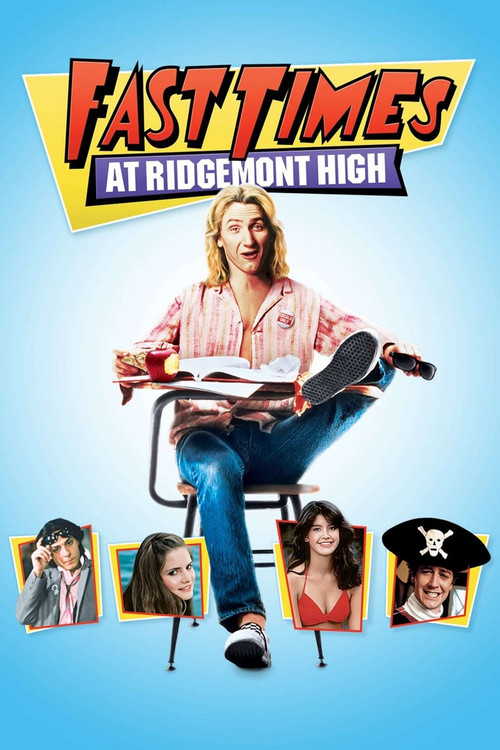
Fast Times at Ridgemont High (1982)
Directed by Amy Heckerling
No — Fast Times at Ridgemont High is not woke, scoring 8 out of 100 on our wokeness meter.
Fast Times at Ridgemont High arrives from 1982 with the confidence of a film that has no thesis to defend.
Consciousness Markers
Directed by Amy Heckerling, and she deliberately sought gender parity in the pool-house nudity, but the film's treatment of Stacy's sexuality is observational rather than a modern feminist thesis.
The cast is overwhelmingly white; Forest Whitaker and Jason Bernard appear in minor, unremarked roles. No deliberate representation casting agenda is present.
Brad's string of dead-end mall and fast-food jobs gesture at service-economy drudgery, but the film offers no systemic critique of capitalism.
Race is essentially absent as a subject; minority actors appear only in incidental background roles with no commentary.
Mr. Hand's history lecture to Spicoli is an in-story gag, not a message-delivery device; the film is observational and never preaches.
No LGBTQ+ characters, themes, or subtext appear anywhere in the film.
No environmental or climate themes whatsoever.
No body-positivity themes; the film's sexual content is presented through conventional 1980s teen-comedy aesthetics.
No neurodivergent characters or themes are present.
The film is a period-agnostic slice of early-80s teen life with no historical revisionism.
Why it received this score
Fast Times at Ridgemont High arrives from 1982 with the confidence of a film that has no thesis to defend. Amy Heckerling directs Cameron Crowe's adaptation of his undercover high school book with a reporter's eye and a comedian's timing. The production anecdote about equal-opportunity nudity in the pool-house scene is real enough, and Heckerling's insistence on showing teenage awkwardness from both sides deserves a small nod. Stacy Hamilton's pregnancy and abortion are handled with matter-of-fact brevity, which in 1982 was its own quiet provocation. Still, the film observes Stacy's sexual education without turning it into a platform. The camera watches, the characters stumble, and nobody steps forward to explain the lesson.
On the representation front, the cast is overwhelmingly white. Forest Whitaker and Jason Bernard pass through minor roles without comment, and race never becomes a subject. The film has no LGBTQ current, no environmental concern, no body-positive detour, no neurodivergent arc, and no interest in revising the historical record. Brad Hamilton's parade of mall and fast-food jobs hints at service-economy drudgery, but the film treats his humiliation as personal comedy instead of systemic indictment. Mr. Hand's history lecture is a gag inside the story, not a message slipped to the audience. Spicoli versus Hand is a clash of temperaments, not a sermon.
The result is a time capsule with a few incidental progressive details and almost no modern cultural agenda. It is preserved in the National Film Registry for being culturally significant, not for preaching. The ledger stays mostly blank. The film remains a sharp, funny, lightly melancholic slice of teenage life, observed with patience and no instruction manual.
Analysis generated by our Consciousness Algorithm
Part of


Synopsis
A group of Southern-California high school students ignore their studies in favor of indulging in their teenage distractions.
Questions about Fast Times at Ridgemont High
Is Fast Times at Ridgemont High woke?
No — Fast Times at Ridgemont High is not woke, scoring 8 out of 100 on our wokeness meter. That earns it a verdict of Ultra Based.
Does Fast Times at Ridgemont High have any woke elements?
Very few. None of the 10 markers reaches 30, the level where a marker counts as present; the highest is Feminist Agenda at 22.
How does Fast Times at Ridgemont High compare to other 1982 movies?
It ranks #12 of the 41 films from 1982 we've scored; their average is 7. The wokest is Gandhi (42).
How is the Woke Score calculated?
An AI-assisted process researches the film and its reception, scores it 0–100 on ten markers, then combines those into one 0–100 Woke Score. It measures a specific set of 2020s cultural themes, not film quality.