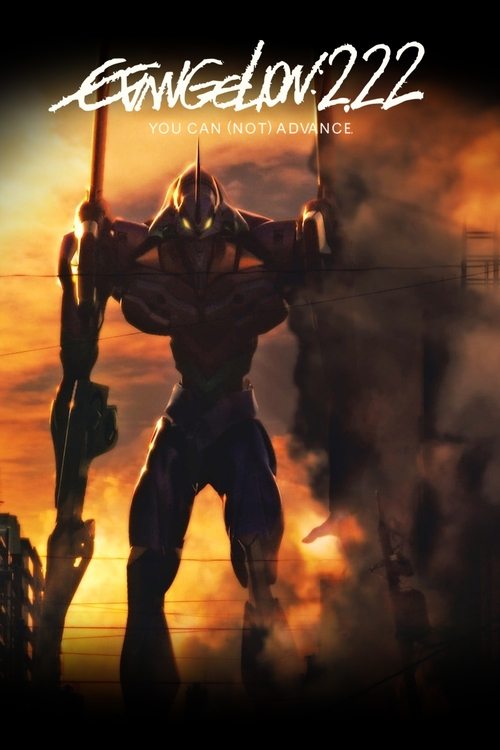
Evangelion: 2.0 You Can (Not) Advance (2009)
Directed by Masayuki
No — Evangelion: 2.0 You Can (Not) Advance is not woke, scoring 14 out of 100 on our wokeness meter.
The second panel of the Rebuild tetralogy does what second panels do.
Consciousness Markers
Asuka and Mari are aggressive, capable female pilots and Misato commands operations, giving women prominent agency, but the film frames this as character drama rather than a feminist thesis.
Shinji's crippling anxiety, depression, and withdrawal, along with Asuka's psychological fragility, are central to the drama, though the film treats these as trauma and emotional damage rather than as an explicit neurodivergence-affirming statement.
Kaworu Nagisa's brief appearance carries the franchise's long-standing homoerotic subtext with Shinji, and his closing line about showing Shinji 'true happiness' gestures at it, but the film itself keeps this implicit and undeveloped.
The film is philosophically dense and existential, but it does not lecture the audience on contemporary social or political issues; its themes are metaphysical and psychological.
The cast is entirely Japanese voice actors voicing Japanese characters; there is no deliberate diversity casting or race-conscious ensemble construction. Mari is a new female pilot, but this is a character addition, not representation casting.
NERV and SEELE are shadowy military-bureaucratic institutions, but the film offers no economic critique or 'eat the rich' framing; the conflict is metaphysical and familial.
No engagement with racial identity, racism, or racial politics whatsoever; the story is entirely concerned with mecha combat and family trauma.
The post-apocalyptic setting stems from the fictional 'Second Impact' catastrophe, not from climate change or environmental messaging.
No body-diversity themes or body-positive messaging are present.
The film is entirely fictional science fiction with no historical revisionism or reframing of real events.
Why it received this score
The second panel of the Rebuild tetralogy does what second panels do. It adds a pilot, the mysterious Mari Illustrious Makinami, renames Asuka, and stages three or four of the finest mecha set pieces ever committed to cel and CG. Shinji still mopes, Gendo still withholds, Tokyo-3 still gets rearranged. The machinery is immaculate. The despair is thorough. Hideaki Anno and his collaborators have kept the psychological furniture exactly where the 1995 series left it, which is either reverence or a shortage of nerve, depending on the evening.
On the cultural ledger, this is a 2009 Japanese production with almost no interest in the social controversies that would later consume Western film discourse. The cast is entirely Japanese performers voicing Japanese characters, and nobody involved is assembling an ensemble around representation. Women hold real power here: Misato runs operations, Asuka and Mari fight with aggression and competence, and the film never pauses to request applause for it. Kaworu's post-credits promise to show Shinji true happiness carries the franchise's long-standing homoerotic undercurrent, kept implicit and brief. Shinji's depression and Asuka's brittleness sit at the center of the drama, though the film treats them as damage to be endured, not as a condition to be affirmed. There is no racial commentary, no climate sermon, no economic critique of NERV's military-industrial arrangement, and no body-diverse casting to speak of.
The remainder is philosophy without a pamphlet. The film is dense, existential, occasionally incomprehensible, and wholly unconcerned with instructing its audience about contemporary politics. It lectures only about the impossibility of human connection, a subject it has earned the right to lecture about. Score it low on the current index. Score it high on the older one. The angels arrive, the wings of light unfurl, and the world nearly ends again, and at no point does anyone stop to explain to us how we ought to feel about it. That restraint is the film's quiet virtue, and its commercial liability, and probably its reason for existing at all.
{"thematic_tags": ["sequel"]}
Analysis generated by our Consciousness Algorithm
Part of


Synopsis
Under constant attack by monstrous creatures called Angels that seek to eradicate humankind, U.N. Special Agency NERV introduces two new EVA pilots to help defend the city of Tokyo-3: the mysterious Makinami Mari Illustrous and the intense Asuka Langley Shikinami. Meanwhile, Gendo Ikari and SEELE proceed with a secret project that involves both Rei and Shinji.
Questions about Evangelion: 2.0 You Can (Not) Advance
Is Evangelion: 2.0 You Can (Not) Advance woke?
No — Evangelion: 2.0 You Can (Not) Advance is not woke, scoring 14 out of 100 on our wokeness meter. That earns it a verdict of Ultra Based.
Does Evangelion: 2.0 You Can (Not) Advance have any woke elements?
Very few. None of the 10 markers reaches 30, the level where a marker counts as present; the highest is Feminist Agenda at 22.
How does Evangelion: 2.0 You Can (Not) Advance compare to other 2009 movies?
It ranks #72 of the 230 films from 2009 we've scored; their average is 14. The wokest is Home (79).
Is Evangelion: 2.0 You Can (Not) Advance the most woke Rebuild of Evangelion movie?
No. It ranks #3 of the 4 Rebuild of Evangelion films we've scored; the wokest is Evangelion: 3.0 You Can (Not) Redo (60).