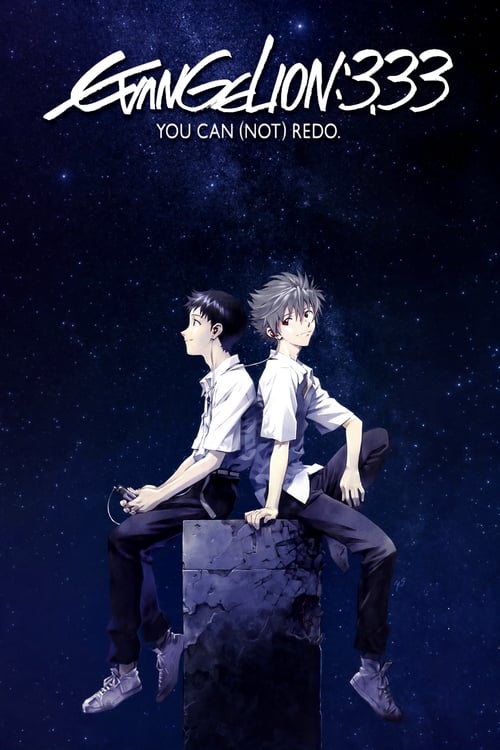
Evangelion: 3.0 You Can (Not) Redo (2012)
Directed by Hideaki Anno
Yes — Evangelion: 3.0 You Can (Not) Redo is woke, scoring 60 out of 100 on our wokeness meter.
Evangelion: 3.0 You Can (Not) Redo arrives as the third panel of the Rebuild tetralogy, and it wastes no time making the viewer feel unwelcome.
Consciousness Markers
Shinji and Kaworu's relationship is central and explicitly romantic/queer-coded, with piano duets, intimate trust, and Kaworu's sacrificial love; keywords include gay romance and BL.
Misato commands WILLE and Asuka/Mari are capable pilots, but the narrative remains focused on Shinji and Kaworu; there is no sustained feminist critique.
Shinji's depression, trauma, and social withdrawal are central, but the film does not explicitly frame these as neurodivergence or advocate for neurodiverse identity.
The film is philosophical and exposition-heavy, but it does not deliver modern social-justice lectures; its opacity is narrative, not didactic.
The cast is entirely Japanese voice actors and the film does not engage in modern diverse-casting practices; female and queer characters are present but not framed as representation casting.
No racial themes or commentary; characters are not racialized in a modern social-justice framework.
Post-apocalyptic devastation stems from metaphysical Impacts, not climate change; there is no environmental crusade.
Conflicts are military and metaphysical, not economic; there is no eat-the-rich or anti-capitalist critique.
No body-positivity themes or body-diverse representation.
No historical revisionism; it is a sci-fi reimagining of a fictional TV series.
Why it received this score
Evangelion: 3.0 You Can (Not) Redo arrives as the third panel of the Rebuild tetralogy, and it wastes no time making the viewer feel unwelcome. Shinji Ikari wakes fourteen years late, unaged, fitted with an explosive collar, and informed by former allies that his last heroic act ended the world. The film is gorgeous and hostile, a two-hour tantrum rendered in immaculate CG water. Hideaki Anno has never been interested in reassurance, and here he withholds it with something close to relish.
The emotional center belongs to Kaworu Nagisa. The piano duets, the shared quarters, the collar moved from one neck to another: all of it constitutes a romance presented plainly and without apology. This is the film's most sincere register. Two boys, a ruined city, and a love that ends in a beheading. The melancholy Shinji carries, his catatonia, his reflex to flee, is treated as character instead of condition, which keeps it from hardening into a case study. It is affecting. It is also, notably, not a lecture.
Elsewhere the ledger runs thin. Misato commands a flying battleship, and Asuka and Mari fly with competence, yet the film shows no sustained interest in making an argument about any of it. The Earth lies in ruins for metaphysical reasons, not carbon ones. There is no economic critique, no racial commentary, no body diversity, no historical revisionism. The obscurity here is narrative, not sermonizing. Anno withholds meaning because he finds withholding meaningful. We are left with a beautiful, frustrating object, and a viewer who has seen worse and will, in all likelihood, see worse again.
Analysis generated by our Consciousness Algorithm
Part of
Synopsis
Fourteen years after Third Impact, Shinji Ikari awakens to a world he does not remember. He hasn't aged. Much of Earth is laid in ruins, NERV has been dismantled, and people who he once protected have turned against him. Befriending the enigmatic Kaworu Nagisa, Shinji continues the fight against the angels and realizes the fighting is far from over, even when it could be against his former allies. The characters' struggles continue amidst the battles against the angels and each other, spiraling down to what could inevitably be the end of the world.
Questions about Evangelion: 3.0 You Can (Not) Redo
Is Evangelion: 3.0 You Can (Not) Redo woke?
Yes — Evangelion: 3.0 You Can (Not) Redo is woke, scoring 60 out of 100 on our wokeness meter. That earns it a verdict of Woke.
What makes Evangelion: 3.0 You Can (Not) Redo woke?
1 of the 10 markers register at 30 or above, led by LGBTQ+ Themes (80). On LGBTQ+ Themes: Shinji and Kaworu's relationship is central and explicitly romantic/queer-coded, with piano duets, intimate trust, and Kaworu's sacrificial love; keywords include gay romance and BL.
How does Evangelion: 3.0 You Can (Not) Redo compare to other 2012 movies?
It ranks #4 of the 230 films from 2012 we've scored; their average is 12. The wokest is Killing Them Softly (92).
Is Evangelion: 3.0 You Can (Not) Redo the most woke Rebuild of Evangelion movie?
Yes. It scores highest of the 4 Rebuild of Evangelion films we've scored.