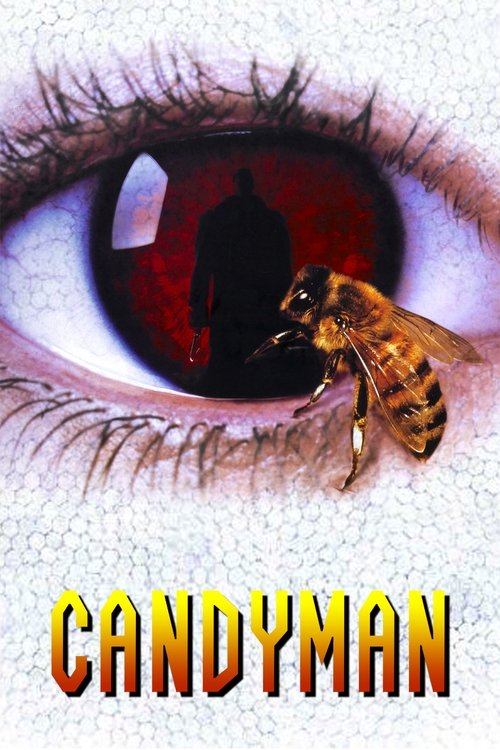
Candyman (1992)
Directed by Bernard Rose
Yes — Candyman is woke, scoring 60 out of 100 on our wokeness meter.
Candyman arrives from 1992, which is to say from a period when a horror film could build its entire premise on the racial geometry of American housing and still be marketed as a slasher.
Consciousness Markers
Race and social class are the film's explicit core: the Candyman is a lynched Black artist, and the plot frames Cabrini-Green residents as victims of racial inequality who use the legend to cope with their conditions.
The film deliberately centers Black performers in pivotal roles — Tony Todd as the titular Candyman, Kasi Lemmons as Bernadette, and Vanessa Williams as Anne-Marie — and populates Cabrini-Green with Black residents presented as ordinary people rather than gang/drug tropes.
The film critiques the neglect and decay of public housing and the dispossession of the urban poor, though it stops short of an explicit anti-capitalist or 'eat the rich' polemic.
The film invents a backstory of a lynched Black painter to reframe Barker's British class parable as an American racial tragedy, evoking real histories of racial violence without documenting actual events.
Social commentary on race and class is woven into the horror rather than delivered as a sermon; critics praised it for scaring with ideas, not preaching.
Helen Lyle is a competent female graduate student who drives the investigation, but the film offers no explicit feminist thesis; her arc is largely a gothic victim-to-avenger trajectory.
No LGBTQ+ characters, themes, or subtext are present in the narrative.
No environmental or climate themes appear in the film.
No body-positivity themes are present.
A developmentally disabled character is briefly referenced in a plot incident, but neurodivergence is not a theme of the film.
Why it received this score
Candyman arrives from 1992, which is to say from a period when a horror film could build its entire premise on the racial geometry of American housing and still be marketed as a slasher. Bernard Rose moved Clive Barker's Liverpool parable to Cabrini-Green and let the architecture do the arguing. The project sits within sight of Helen Lyle's comfortable apartment, close enough that she can treat other people's poverty as a thesis topic. The film casts Black performers in the roles that matter: Tony Todd as the lynched painter turned avenging spirit, Kasi Lemmons as the friend who dies for Helen's curiosity, Vanessa Williams as the mother whose son becomes the bargaining chip. Rose populates the buildings with ordinary residents, deliberately avoiding the gang and drug shorthand that the era's cinema reached for by reflex.
The social critique is the engine, not the ornament. Cabrini-Green is a monument to municipal neglect, and the film knows it. A wealthy white academic builds a career on the legend while the people living beneath it use the story to explain a world that has already abandoned them. That is class anger, though it never organizes itself into a manifesto. The backstory of the Candyman, a Black artist murdered by a lynch mob for loving a white woman, is invented wholesale, borrowing the emotional weight of real racial terror without claiming any specific historical event. Helen herself is competent and driven, though her reward is a gothic martyrdom and a hook.
What the film declines to do is equally instructive. It offers no romantic subplot of any persuasion, no environmental sermon, no meditation on body image or cognitive difference. Its arguments stay inside the horror, which is why they land. The result is a picture with a genuine racial conscience and very little appetite for instructing its audience. That restraint is the rarest thing in it.
Analysis generated by our Consciousness Algorithm


Synopsis
The Candyman, a murderous soul with a hook for a hand, is accidentally summoned to reality by a skeptic grad student researching the monster's myth.
Questions about Candyman
Is Candyman woke?
Yes — Candyman is woke, scoring 60 out of 100 on our wokeness meter. That earns it a verdict of Woke.
What makes Candyman woke?
3 of the 10 markers register at 30 or above, led by Racial Consciousness (80), Representation Casting (60) and Eat the Rich (35). On Racial Consciousness: Race and social class are the film's explicit core: the Candyman is a lynched Black artist, and the plot frames Cabrini-Green residents as victims of racial inequality who use the legend to cope with their conditions.
How does Candyman compare to other 1992 movies?
It ranks #2 of the 74 films from 1992 we've scored; their average is 12. The wokest is The Crying Game (62).
How is the Woke Score calculated?
An AI-assisted process researches the film and its reception, scores it 0–100 on ten markers, then combines those into one 0–100 Woke Score. It measures a specific set of 2020s cultural themes, not film quality.