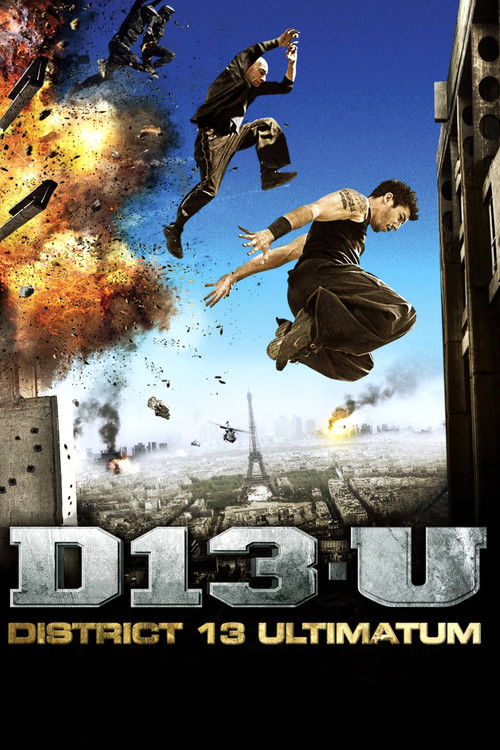
District 13: Ultimatum (2009)
Directed by Patrick Alessandrin
No — District 13: Ultimatum is not especially woke, scoring 30 out of 100 on our wokeness meter.
District 13: Ultimatum arrives as a sequel to a parkour action curio, and it carries its politics like a man carrying too many grocery bags.
Consciousness Markers
The central conspiracy has corrupt state agents plotting to bomb the district so luxury flats can be built on the cleared land, a direct eat-the-rich/anti-gentrification critique of profit-driven displacement.
The ensemble is genuinely multi-ethnic, with gang lords drawn from African, Asian, Arab, Gypsy, and skinhead communities, plus Élodie Yung as a female gang boss. The diversity reflects the real demographics of the French banlieue rather than any casting agenda, so it registers modestly.
The film is explicitly about ethnically defined gangs in a walled-off banlieue and the state's willingness to abandon its minority residents, giving it a real if blunt social-consciousness streak.
Critics noted the film 'bites off more than it can chew with its political subtext,' but the messaging stays subordinate to the action set pieces rather than preaching directly.
Élodie Yung's Tao leads one of the five gangs, giving the film a token female authority figure, but the narrative remains a male-dominated buddy action vehicle with no feminist argument.
No LGBTQ+ characters, themes, or subtext appear anywhere in the film.
No environmental or climate themes are present.
No body-positivity themes; the film celebrates athletic, muscular parkour physiques.
No neurodivergent characters or themes are present.
The film is a contemporary fictional thriller with no historical revisionism.
Why it received this score
District 13: Ultimatum arrives as a sequel to a parkour action curio, and it carries its politics like a man carrying too many grocery bags. Five ethnically defined gangs rule the walled banlieue: African, Asian, Arab, Gypsy, skinhead. The film treats this as demographic fact, not a casting statement. Élodie Yung's Tao gives the boys' club one female boss, but the movie remains a buddy action machine. No LGBTQ content, no climate sermon, no body-positive or neurodivergent thread. The film is too busy jumping between rooftops and punching corrupt officials.
The plot's engine is a conspiracy by internal security agents to bomb the district and build luxury flats on the cleared land. That is an anti-gentrification, eat-the-rich fable, blunt and effective. The state is willing to sacrifice its minority residents for profit, and the film knows this is villainy. The racial consciousness is real, if unsubtle. The gangs are not window dressing; their alliance against the DISS drives the climax. Still, the message stays subordinate to the set pieces. Critics said it bites off more than it can chew, and they were right. The politics are a side dish, not the main course.
As a piece of social commentary, the film lands somewhere between a punch and a shrug. It has no interest in historical revision, no environmental crusade, no lectures about identity beyond the basic fact of who lives in the district. The preachiness is mild. The action is the point. We watch Damien and Leïto rescue a memory card, escape prison, and storm the Élysée Palace with a coalition of gang lords. The result is a sequel that knows its audience wants kicks, not sermons. It offers a few kicks of conscience along the way. A serious classification yields a moderate grade for cultural awareness, with most other boxes left empty. The film is not trying to educate us. It is trying to entertain us, and occasionally it remembers to be angry about real estate.
Analysis generated by our Consciousness Algorithm


Synopsis
Damien and Leito return to District 13 on a mission to bring peace to the troubled sector that is controlled by five different gang bosses, before the city’s secret services take drastic measures to solve the problem.
Questions about District 13: Ultimatum
Is District 13: Ultimatum woke?
No — District 13: Ultimatum is not especially woke, scoring 30 out of 100 on our wokeness meter. That earns it a verdict of Based.
Does District 13: Ultimatum have any woke elements?
3 of the 10 markers register at 30 or above, led by Eat the Rich (45), Representation Casting (42) and Racial Consciousness (40). On Eat the Rich: The central conspiracy has corrupt state agents plotting to bomb the district so luxury flats can be built on the cleared land, a direct eat-the-rich/anti-gentrification critique of profit-driven displacement.
How does District 13: Ultimatum compare to other 2009 movies?
It ranks #20 of the 230 films from 2009 we've scored; their average is 14. The wokest is Home (79).
How is the Woke Score calculated?
An AI-assisted process researches the film and its reception, scores it 0–100 on ten markers, then combines those into one 0–100 Woke Score. It measures a specific set of 2020s cultural themes, not film quality.