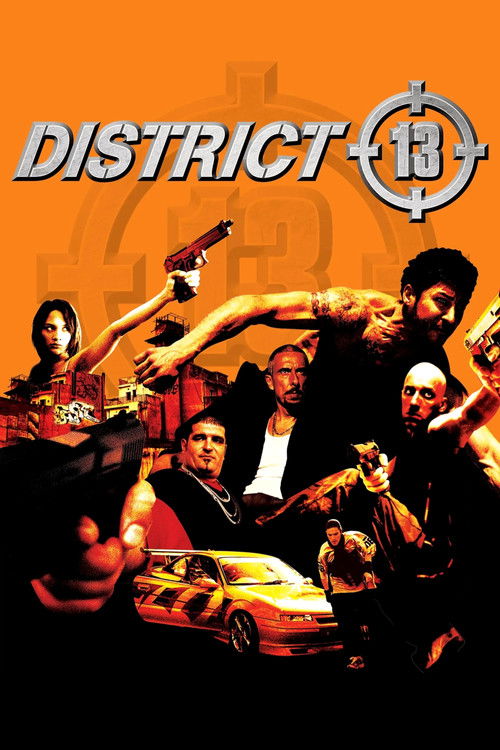
District B13 (2004)
Directed by Pierre Morel
No — District B13 is not woke, scoring 15 out of 100 on our wokeness meter.
District B13 arrived in 2004 with a wall around Paris and a young man named David Belle running up it.
Consciousness Markers
The cast is largely French-Maghrebi actors, but this reflects the natural demographics of a Paris banlieue setting rather than a deliberate diversity-casting initiative; the film makes no comment on it.
The film depicts a walled-off, state-abandoned banlieue whose largely immigrant population is left without schools or services, and the government conspires to destroy it — a social critique of state neglect of the poor suburbs, though framed through class and geography rather than explicit racial terms.
The political message about government betrayal of the banlieue is delivered through the plot's climax and broadcast confession rather than direct moralizing, keeping the didacticism modest.
The antagonist force is a corrupt government apparatus and a drug gang, not a capitalist class; there is no eat-the-rich framing or critique of wealth extraction.
Lola functions primarily as a kidnapped sister to be rescued, a classic damsel-in-distress device; her one moment of agency (restraining Damien) is incidental rather than a feminist statement.
No LGBTQ+ characters, themes, or subtext appear anywhere in the film.
No environmental or climate themes are present.
No body-positivity themes or messaging appear.
No neurodivergent characters or themes are present.
The film is a fictional near-future dystopia with no engagement with historical revisionism.
Why it received this score
District B13 arrived in 2004 with a wall around Paris and a young man named David Belle running up it. Pierre Morel directs, Luc Besson produces, and the plot concerns a neutron bomb, a kidnapped sister, and an undercover cop who cannot quite believe his own government would betray him. The stunt work is extraordinary and the dialogue is functional. This is a film that knows exactly what it is, which is a chase sequence with a political grievance stapled to the end.
The grievance is real but narrow. The walled banlieue of the title is a state-abandoned zone, populated largely by immigrants and left without schools, utilities, or police, and the government's plan to erase it is the film's actual villain. That is a critique of neglect, framed through class and geography. The casting reflects the demographics of the setting with no editorializing attached. The villainy belongs to a corrupt official and a drug gang, not to a class of owners extracting wealth, so the economic reading stays thin. Lola, the sister, spends most of the running time handcuffed to a missile, which is not a statement about anything. She gets one useful moment near the end and the film moves on.
What remains is a lean piece of pulp with a sermon tucked into its final minutes, delivered through a broadcast confession instead of a monologue. The environmental, romantic, and neurological dimensions of human experience are entirely absent, as are any historical arguments. This is a film about jumping over things, and it is very good at that.
Analysis generated by our Consciousness Algorithm


Synopsis
Set in the ghettos of Paris in 2010, an undercover cop and ex-thug try to infiltrate a gang in order to defuse a neutron bomb.
Questions about District B13
Is District B13 woke?
No — District B13 is not woke, scoring 15 out of 100 on our wokeness meter. That earns it a verdict of Ultra Based.
Does District B13 have any woke elements?
2 of the 10 markers register at 30 or above, led by Racial Consciousness (30) and Representation Casting (30). On Racial Consciousness: The film depicts a walled-off, state-abandoned banlieue whose largely immigrant population is left without schools or services, and the government conspires to destroy it — a social critique of state neglect of the poor suburbs, though framed through class and geography rather than explicit racial terms.
How does District B13 compare to other 2004 movies?
It ranks #42 of the 178 films from 2004 we've scored; their average is 12. The wokest is Tropical Malady (62).
How is the Woke Score calculated?
An AI-assisted process researches the film and its reception, scores it 0–100 on ten markers, then combines those into one 0–100 Woke Score. It measures a specific set of 2020s cultural themes, not film quality.