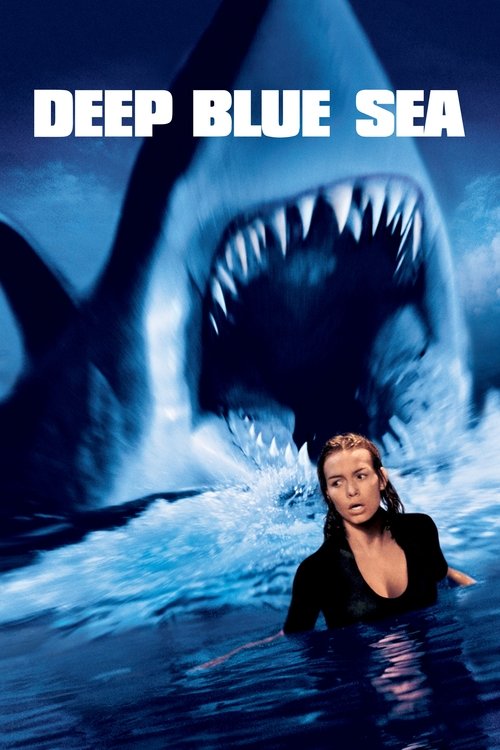
Deep Blue Sea (1999)
Directed by Renny Harlin
No — Deep Blue Sea is not woke, scoring 8 out of 100 on our wokeness meter.
Renny Harlin's 1999 creature feature concerns a team of researchers in an undersea facility who have enlarged the brains of mako sharks in pursuit of an Alzheimer's cure, and who then spend the second act being eaten for their trouble.
Consciousness Markers
The cast is led by a woman (Saffron Burrows) with prominent Black roles for Samuel L. Jackson and LL Cool J, plus other ethnic variety, but this assortment exists naturally within a 1999 genre B-movie without any representational commentary.
A woman anchors the cast as lead scientist, but she is coded as the culpable villain and is killed off after test audiences rejected her survival, so the film carries no feminist program.
A corporate executive is dispatched by anxious financial backers to audit the research, a faint nod to funding-driven hubris, but this is standard monster-movie plotting rather than an anti-capitalist argument.
Samuel L. Jackson and LL Cool J feature prominently, but their characters are race-neutral and the film engages no racial themes or commentary whatsoever.
The film delivers a brief unity monologue before a character is eaten, but it functions as a gag, not as a preachy sermon to the audience.
No LGBTQ+ characters, subtext, or themes of any kind appear in the film.
No environmental or climate themes are present; the only ecological angle is that the sharks were made man-made rather than natural predators.
No body-positive themes or messaging appear in the film.
No neurodivergent characters or themes are present; the genetically enhanced intelligence belongs to sharks, not people.
The film is an original story with no historical revisionism of any kind.
Why it received this score
Renny Harlin's 1999 creature feature concerns a team of researchers in an undersea facility who have enlarged the brains of mako sharks in pursuit of an Alzheimer's cure, and who then spend the second act being eaten for their trouble. The cast is assembled with an eye toward variety. Saffron Burrows anchors as the lead scientist, Samuel L. Jackson lends gravitas as the corporate auditor, and LL Cool J supplies warmth as the cook. The assortment is real, and it is entirely unremarked upon. This is a 1999 genre picture doing what 1999 genre pictures did: filling seats. No representational argument is made, and none is attempted.
The woman at the center of the ensemble is also the film's architect of catastrophe. Test audiences grasped this, objected to her survival, and the production dutifully reshot the ending so that she is devoured as penance. A feminist program this is not. The Black performers are given no racial interiority whatsoever. They are professionals in a shark movie, and the movie treats them as such. A corporate executive arrives to audit the research, which registers as the faintest possible shrug at funding-driven hubris, the standard furniture of monster plotting.
The remaining categories yield nothing. No ecological sermon, though the sharks are man-made. No body-positive messaging. No neurodivergent characters, since the enhanced cognition belongs to fish. No LGBTQ+ presence. No historical revisionism, the story being invented wholesale. The one speech about group unity is delivered seconds before the speaker is dragged into the water, and it lands as a gag. The film that remains is a lean, efficient B-movie with almost no contemporary social signaling, which is either a relief or a disappointment depending on the appetite.
Analysis generated by our Consciousness Algorithm
Part of


Synopsis
Researchers on the undersea lab Aquatica have genetically altered the brains of captive sharks to develop a cure for Alzheimer's disease. But there's an unexpected side effect: the sharks got smarter, faster, and more dangerous. After a big storm damages their remote research facility, they must fight for their lives.
Questions about Deep Blue Sea
Is Deep Blue Sea woke?
No — Deep Blue Sea is not woke, scoring 8 out of 100 on our wokeness meter. That earns it a verdict of Ultra Based.
Does Deep Blue Sea have any woke elements?
1 of the 10 markers register at 30 or above, led by Representation Casting (30). On Representation Casting: The cast is led by a woman (Saffron Burrows) with prominent Black roles for Samuel L.
How does Deep Blue Sea compare to other 1999 movies?
It ranks #56 of the 103 films from 1999 we've scored; their average is 14. The wokest is Boys Don't Cry (60).
How is the Woke Score calculated?
An AI-assisted process researches the film and its reception, scores it 0–100 on ten markers, then combines those into one 0–100 Woke Score. It measures a specific set of 2020s cultural themes, not film quality.