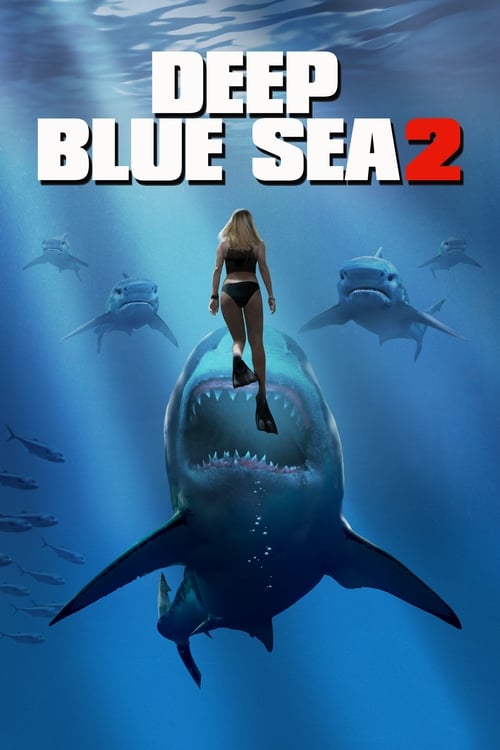
Deep Blue Sea 2 (2018)
Directed by Darin Scott
No — Deep Blue Sea 2 is not woke, scoring 14 out of 100 on our wokeness meter.
Deep Blue Sea 2 arrives with the quiet dignity of a direct-to-video sequel nobody requested, and it conducts itself accordingly.
Consciousness Markers
The villain is a big-pharma billionaire whose unethical genetic experiments on sharks are driven by profit and control, giving the film a mild anti-corporate streak.
The cast includes a female lead, a Black antagonist, and Asian supporting characters, but the diversity appears incidental rather than a marketed progressive statement.
The protagonist is a competent female shark conservationist, but the film does not engage with feminist themes or gender politics.
There are brief conservationist objections to the shark experiments, but the film is not preachy or message-driven.
There are no LGBTQ+ characters, themes, or subtext in the film.
The film has a Black villain and Asian supporting characters, but race is not commented on or used as a thematic element.
Shark conservation is part of the protagonist's background, but the film is not about climate change or environmental activism.
There is no body-positivity theme or related commentary.
Neurobiology is mentioned in the plot, but neurodivergence is not represented or discussed.
The film is a fictional creature feature with no historical revisionism.
Why it received this score
Deep Blue Sea 2 arrives with the quiet dignity of a direct-to-video sequel nobody requested, and it conducts itself accordingly. A shark conservationist named Misty Calhoun is summoned to an offshore laboratory by a pharmaceutical billionaire who has been rewriting the brains of bull sharks for reasons that never quite cohere. The cast is reasonably varied, with a woman at the center and a Black antagonist running the operation, though the film treats none of this as a statement worth making. It simply is. Danielle Savre's Misty is competent and unbothered, which registers as a faint echo of progressive casting without ever stopping to argue the point.
The villain, Carl Durant, is a billionaire who fiddles with genetics for profit and a vague fear that machines will someday run the world. This lends the proceedings a thin anti-corporate veneer, the kind that surfaces whenever a rich man in a lab coat gets eaten. It is not a thesis. It is a shark doing what sharks do. Brief objections to the experiments are raised and promptly forgotten, and the film never lectures. It is far too busy beheading supporting characters to moralize.
What we are left with is a creature feature that understands its assignment. Sharks get smart. People get eaten. The facility floods, the players dwindle, and a final explosion fails to solve anything. On the matter of cultural consciousness, the film registers as a shrug, an agreeable and efficiently forgettable exercise in the genre. It means no harm and takes no position. For a movie about genetically enhanced fish, that is roughly the correct posture, and the 0 percent score from assembled critics suggests nobody was consulted on the matter.
Analysis generated by our Consciousness Algorithm
Part of


Synopsis
When shark conservationist Dr. Misty Calhoun is invited to consult on a top-secret project run by pharmaceutical billionaire Carl Durant, she is shocked to learn that the company is using unpredictable and highly aggressive bull sharks as its test subjects, which soon break loose and cause havoc.
Questions about Deep Blue Sea 2
Is Deep Blue Sea 2 woke?
No — Deep Blue Sea 2 is not woke, scoring 14 out of 100 on our wokeness meter. That earns it a verdict of Ultra Based.
Does Deep Blue Sea 2 have any woke elements?
2 of the 10 markers register at 30 or above, led by Eat the Rich (35) and Representation Casting (30). On Eat the Rich: The villain is a big-pharma billionaire whose unethical genetic experiments on sharks are driven by profit and control, giving the film a mild anti-corporate streak.
How does Deep Blue Sea 2 compare to other 2018 movies?
It ranks #152 of the 325 films from 2018 we've scored; their average is 20. The wokest is Return (92).
How is the Woke Score calculated?
An AI-assisted process researches the film and its reception, scores it 0–100 on ten markers, then combines those into one 0–100 Woke Score. It measures a specific set of 2020s cultural themes, not film quality.