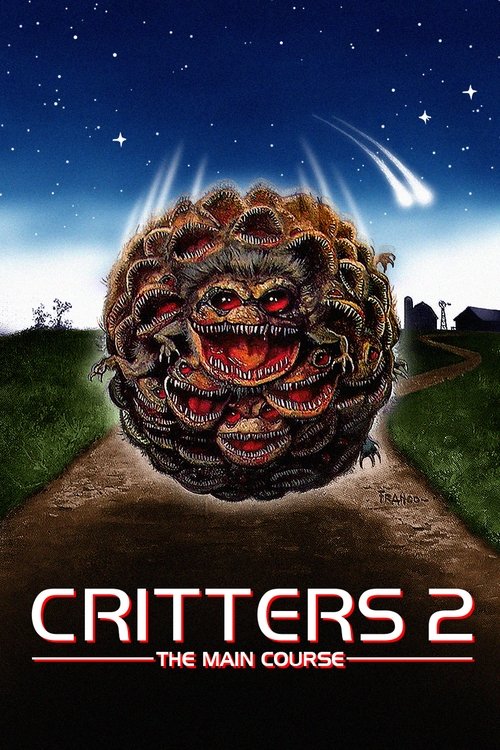
Critters 2 (1988)
Directed by Mick Garris
No — Critters 2 is not woke, scoring 0 out of 100 on our wokeness meter.
Critters 2: The Main Course arrived in 1988, two years after the first film, and it carries the confidence of a sequel that knows exactly what it is: eighty-odd minutes of puppetry, small-town panic, and Easter imagery deployed for slapstick carnage.
Consciousness Markers
The cast is uniformly white with no deliberate or commented-upon diverse casting; the small-town Kansas setting is populated by default demographics.
No LGBTQ+ characters, themes, or subtext of any kind appear in this 1988 creature feature.
Female characters exist largely as victims or as the shape-shifter's borrowed 'busty centerfold' form; there is no feminist framing whatsoever.
Race is entirely absent as a subject; the film has no interest in racial dynamics or commentary.
No environmental or climate themes; the alien threat is purely carnivorous, not ecological.
The burger-factory climax is a set piece, not a critique of capitalism; no economic messaging is present.
The film's treatment of the centerfold form is the opposite of body-positive, playing the 'gorgeous, busty' body for leering effect.
No neurodivergent characters or themes are present or explored.
The film is pure pulp fiction with no historical subject matter to revise.
A campy Easter-themed monster romp makes no attempt to lecture the audience on any social issue.
Why it received this score
Critters 2: The Main Course arrived in 1988, two years after the first film, and it carries the confidence of a sequel that knows exactly what it is: eighty-odd minutes of puppetry, small-town panic, and Easter imagery deployed for slapstick carnage. Mick Garris, making his directorial debut, keeps the camera low to the ground so the Krites can scurry, gnaw, and multiply. The town of Grover's Bend is white, rural, and unexamined. Nobody in the frame pauses to consider what the demographics might signify, because the film has no interest in signification of that kind. The creatures want to eat. The humans want to survive. That is the entire transaction.
Consider the shape-shifter Lee, who leafs through a magazine and adopts the body of a centerfold model. The film treats this form as a joke and a leer, never as a statement about beauty standards or self-image. A woman in a tank top runs from monsters, and the camera does not editorialize. The climax stages a chase through a burger factory, a location chosen because industrial equipment makes for good explosions, not because anyone wishes to indict the food industry. Easter eggs, a pitchfork, a man in a bunny suit who meets an unfortunate end: these are props in a gag reel. No sermon follows. No lesson is extracted.
The result is a film entirely innocent of the social preoccupations that now structure so much of our cultural conversation. It is crude, silly, occasionally mean, and utterly without an agenda beyond the next scare. Roger Ebert gave it one star and declared it had no reason to exist. He was wrong about the reason, though not about the star count. Its reason is that a man named Charlie flies a spaceship into a giant ball of alien vermin and lives to become sheriff. That is enough. It asks nothing of us but attention, and it repays that attention with puppets and teeth.
{"thematic_tags": ["sequel"]} could not be embedded cleanly, so the classification stands: this is a direct continuation of a prior installment and nothing else in the taxonomy applies.
Analysis generated by our Consciousness Algorithm


Synopsis
Three bounty hunters from space fly back to the town of Grovers Bend, hoping to save local residents from a new batch of Critter eggs.
Questions about Critters 2
Is Critters 2 woke?
No — Critters 2 is not woke, scoring 0 out of 100 on our wokeness meter. That earns it a verdict of Ultra Based.
Does Critters 2 have any woke elements?
No. All 10 markers score zero.
How does Critters 2 compare to other 1988 movies?
It ranks #59 of the 73 films from 1988 we've scored; their average is 10. The wokest is Stand and Deliver (58).
How is the Woke Score calculated?
An AI-assisted process researches the film and its reception, scores it 0–100 on ten markers, then combines those into one 0–100 Woke Score. It measures a specific set of 2020s cultural themes, not film quality.