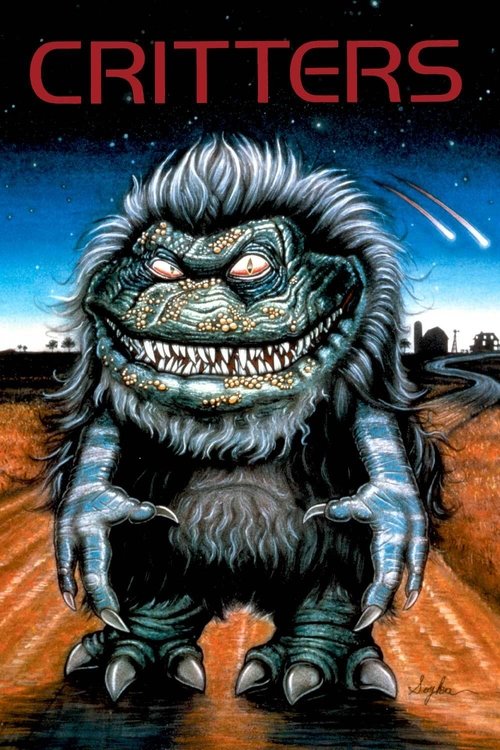
Critters (1986)
Directed by Stephen Herek
No — Critters is not woke, scoring 0 out of 100 on our wokeness meter.
Critters arrives from 1986 with a simple mandate: small furry aliens eat rural Kansans, and two shape-shifting bounty hunters arrive to clean up the mess.
Consciousness Markers
The cast is a uniformly white ensemble of small-town Kansas archetypes; no diverse casting or representation is present or commented upon.
No LGBTQ+ characters, themes, or subtext appear anywhere in the film.
Dee Wallace plays a conventional mother and April a conventional teenage daughter; the film offers no feminist framing or commentary.
Race is entirely absent as a subject; the film is a rural white-family creature feature with no racial themes.
No environmental or climate themes whatsoever; the threat is carnivorous alien wildlife, not ecological.
No economic critique or class commentary; the film is a straightforward monster romp.
No body-positivity themes; bodies here exist only to be eaten by furry aliens.
Charlie is the town drunk and crackpot, played for comic relief, not framed through any neurodivergence lens.
The film engages no historical subject matter to revise.
A campy 1986 creature feature with zero didactic messaging or moralizing.
Why it received this score
Critters arrives from 1986 with a simple mandate: small furry aliens eat rural Kansans, and two shape-shifting bounty hunters arrive to clean up the mess. The Brown family, mother, father, teenage daughter, younger son, exists as a nuclear unit assembled from creature-feature parts. Dee Wallace performs maternal concern. M. Emmet Walsh performs sweaty law enforcement. Charlie the town drunk mutters about fillings and abductions. The film has no interest in interrogating any of this. It wants to put puppets in a barn, blow up a farmhouse, and send the audience home before the credits roll.
Seen through the lens of contemporary social consciousness, the cupboard is bare. The casting is uniformly white, the gender roles are drawn from a 1950s sitcom, and race never enters the frame as a subject. There is no LGBTQ subtext, no economic critique, no environmental sermon, no body-positive reading, and no neurodivergent framing. Charlie is a comic crackpot, not a case study. History is not revised because history is not engaged. The aliens are not metaphors for climate collapse or late capitalism. They are hungry, they have quills, and they roll into balls when threatened.
To call the film preachy would be a lie. It has no lesson to deliver, no moral to impose, no audience to scold. Its pleasures are practical: puppeteers below a hayloft coordinating a bulging stomach, a Molotov cocktail made from whiskey, a church and bowling alley panicked by blank-faced bounty hunters. The result is a modest, campy diversion with the social awareness of a firecracker. We score it accordingly, with the solemnity such an empty vessel deserves. The only thing it represents is the durable appeal of watching a furball eat a cow.
Analysis generated by our Consciousness Algorithm


Synopsis
Carnivorous aliens arrive unannounced at a Kansas family farm; two intergalactic bounty hunters soon follow, determined to blow them off the planet.
Questions about Critters
Is Critters woke?
No — Critters is not woke, scoring 0 out of 100 on our wokeness meter. That earns it a verdict of Ultra Based.
Does Critters have any woke elements?
No. All 10 markers score zero.
How does Critters compare to other 1986 movies?
It ranks #47 of the 62 films from 1986 we've scored; their average is 7. The wokest is Star Trek IV: The Voyage Home (42).
How is the Woke Score calculated?
An AI-assisted process researches the film and its reception, scores it 0–100 on ten markers, then combines those into one 0–100 Woke Score. It measures a specific set of 2020s cultural themes, not film quality.