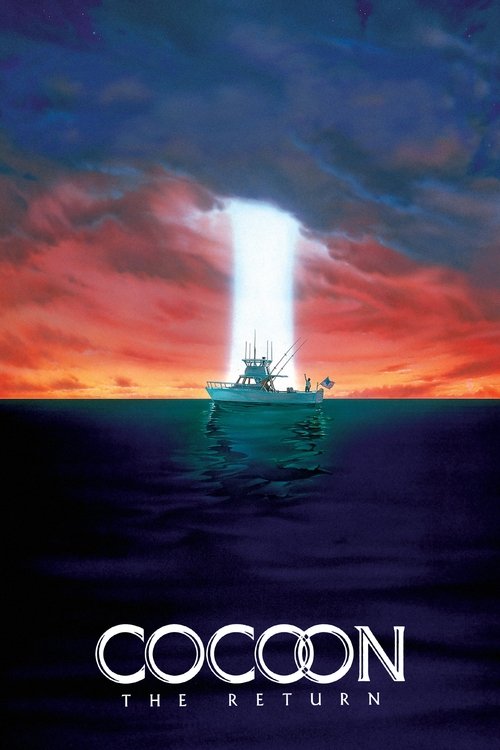
Cocoon: The Return (1988)
Directed by Daniel Petrie
No — Cocoon: The Return is not woke, scoring 8 out of 100 on our wokeness meter.
A sequel nobody demanded, arriving three years late and roughly twenty-five million dollars short of its predecessor's take, Cocoon: The Return reassembles the retirement-home ensemble for one more round of mortality negotiations.
Consciousness Markers
The ensemble is a rare showcase for elderly actors (Ameche, Tandy, Cronyn, Stapleton), but this is age representation rather than the modern identity-conscious casting the marker tracks; the cast remains overwhelmingly white and conventional.
The film gently sermonizes that family matters more than living forever, but it delivers this through sentiment and character choices rather than preachy exposition.
Courteney Cox's Sara is a scientist with a conscience who defies her employer, and Alma and Bess make consequential life choices, but the film is framed around patriarchal family devotion rather than any feminist critique.
The institute and military's desire to seize and exploit the alien carries a faint institutional-suspicion streak, but it is never framed as a critique of capitalism or wealth.
No LGBTQ+ characters, themes, or subtext appear anywhere in the film.
No engagement with race, racial identity, or racial justice whatsoever.
The Oceanographic Institute is a plot device, not an environmentalist statement; no climate or ecological theme is present.
No body-positivity themes; the film's treatment of aging is about mortality and vitality, not body acceptance.
No neurodivergent characters or themes are present.
The film is speculative fiction with no historical subject matter to revise.
Why it received this score
A sequel nobody demanded, arriving three years late and roughly twenty-five million dollars short of its predecessor's take, Cocoon: The Return reassembles the retirement-home ensemble for one more round of mortality negotiations. Don Ameche, Jessica Tandy, Hume Cronyn and Maureen Stapleton return to Earth to retrieve a leftover cocoon, only to spend the runtime deciding whether immortality is worth outliving their grandchildren. Daniel Petrie directs with the gentle, unhurried competence of a man who has done this before and expects no medals for it. Roger Ebert noted that the film mostly offers the chance to watch everyone say goodbye a second time. He was correct. The picture is a farewell tour with a spaceship in the parking lot.
On the matter of social consciousness, the offering is thin but not empty. The ensemble is a genuine showcase for performers past seventy, which registers as age representation of a sort, though the cast remains uniformly white and thoroughly conventional. Courteney Cox's Sara is a scientist who quits rather than hand an alien to the military, and Alma and Bess each make consequential choices about their own futures, yet the film organizes itself around family devotion and patriarchal warmth instead of any feminist argument. The institute's appetite for seizing and exploiting the visitor carries a faint institutional suspicion, never a critique of capital. No LGBTQ presence, no racial engagement, no climate concern, no body acceptance, no neurodivergent characters. What remains is sentiment, delivered warmly and without a lecture.
The moral arrives through character rather than sermon: family matters more than living forever. It is a soft lesson, administered with ice cream and tears, and it asks nothing of the audience beyond a handkerchief. As a piece of cultural classification, the film is a relic of a gentler studio era, earnest, well-acted and almost entirely untouched by the identity preoccupations that would later dominate the discourse. It means well. It simply does not mean much else.
Analysis generated by our Consciousness Algorithm


Synopsis
The reinvigorated elderly group that left Earth comes back to visit their relatives. Will they all decide to go back to the planet where no one grows old, or will they be tempted to remain on Earth?
Questions about Cocoon: The Return
Is Cocoon: The Return woke?
No — Cocoon: The Return is not woke, scoring 8 out of 100 on our wokeness meter. That earns it a verdict of Ultra Based.
Does Cocoon: The Return have any woke elements?
Very few. None of the 10 markers reaches 30, the level where a marker counts as present; the highest is Lecture Energy at 12.
How does Cocoon: The Return compare to other 1988 movies?
It ranks #28 of the 73 films from 1988 we've scored; their average is 10. The wokest is Stand and Deliver (58).
How is the Woke Score calculated?
An AI-assisted process researches the film and its reception, scores it 0–100 on ten markers, then combines those into one 0–100 Woke Score. It measures a specific set of 2020s cultural themes, not film quality.