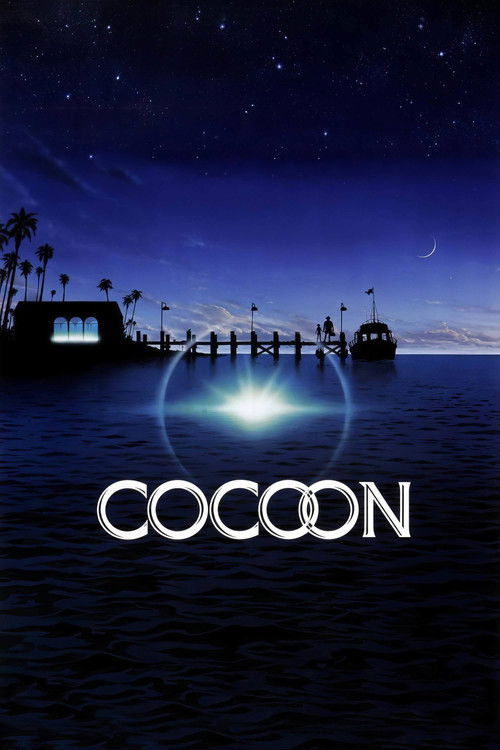
Cocoon (1985)
Directed by Ron Howard
No — Cocoon is not woke, scoring 0 out of 100 on our wokeness meter.
Ron Howard's Cocoon (1985) concerns three residents of a Florida retirement home who trespass into a swimming pool charged with alien life force and briefly become young again.
Consciousness Markers
The cast is overwhelmingly white, with no deliberate diverse or inclusive casting choices; the ensemble is a group of veteran white Hollywood actors.
There are no LGBTQ+ characters, themes, or subtext anywhere in the film.
While elderly women appear as characters, the film offers no feminist critique or agenda; the wives largely function as companions to the male leads.
The film engages no racial themes or commentary whatsoever.
No environmental or climate themes are present; the aliens' concern is with life force and returning home, not ecology.
There is no economic critique or anti-capitalist messaging; the film is a gentle fantasy about aging and rejuvenation.
The film's theme of rejuvenation is about regaining youth, not body acceptance or positivity in the modern sense.
No neurodivergent characters or themes are depicted.
The film is a work of science fiction with no historical subject matter to revise.
The film is sentimental and heartwarming rather than preachy; it delivers no moralizing lecture to the audience.
Why it received this score
Ron Howard's Cocoon (1985) concerns three residents of a Florida retirement home who trespass into a swimming pool charged with alien life force and briefly become young again. The cast is a roll call of Hollywood elders: Don Ameche, Hume Cronyn, Jessica Tandy, Maureen Stapleton, Jack Gilford, Gwen Verdon. They were hired for their accumulated screen history, not to make a statement about who gets to appear on screen. Wilford Brimley, cast as a man in his seventies, was fifty during production, his hair bleached gray and liver spots painted on. That is the extent of the film's transformative cosmetics, and it serves a joke about aging, not a conversation about it.
The film has no interest in the categories that occupy the current cultural moment. No character's race is examined. No one is gay, or coded as such. The women regain their vigor and are still defined by their husbands. The elderly residents give away their money, and the film treats this as poignant instead of political. The aliens are benign visitors reclaiming their dormant kin; they have no ecological grievance and no critique of capital. There is no sermon here. When Bernie refuses the pool and stays behind with his dying wife, the movie's position is plain: love and mortality over endless youth. It is a conservative ending delivered with warmth.
What remains is a sentimental fantasy, Spielberg-adjacent, well made, and entirely without instruction. It wants us to feel something about getting old, and it succeeds, and it asks nothing else of us. A studio spent seventeen and a half million dollars on it, and it won two Academy Awards. Such a thing could be made then. It could probably be made now, provided nobody expected it to mean anything.
Analysis generated by our Consciousness Algorithm
Synopsis
When a group of trespassing seniors swim in a pool containing alien cocoons, they find themselves energized with youthful vigor.
Questions about Cocoon
Is Cocoon woke?
No — Cocoon is not woke, scoring 0 out of 100 on our wokeness meter. That earns it a verdict of Ultra Based.
Does Cocoon have any woke elements?
No. All 10 markers score zero.
How does Cocoon compare to other 1985 movies?
It ranks #51 of the 68 films from 1985 we've scored; their average is 8. The wokest is The Color Purple (62).
How is the Woke Score calculated?
An AI-assisted process researches the film and its reception, scores it 0–100 on ten markers, then combines those into one 0–100 Woke Score. It measures a specific set of 2020s cultural themes, not film quality.