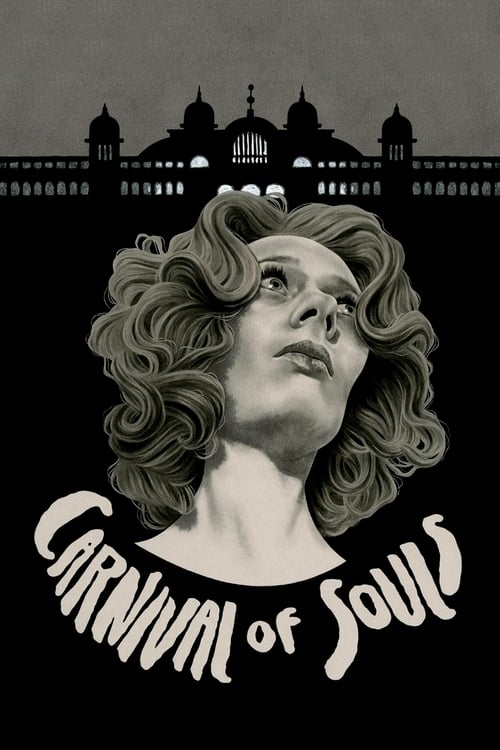
Carnival of Souls (1962)
Directed by Herk Harvey
No — Carnival of Souls is not woke, scoring 3 out of 100 on our wokeness meter.
Carnival of Souls arrives for classification as a 1962 curiosity shot for roughly $33,000 across Kansas and Utah by Herk Harvey, a man who made industrial films for a living and made this one on his vacation.
Consciousness Markers
Mary Henry is an independent woman who relocates alone and takes a job, but the film has no feminist thesis; her agency is a genre convention of the psychological horror, not an agenda.
The cast is uniformly white and drawn from a small regional talent pool; the female lead is a casting choice, not a diversity statement. No representation-conscious casting of any kind.
No LGBTQ+ characters, themes, or subtext appear anywhere in the film.
Race is entirely absent as a subject; the film's anxieties are metaphysical, not social.
No environmental or climate themes whatsoever.
No economic critique; the abandoned pavilion is a haunted setting, not a symbol of class struggle.
No body-positive messaging or body-diverse casting.
Mary's dissociation and terror are supernatural in origin, not a depiction of neurodivergence as identity or representation.
The film makes no historical claims to revise; it is a ghost story with no engagement with the historical record.
The film shows rather than tells, offering atmosphere and dread instead of moral instruction. No sermonizing of any kind.
Why it received this score
Carnival of Souls arrives for classification as a 1962 curiosity shot for roughly $33,000 across Kansas and Utah by Herk Harvey, a man who made industrial films for a living and made this one on his vacation. Mary Henry survives a bridge accident she cannot explain, moves to Salt Lake City, takes work as a church organist, and spends the remainder of the running time being stalked by a pale gentleman who never speaks. The organ hums. The pavilion waits. The dread accumulates with the patience of a patient thing. It is a mood, and the mood holds.
As a document of modern social consciousness, the ledger is nearly blank, and the blankness is honest. The cast is white, regional, and small. Race is not a subject. Neither is sexuality, nor the climate, nor the extraction of labor from the working class, nor the politics of the body, nor the politics of the mind. Mary's dissociation is a ghost's condition, not an identity. The film makes no claims about history and declines to revise any. It never turns to the camera to explain how we ought to live. Harvey preferred fog to argument, and the arrangement suits him.
There is a single faint signal, and we register it without enthusiasm. Mary is a woman who leaves town alone, secures employment, rents a room, and refuses a persistent suitor with no apology. That is agency, and the film grants it. It is also the standard furniture of psychological horror, where a solitary protagonist must be isolated for the machinery to function. Independence here is a plot requirement, not a program. We note it, we credit it lightly, and we move on.
Analysis generated by our Consciousness Algorithm


Synopsis
Mary Henry ends up the sole survivor of a fatal car accident through mysterious circumstances. Trying to put the incident behind her, she moves to Utah and takes a job as a church organist. But her fresh start is interrupted by visions of a fiendish man. As the visions begin to occur more frequently, Mary finds herself drawn to the deserted carnival on the outskirts of town. The strangely alluring carnival may hold the secret to her tragic past.
Questions about Carnival of Souls
Is Carnival of Souls woke?
No — Carnival of Souls is not woke, scoring 3 out of 100 on our wokeness meter. That earns it a verdict of Ultra Based.
Does Carnival of Souls have any woke elements?
Very few. None of the 10 markers reaches 30, the level where a marker counts as present; the highest is Feminist Agenda at 5.
How does Carnival of Souls compare to other 1962 movies?
It ranks #16 of the 23 films from 1962 we've scored; their average is 9. The wokest is The Exterminating Angel (47).
How is the Woke Score calculated?
An AI-assisted process researches the film and its reception, scores it 0–100 on ten markers, then combines those into one 0–100 Woke Score. It measures a specific set of 2020s cultural themes, not film quality.