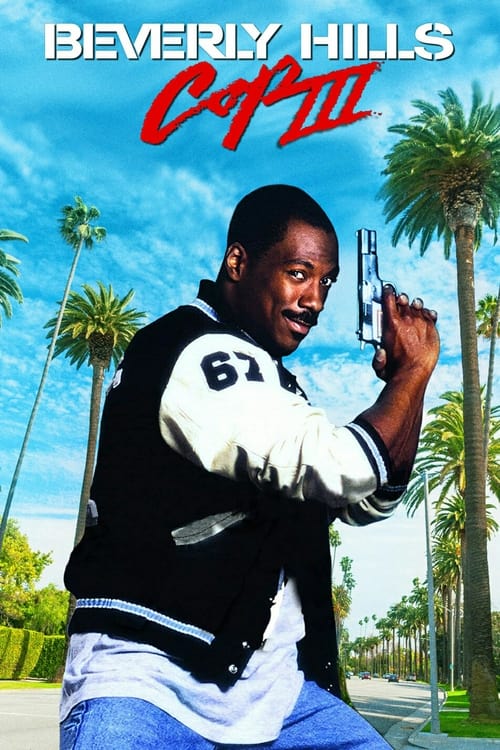
Beverly Hills Cop III (1994)
Directed by John Landis
No — Beverly Hills Cop III is not woke, scoring 13 out of 100 on our wokeness meter.
Beverly Hills Cop III arrives in 1994 as a franchise running on fumes and a star who had decided, against the advice of everyone within earshot, that his wisecracking detective should now be an adult.
Consciousness Markers
Eddie Murphy headlines as Axel Foley with Héctor Elizondo as a Latino co-lead, giving the film a naturally diverse principal cast, though the diversity is unremarked upon and typical of 1990s buddy-cop casting rather than a deliberate representational statement.
No LGBTQ+ characters, themes, or subtext appear anywhere in the film.
Janice Perkins exists as a park employee and eventual love interest; there is no feminist framing, critique of patriarchy, or female-empowerment agenda.
The film engages no racial themes or commentary; Axel's Blackness is never a subject of the narrative.
No environmental or climate themes are present.
The villains run a counterfeiting ring for personal profit; the film offers no critique of capitalism, class, or wealth distribution.
No body-positivity themes or messaging appear.
No neurodivergent characters or themes are depicted.
The film is a straightforward contemporary action-comedy with no historical revisionism.
The film is pure entertainment with no didactic messaging or moral lecturing of any kind.
Why it received this score
Beverly Hills Cop III arrives in 1994 as a franchise running on fumes and a star who had decided, against the advice of everyone within earshot, that his wisecracking detective should now be an adult. Axel Foley returns to Beverly Hills to investigate a counterfeiting operation hidden inside a theme park called WonderWorld, and the resulting film is a machine for delivering shootouts and a three-armed Ferris wheel rescue. John Landis directs with the weary competence of a man who knows the script is not a problem he can fix. The whole enterprise carries the faint odor of a contractual obligation, which is not a social statement, merely a business one.
The cast is genuinely mixed in the manner of 1990s buddy-cop product: Eddie Murphy at the center, Héctor Elizondo as his new partner, a rotating bench of Latino and Black supporting players. Nobody comments on any of it. The film has no interest in what any of this means, and that indifference is itself the finding. There is no romantic architecture beyond a park employee who smiles at the right moments, no engagement with race as a subject, no environmental sermon, no critique of the wealthy men running the counterfeit ring, who are simply criminals with a printing press. The villains want money. The hero wants justice for his dead supervisor. That is the entire moral ledger.
We are left with a curious artifact: a major studio sequel in which nothing is being argued and no one is being instructed. The picture is frequently dull, occasionally competent, and entirely free of sermonizing. For a certain kind of viewer, that absence registers as a relief. For the classification ledger, it registers as a long column of zeroes with a single modest entry. The theme park rides are the only things here with a thesis, and their thesis is centrifugal force. It is a strange legacy for a franchise, and an honest one.
{"thematic_tags": ["sequel", "box_office_number_one"]}
Analysis generated by our Consciousness Algorithm
Part of


Synopsis
When his boss is killed, Detroit cop Axel Foley finds evidence that the murderer had ties to a California amusement park called Wonder World. Returning to sunny Beverly Hills once more, Foley reunites with Detective Billy Rosewood to solve the case. Along with Billy's new partner, Detective Jon Flint, they discover that Wonder World is being used as a front for a massive counterfeiting ring.
Questions about Beverly Hills Cop III
Is Beverly Hills Cop III woke?
No — Beverly Hills Cop III is not woke, scoring 13 out of 100 on our wokeness meter. That earns it a verdict of Ultra Based.
Does Beverly Hills Cop III have any woke elements?
1 of the 10 markers register at 30 or above, led by Representation Casting (30). On Representation Casting: Eddie Murphy headlines as Axel Foley with Héctor Elizondo as a Latino co-lead, giving the film a naturally diverse principal cast, though the diversity is unremarked upon and typical of 1990s buddy-cop casting rather than a deliberate representational statement.
How does Beverly Hills Cop III compare to other 1994 movies?
It ranks #19 of the 86 films from 1994 we've scored; their average is 10. The wokest is On Deadly Ground (75).
Is Beverly Hills Cop III the most woke Beverly Hills Cop movie?
No. It ranks #2 of the 4 Beverly Hills Cop films we've scored; the wokest is Beverly Hills Cop: Axel F (20).