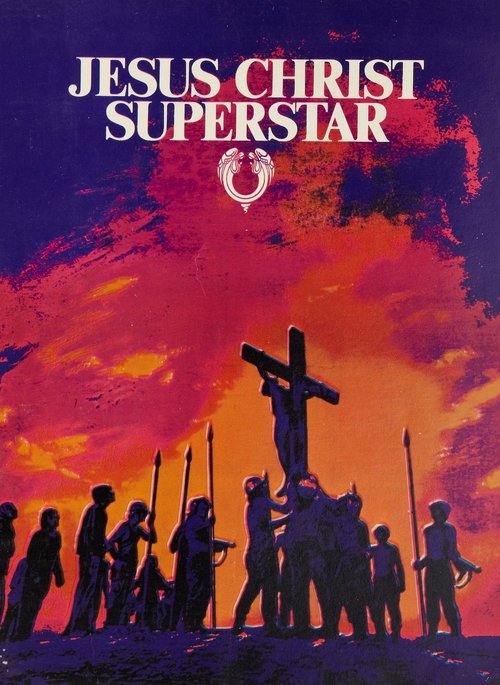
Jesus Christ Superstar (1973)
Directed by Norman Jewison
No — Jesus Christ Superstar is not especially woke, scoring 37 out of 100 on our wokeness meter.
Norman Jewison's 1973 adaptation of the Rice and Lloyd Webber rock opera arrives dressed as a bus tour, a troupe of hippies pitching tents in the Negev to restage the Passion in bell bottoms and tank tops.
Consciousness Markers
Telling the Passion from Judas's sympathetic viewpoint, humanizing the betrayer as a tragic instrument of God's plan, is a substantial revision of the traditional Gospel account.
The deliberate non-traditional casting of a Black actor (Carl Anderson) as Judas in a leading role, plus a multiracial hippie troupe, was notably progressive for 1973 and remains the film's signature cultural footprint.
The sung-through format delivers its social-injustice themes (Judas's protests, the poor versus the ointment) with rhetorical force, though it works more as emotional rock opera than modern sermonizing.
Judas is reframed as a humanitarian concerned with the poor and social injustice, and Jesus ransacks the temple's money lenders and merchants, giving the film a recurring anti-wealth, anti-materialist streak.
Mary Magdalene is given interiority and her own numbers, but she remains framed through her longing for Jesus rather than any explicit feminist argument.
The film practices colorblind casting but never engages racial themes or the experience of race; the Black Judas is a casting statement, not a thematic one.
No LGBTQ+ characters or themes appear; the narrative is wholly concerned with the Passion and the Judas/Jesus conflict.
No environmental content whatsoever; the desert serves as backdrop, not ecology.
No body-diversity or body-acceptance messaging; the cast is a conventional group of singers and dancers.
No depiction of neurodivergence or neurodiverse identity anywhere in the narrative.
Why it received this score
Norman Jewison's 1973 adaptation of the Rice and Lloyd Webber rock opera arrives dressed as a bus tour, a troupe of hippies pitching tents in the Negev to restage the Passion in bell bottoms and tank tops. The conceit is modest and the desert is indifferent. What the production does with casting, however, remains its most durable contribution to the culture. Carl Anderson plays Judas, a Black performer handed the emotional and theological center of a story that Western cinema had spent decades reserving for white men. The surrounding ensemble is a mixed company of singers and dancers, assembled without ceremony. This was a statement in 1973, made without a line of dialogue explaining it. The film simply casts, and moves on.
The libretto's real mischief lies elsewhere. Telling the Passion from the betrayer's side, granting Judas a conscience, a grievance, and a death that reads as tragedy instead of damnation, is a substantial rewrite of the received account. He becomes a man worried about the poor. Jesus, meanwhile, snaps at lepers, tolerates expensive ointment, and overturns the tables of the money lenders with real fury. The material keeps circling a suspicion of wealth and of a movement that has lost its purpose. It is a rock opera, though, not a pamphlet. The social argument arrives on a melody and leaves on one.
Mary Magdalene gets her interiority and her signature ballad, though the film frames her almost entirely through longing for a man who will not love her back. That is the ceiling here. The colorblind casting never once examines race as a lived fact. There is no environmental conscience, no body-diverse ensemble, no neurodivergent thread to speak of. What remains is a strange, sincere artifact: a Broadway curiosity that put a Black Judas at the center of the biggest story in the West and declined to make a speech about it. The bus drives off. The cross stays in the sand.
Analysis generated by our Consciousness Algorithm
Part of


Synopsis
As played out by a theatre troupe, the last days of Jesus Christ are depicted from the perspective of Judas Iscariot, his betrayer. As Jesus' following increases, Judas begins to worry that Jesus is falling for his own hype, forgetting the principles of his teachings and growing too close to the prostitute Mary Magdalene.
Questions about Jesus Christ Superstar
Is Jesus Christ Superstar woke?
No — Jesus Christ Superstar is not especially woke, scoring 37 out of 100 on our wokeness meter. That earns it a verdict of Based.
Does Jesus Christ Superstar have any woke elements?
3 of the 10 markers register at 30 or above, led by Revisionist History (65), Representation Casting (60) and Lecture Energy (30). On Revisionist History: Telling the Passion from Judas's sympathetic viewpoint, humanizing the betrayer as a tragic instrument of God's plan, is a substantial revision of the traditional Gospel account.
How does Jesus Christ Superstar compare to other 1973 movies?
It ranks #2 of the 32 films from 1973 we've scored; their average is 11. The wokest is Soylent Green (39).
How is the Woke Score calculated?
An AI-assisted process researches the film and its reception, scores it 0–100 on ten markers, then combines those into one 0–100 Woke Score. It measures a specific set of 2020s cultural themes, not film quality.