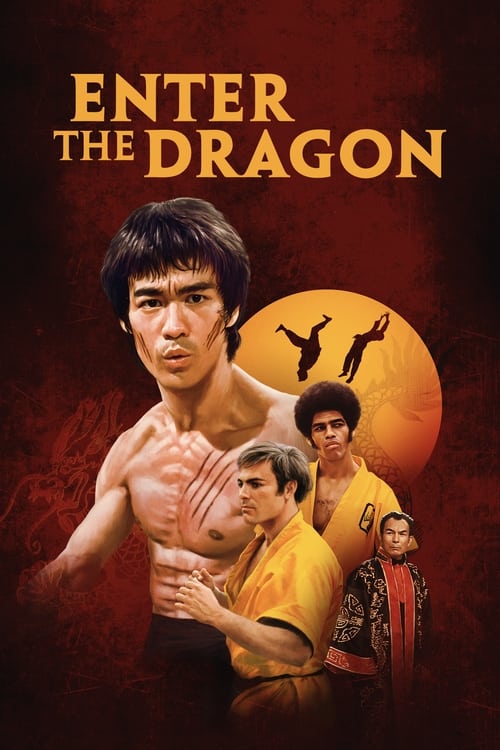
Enter the Dragon (1973)
Directed by Robert Clouse
No — Enter the Dragon is not especially woke, scoring 21 out of 100 on our wokeness meter.
We approach Enter the Dragon as we would a well-preserved vintage: 1973, Warner Bros.
Consciousness Markers
The film deliberately features an Asian lead, a Black co-lead, and a multiracial international cast, with producers explicitly seeking broad global appeal. This is notable for 1973, though it is not framed through modern DEI casting discourse.
Jim Kelly's Williams is explicitly described as an African American activist on the run after defending himself against racist police officers. This gives the film a concrete racial-consciousness element, though it is not the central thesis.
There are no LGBTQ+ themes, characters, or subtext in the film.
Women are largely presented as harem members, prostitutes, or supporting figures; the film contains no feminist agenda or critique of patriarchy.
There is no environmental or climate-related theme in the film.
The villain is a crime lord running drugs and prostitution, not a capitalist system or economic class critique.
The film does not engage with body positivity or size-diversity themes.
There is no depiction or discussion of neurodivergence in the film.
The film is not a historical revision or counter-narrative about real events.
The film includes martial arts philosophy and Shaolin lessons, but it does not deliver modern social-justice lecture energy.
Why it received this score
We approach Enter the Dragon as we would a well-preserved vintage: 1973, Warner Bros. and Golden Harvest, a budget of $850,000, and a martial artist who would not live to see the premiere. The film's most interesting feature, culturally speaking, is its casting architecture. Producers wanted the widest possible international audience and assembled an Asian lead, a Black co-lead, and a white American foil. Representation here is a matter of market arithmetic dressed as cosmopolitanism, which is not the same thing as contemporary equity casting, but it is a deliberate choice worth cataloguing. Jim Kelly's Williams arrives with a backstory involving racist police officers in Los Angeles, a detail that plants a small flag of racial consciousness in an otherwise tournament-shaped narrative. It is one scene of motivation, not a thesis, and the film moves on briskly to the fighting.
The rest of the ledger is quiet. Women appear as harem members and attendants, and the film has no interest in interrogating that arrangement. There is no LGBTQ presence, no climate anxiety, no body-diversity conversation, and no neurodivergent framing. The villain is a crime lord with a drug operation and a metal hand, not a stand-in for the market economy, so the anti-capitalist reading does not apply. The Shaolin philosophy is present, but it is instruction in combat and discipline, not sermonizing about contemporary social arrangements. Nobody pauses the tournament to deliver a lecture on structural injustice, and for that we are mildly grateful.
What remains is a spy plot wearing a gi, a mirror maze, and a thumbs-up across a battlefield of extras. The film earns its place in the National Film Registry on the strength of choreography and influence, not ideological programming. It is a product of its moment, competently assembled, and only intermittently aware of the world beyond the island.
Analysis generated by our Consciousness Algorithm
Part of


Synopsis
A martial artist agrees to spy on a reclusive crime lord using his invitation to a tournament there as cover.
Questions about Enter the Dragon
Is Enter the Dragon woke?
No — Enter the Dragon is not especially woke, scoring 21 out of 100 on our wokeness meter. That earns it a verdict of Based.
Does Enter the Dragon have any woke elements?
2 of the 10 markers register at 30 or above, led by Representation Casting (45) and Racial Consciousness (40). On Representation Casting: The film deliberately features an Asian lead, a Black co-lead, and a multiracial international cast, with producers explicitly seeking broad global appeal.
How does Enter the Dragon compare to other 1973 movies?
It ranks #7 of the 32 films from 1973 we've scored; their average is 11. The wokest is Soylent Green (39).
How is the Woke Score calculated?
An AI-assisted process researches the film and its reception, scores it 0–100 on ten markers, then combines those into one 0–100 Woke Score. It measures a specific set of 2020s cultural themes, not film quality.