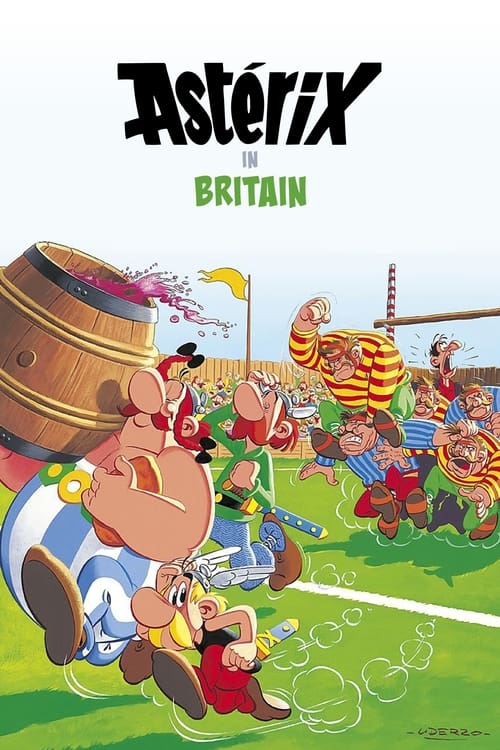
Asterix in Britain (1986)
Directed by Pino Van Lamsweerde
No — Asterix in Britain is not woke, scoring 0 out of 100 on our wokeness meter.
Released in 1986, Asterix in Britain is the fifth animated outing for Goscinny and Uderzo's indomitable Gauls, and it arrives with the modest ambition of adapting a well-liked comic book without incident.
Consciousness Markers
The cast and characters are entirely white Gauls, Britons, and Romans, with no modern diverse casting or commentary on representation.
No LGBTQ+ characters, themes, or subtext.
No feminist themes or gender-conscious narrative; female characters are peripheral.
No engagement with racial identity, racism, or racial justice.
No environmental or climate themes.
No critique of capitalism or wealth inequality; the conflict is imperial Roman conquest, not economic.
Obelix's size is played for comedy and strength, not as a body-positivity message.
No neurodivergent characters or themes.
It's a comedic fantasy set in Roman times, not a revisionist historical narrative with modern social justice framing.
The film is a light adventure comedy and does not lecture the audience on social issues.
Why it received this score
Released in 1986, Asterix in Britain is the fifth animated outing for Goscinny and Uderzo's indomitable Gauls, and it arrives with the modest ambition of adapting a well-liked comic book without incident. Asterix and Obelix escort a barrel of magic potion across the Channel to a lone British village still resisting Caesar, encountering fog, warm beer, boiled boar with mint sauce, and a rugby match officiated by a druid. The Phoenician herbs Asterix acquires en route turn out to be tea, which the Britons promptly adopt as a national drink. It is a gag about a hot beverage. Nothing more is claimed for it.
Viewed through the lens of contemporary cultural expectation, the film is a vacuum. The cast is uniformly white and entirely unbothered by the fact. There are no LGBTQ characters, no feminist argument, no racial reckoning, no climate anxiety, no critique of capital, and no neurodivergent arc. Obelix's girth is a running joke about appetite and violence, not a meditation on body acceptance. The Britons are a national stereotype, cheerfully rendered, and the film never pauses to interrogate the stereotype or apologize for it. Rome is an empire to be punched, not a metaphor for structural injustice.
None of this is a failing. The film was made in 1986, comfortably before the vocabulary it lacks had been assembled, and it has no interest in instructing anyone about anything. It wants to be funny for eighty minutes and then stop. It succeeds at the first and honors the second. A score of zero is not a verdict on quality. It is a statement of historical fact. This is a comic adventure about a magic potion, and it would be bewildered to learn that anything else was ever expected of it.
It is, in the end, a film about tea. The sommelier tastes nothing. The glass is clean, the vintage is simply from another cellar entirely, and there is no shame in that. We file it accordingly and move on to the next bottle.
Poured, sniffed, and found to contain no social consciousness whatsoever. A bracing zero, and a perfectly pleasant afternoon.
Asterix in Britain: a Gaulish romp with warm beer, rugby, and not a single lecture to be found. The scoring reflects a film that predates the entire discourse and declines, politely, to participate in it. There is no representation agenda, no identity politics, no environmental sermon, and no economic grievance. There is only a small man with a moustache, a large man with a boar, and a barrel that must reach a village. The classification is complete. The film is innocent of everything currently in fashion, and it seems entirely at peace with that verdict.
Final assessment: zero. The sommelier sets down the glass, makes a small note in the ledger, and reaches for the next bottle. The cellar is long, the evening is longer, and the work continues.
Asterix in Britain is a 1986 French animated film directed by Pino Van Lamsweerde, adapted from the graphic novel by René Goscinny and Albert Uderzo. It is the fifth film in the animated Asterix series and forms part of the Asterix and Obelix animated collection. It is a book adaptation and a series continuation, and it is nothing else besides. There is no superhero, no true story, no remake, and no Oscar. The record is complete.
It ends, as these things do, with a banquet. Everyone is fed, nobody is lectured, and the credits roll over a village that has learned nothing about itself. We should all be so fortunate.
Zero. Filed. Next.
Analysis generated by our Consciousness Algorithm
Part of


Synopsis
One little ancient British village still holds out against the Roman invaders. Asterix and Obelix are invited to help. They must face fog, rain, warm beer and boiled boar with mint sauce, but they soon have Governor Encyclopaedius Britannicus's Romans declining and falling. Until a wild race for a barrel of magic potion lands them in the drink.
Questions about Asterix in Britain
Is Asterix in Britain woke?
No — Asterix in Britain is not woke, scoring 0 out of 100 on our wokeness meter. That earns it a verdict of Ultra Based.
Does Asterix in Britain have any woke elements?
No. All 10 markers score zero.
How does Asterix in Britain compare to other 1986 movies?
It ranks #47 of the 62 films from 1986 we've scored; their average is 7. The wokest is Star Trek IV: The Voyage Home (42).
Is Asterix in Britain the most woke Asterix and Obelix (Animation) movie?
No. It ranks #7 of the 10 Asterix and Obelix (Animation) films we've scored; the wokest is Asterix: The Secret of the Magic Potion (22).