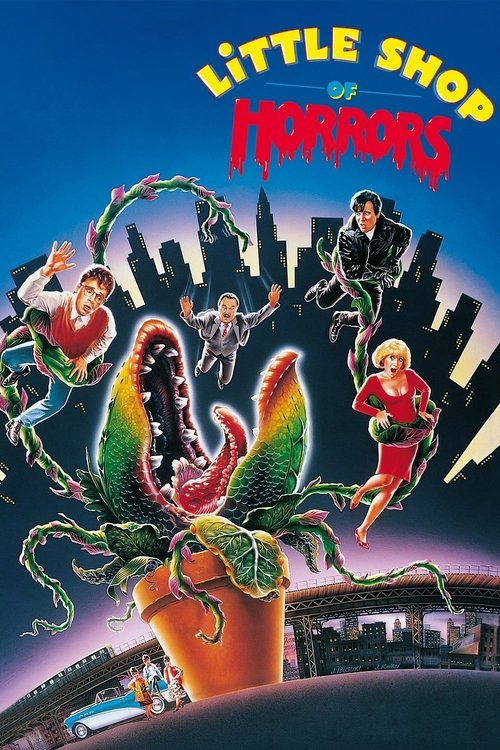
Little Shop of Horrors (1986)
Directed by Frank Oz
No — Little Shop of Horrors is not especially woke, scoring 21 out of 100 on our wokeness meter.
Frank Oz's 1986 adaptation of the off-Broadway musical arrives with a Motown chorus of three Black women narrating the decay of Skid Row, and Levi Stubbs of the Four Tops lending his growl to the carnivorous plant.
Consciousness Markers
A Motown-style Greek chorus of three Black women (Tichina Arnold, Tisha Campbell, Michelle Weeks) drives the narrative, and Black vocalist Levi Stubbs voices the title plant, giving the film a notably integrated cast for 1986—though this reads as organic musical-theater casting rather than a modern diversity mandate.
The original ending explicitly blames 'the greed of their owners' for the plant apocalypse, and 'The Meek Shall Inherit' skewers selling out for fame and corporate contracts—a genuine, if satirical, eat-the-rich streak.
The greed-and-consumerism moral is delivered through song and spectacle rather than sermon, keeping the didacticism light and largely confined to the restored finale.
Audrey is trapped with a sadistic abuser and dreams only of suburban domesticity in 'Somewhere That's Green'; the film critiques her mistreatment but offers no feminist framework or agency-driven arc.
The Skid Row setting and the Black doo-wop chorus gesture at an urban underclass, but the film makes no explicit commentary on race or racial injustice.
The dentist sequence with Bill Murray's masochistic patient Arthur Denton carries a widely-noted homoerotic subtext, but it is coded innuendo rather than any explicit LGBTQ+ theme or character.
The carnivorous plant is an extraterrestrial menace bent on conquest, not an ecological parable; no environmental themes are present.
No body-image or body-acceptance themes appear in the film.
No neurodivergence themes or neurodivergent-coded characters are present.
The film is a fantastical musical with no historical subject matter to revise.
Why it received this score
Frank Oz's 1986 adaptation of the off-Broadway musical arrives with a Motown chorus of three Black women narrating the decay of Skid Row, and Levi Stubbs of the Four Tops lending his growl to the carnivorous plant. This is an unusually integrated cast for its moment, though the integration reads as musical-theater tradition: the doo-wop idiom demands those voices. It is inherited cultural practice, not a modern diversity mandate. The film's social consciousness was assembled decades before the current vocabulary existed to describe it.
Where the film carries real ideological weight is in its contempt for commerce. The restored director's cut ends with the plant's progeny overrunning the Earth, and the chorus lays the blame squarely on the greed of their owners. The number "The Meek Shall Inherit" skewers the seduction of contracts, licensing, and fame. This is a genuine eat-the-rich streak, though it arrives through song and spectacle. The lecturing stays light, confined mostly to that restored finale, and the film prefers to entertain its audience while quietly indicting them.
Elsewhere the record is spare. Audrey endures a sadistic boyfriend and dreams only of a suburban kitchen, and the film critiques her mistreatment without granting her a framework or an agency-driven arc. Bill Murray's masochistic dental patient carries a coded innuendo that never matures into an actual theme. The plant is an extraterrestrial conqueror, not an ecological parable, so no environmental conscience stirs. Nothing here addresses body image, neurodivergence, or the rewriting of history, since the film has no historical subject to rewrite. It is a creature feature with a Motown beat, and it asks nothing of us but to keep feeding it.
Analysis generated by our Consciousness Algorithm


Synopsis
Seymour Krelborn is a nerdy orphan working at Mushnik's, a flower shop in urban Skid Row. He harbors a crush on fellow co-worker, Audrey Fulquard, and is berated by Mr. Mushnik daily. One day, Seymour finds a very mysterious unidentified plant which he calls Audrey II. The plant seems to have a craving for blood and soon begins to sing for its supper.
Questions about Little Shop of Horrors
Is Little Shop of Horrors woke?
No — Little Shop of Horrors is not especially woke, scoring 21 out of 100 on our wokeness meter. That earns it a verdict of Based.
Does Little Shop of Horrors have any woke elements?
2 of the 10 markers register at 30 or above, led by Eat the Rich (45) and Representation Casting (45). On Eat the Rich: The original ending explicitly blames 'the greed of their owners' for the plant apocalypse, and 'The Meek Shall Inherit' skewers selling out for fame and corporate contracts—a genuine, if satirical, eat-the-rich streak.
How does Little Shop of Horrors compare to other 1986 movies?
It ranks #6 of the 62 films from 1986 we've scored; their average is 7. The wokest is Star Trek IV: The Voyage Home (42).
How is the Woke Score calculated?
An AI-assisted process researches the film and its reception, scores it 0–100 on ten markers, then combines those into one 0–100 Woke Score. It measures a specific set of 2020s cultural themes, not film quality.