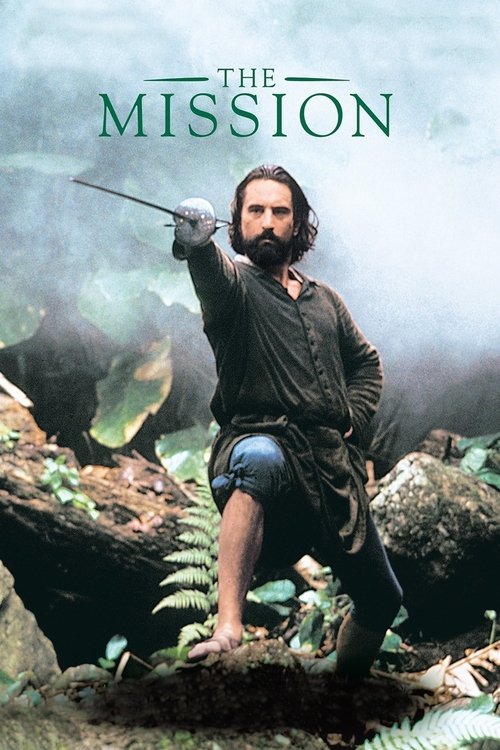
The Mission (1986)
Directed by Roland Joffé
No — The Mission is not especially woke, scoring 33 out of 100 on our wokeness meter.
The Mission arrives from 1986, a British historical drama directed by Roland Joffe, and it carries itself with the unhurried gravity of a cathedral tour.
Consciousness Markers
The film is centrally about the enslavement and massacre of the Guaraní by Spanish and Portuguese colonizers, and condemns the view of natives as 'animals fit only for slavery' — though framed through a religious-humanist rather than modern racial lens.
The film is famously ponderous and didactic, stating its moral points rather than dramatizing them, culminating in Altamirano's explicit thesis line: 'No, thus have we made the world. Thus have I made it.'
The Guaraní are played by some indigenous actors (Bercelio Moya, Sigifredo Ismare) and given substantial screen time, but the leads and moral center remain white European figures, and critics noted the natives are treated as 'mission furniture.'
The film critiques colonial greed, the slave trade, and the commodification of indigenous lives and lands, but its target is colonial exploitation rather than capitalism as such.
A historical drama that takes liberties with the record (Altamirano's role, the Guaraní's swift conversion), but its revisionism is a traditional religious-epic sympathy rather than a modern ideological reframing.
No LGBTQ+ characters or themes appear anywhere in the film.
The few female characters (Carlotta) are incidental plot devices; the film's concerns are entirely clerical, colonial, and martial.
No environmental or climate themes are present.
No body-positivity themes or messaging.
No neurodivergence themes or characters.
Why it received this score
The Mission arrives from 1986, a British historical drama directed by Roland Joffe, and it carries itself with the unhurried gravity of a cathedral tour. Robert De Niro drags his armor through the jungle as a reformed slave hunter. Jeremy Irons plays an oboe at a waterfall and waits to be understood. Between them sits an entire indigenous nation, the Guarani, patient and smiling, waiting to be instructed in the mechanics of European salvation. The film took the Palme d'Or and an Academy Award for cinematography, and it holds the top slot on the Church Times list of religious films. None of this makes it nimble.
The casting earns partial credit. A handful of Guarani roles went to indigenous performers, Bercelio Moya and Sigifredo Ismare among them, and they are granted genuine screen time. The moral center, however, stays firmly in European hands, and the historian James Schofield Saeger judged the natives to be mission furniture: smiling, singing, undifferentiated. The film does condemn the colonizers who call indigenous people animals fit only for slavery, and it lingers on the massacre at the climax. That is a religious humanism older than the current vocabulary, and the racial awareness on display is real but delivered from the pulpit. Colonial greed, the slave trade, and the sale of thirty thousand people for fewer than one peso each all come under fire. The target is exploitation, not the economic machinery that produced it.
The script states its moral points instead of dramatizing them, a habit that moved one New York Times critic to complain about fancy locutions. Cardinal Altamirano eventually says the thesis out loud: no, thus have we made the world, thus have I made it. The historical record is softened here and there, conversion arrives suspiciously fast, native resistance is quietly trimmed, though the impulse is old-fashioned epic sympathy, not ideological reframing. There is no romance beyond a stray fiancee, no environmental lament, no discussion of bodies or brains or capital in the contemporary sense. The film leaves us with a handsome, ponderous sermon about complicity, delivered by men in robes to a congregation that already agrees.
Analysis generated by our Consciousness Algorithm


Synopsis
When a Spanish Jesuit goes into the South American wilderness to build a mission in the hope of converting the Indians of the region, a slave hunter is converted and joins his mission. When Spain sells the colony to Portugal, they are forced to defend all they have built against the Portuguese aggressors.
Questions about The Mission
Is The Mission woke?
No — The Mission is not especially woke, scoring 33 out of 100 on our wokeness meter. That earns it a verdict of Based.
Does The Mission have any woke elements?
4 of the 10 markers register at 30 or above, led by Racial Consciousness (50), Lecture Energy (45) and Representation Casting (35). On Racial Consciousness: The film is centrally about the enslavement and massacre of the Guaraní by Spanish and Portuguese colonizers, and condemns the view of natives as 'animals fit only for slavery' — though framed through a religious-humanist rather than modern racial lens.
How does The Mission compare to other 1986 movies?
It ranks #2 of the 62 films from 1986 we've scored; their average is 7. The wokest is Star Trek IV: The Voyage Home (42).
How is the Woke Score calculated?
An AI-assisted process researches the film and its reception, scores it 0–100 on ten markers, then combines those into one 0–100 Woke Score. It measures a specific set of 2020s cultural themes, not film quality.