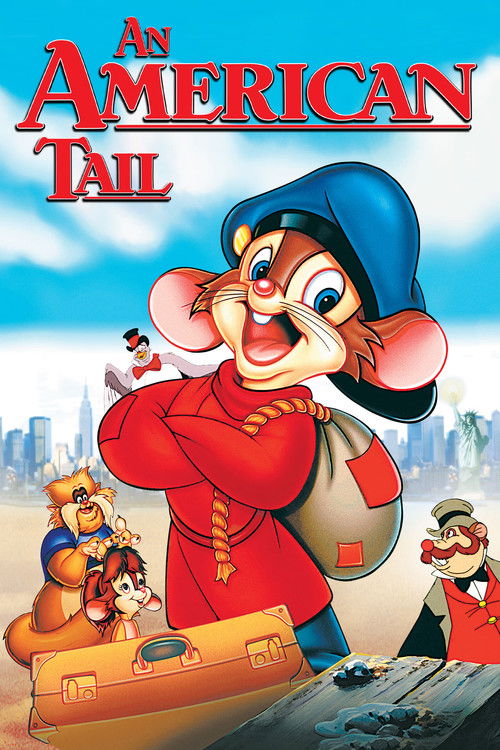
An American Tail (1986)
Directed by Don Bluth
No — An American Tail is not especially woke, scoring 25 out of 100 on our wokeness meter.
Don Bluth's 1986 feature opens in 1885 Shostka with a Hanukkah candle and closes with a winking Statue of Liberty, and in between it commits the unfashionable act of naming its immigrants.
Consciousness Markers
The film directly depicts antisemitic pogroms, immigrant solidarity, and ethnic discrimination against Russian-Jewish, Italian, and Irish mice, making ethnic identity central.
Critiques sweatshop labor, protection rackets, and corrupt machine politics, but these are background elements rather than a central anti-capitalist message.
Voice cast includes actors of Jewish, Italian, and other ethnic backgrounds, and characters are explicitly identified as Russian-Jewish, Italian, Irish, and German immigrants, though not a modern diversity casting effort.
Offers gentle moral lessons about immigration and tolerance, but avoids preachy modern lecture style.
Female characters like Bridget and Gussie show agency and leadership, but the film does not advance a feminist agenda.
No LGBTQ+ characters or themes.
No environmental or climate themes.
No body positivity themes.
No neurodivergence themes.
Historical setting is used for fiction, not to revise historical narratives.
Why it received this score
Don Bluth's 1986 feature opens in 1885 Shostka with a Hanukkah candle and closes with a winking Statue of Liberty, and in between it commits the unfashionable act of naming its immigrants. The Mousekewitzes are Russian-Jewish mice fleeing an antisemitic arson attack. Their fellow travelers are Italian, Irish, and German, identified by accent and surname, and the film treats this ethnic patchwork as the engine of the plot. The cats are not merely predators. They are the Cossacks, the pogrom, and later the protection racket, and the movie never pretends otherwise. Few animated films of the era carried this much ethnic specificity, and fewer still let it drive the story.
The economic argument is present but subordinate. Fievel is sold into a sweatshop. Warren T. Rat extorts the neighborhood for protection he never delivers, assisted by a British cockroach accountant who counts money with visible pleasure. Honest John, a drunk ward heeler modeled on Tammany Hall, cannot help a mouse who has not registered to vote. These are sharp touches, and they sit in the background where they belong, texture instead of thesis.
Elsewhere the ledger runs thin. Bridget and Gussie Mausheimer show nerve and organizational talent, though the film's interest in women begins and ends with competence. There is no LGBTQ presence, no body positivity, no neurodivergence, no climate anxiety, no revision of the historical record. The lessons about tolerance arrive gently, sung by a French pigeon and a fiddle, and they are the lessons of 1986: assimilation as happy ending, America as a promise slightly dented but still standing. Sentimental, sincere, and less preachy than its descendants. The hat fits now. That is the whole sermon.
Analysis generated by our Consciousness Algorithm
Part of


Synopsis
A young mouse named Fievel and his family decide to migrate to America, a "land without cats," at the turn of the 20th century. But somehow, Fievel ends up in the New World alone and must fend off not only the felines he never thought he'd have to deal with again but also the loneliness of being away from home.
Questions about An American Tail
Is An American Tail woke?
No — An American Tail is not especially woke, scoring 25 out of 100 on our wokeness meter. That earns it a verdict of Based.
Does An American Tail have any woke elements?
2 of the 10 markers register at 30 or above, led by Racial Consciousness (55) and Eat the Rich (30). On Racial Consciousness: The film directly depicts antisemitic pogroms, immigrant solidarity, and ethnic discrimination against Russian-Jewish, Italian, and Irish mice, making ethnic identity central.
How does An American Tail compare to other 1986 movies?
It ranks #4 of the 62 films from 1986 we've scored; their average is 7. The wokest is Star Trek IV: The Voyage Home (42).
How is the Woke Score calculated?
An AI-assisted process researches the film and its reception, scores it 0–100 on ten markers, then combines those into one 0–100 Woke Score. It measures a specific set of 2020s cultural themes, not film quality.