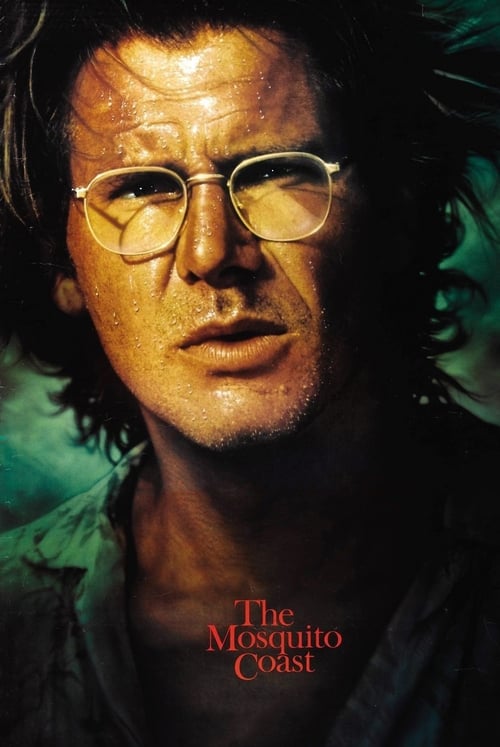
The Mosquito Coast (1986)
Directed by Peter Weir
No — The Mosquito Coast is not woke, scoring 15 out of 100 on our wokeness meter.
Peter Weir's 1986 adaptation of Paul Theroux's novel follows Allie Fox, an inventor who abandons American consumerism for a jungle utopia in Central America and proceeds to convert his family into collateral damage.
Consciousness Markers
Allie Fox explicitly spurns the American Dream, consumerism, and greed, delivering a sustained critique of materialist American life, though the film treats his anti-capitalism as a symptom of his unraveling rather than a program.
Allie delivers speeches about American greed, crime, and impending nuclear war, giving the film a moderate lecturing streak, though it is embedded in character rather than directed at the audience.
The film critiques the destructive patriarchal delusion of its protagonist, but the mother remains largely submissive and the story is a character study of a tyrant rather than a feminist statement.
The cast is overwhelmingly white (Ford, Mirren, Phoenix), with Central American locals and a small Black supporting turn by Butterfly McQueen cast naturally rather than as a diversity statement.
Central American villagers and an indigenous tribe appear, and the missionary Spellgood's cultural destruction is criticized, but the film frames this as a clash of ideals rather than racial consciousness.
The destroyed ice machine poisons the river, an incidental environmental consequence, but the film mounts no climate crusade.
No LGBTQ+ characters, themes, or subtext of any kind appear in the film.
No body positivity themes or messaging are present.
Allie's erratic and aggressive behavior reads as obsession and possible breakdown, not as framed neurodivergence.
The film is a fictional adaptation of a novel and makes no revisionist historical claims.
Why it received this score
Peter Weir's 1986 adaptation of Paul Theroux's novel follows Allie Fox, an inventor who abandons American consumerism for a jungle utopia in Central America and proceeds to convert his family into collateral damage. Harrison Ford plays him with a grin that curdles by degrees. The film is a character study of a tyrant, and it knows it. That self-awareness is the source of its modest cultural conscience, and also the ceiling on it.
The anti-capitalist streak here is genuine and sustained. Allie rails against greed, the American Dream, and the coming nuclear war, and the film lets those sermons land before quietly treating them as symptoms. We are watching a man come apart, not receiving a program. His speeches about greed and crime carry a lecturing charge, though the lecture is aimed at his children and the villagers, not at us. The critique of the missionary Spellgood's cultural demolition registers as a clash of ideals. The mother stays largely submissive, so the indictment of patriarchal delusion never becomes a feminist argument. Local performers appear as locals, cast without ceremony.
Elsewhere the inventory is bare. No queer presence. No body politics. No framing of Allie's volatility as neurodivergence, since obsession and breakdown are not diagnosis. No historical revision, and only an incidental environmental note when the destroyed ice machine poisons the river. This is a pre-2010 film that was not ahead of its time. Ronald Reagan screened it at Camp David, which is its own kind of review. The picture is well made and exhausting, and the classification stands.
Analysis generated by our Consciousness Algorithm


Synopsis
An inventor spurns his city life and moves his family into the jungles of Central America to make a utopia.
Questions about The Mosquito Coast
Is The Mosquito Coast woke?
No — The Mosquito Coast is not woke, scoring 15 out of 100 on our wokeness meter. That earns it a verdict of Ultra Based.
Does The Mosquito Coast have any woke elements?
1 of the 10 markers register at 30 or above, led by Eat the Rich (40). On Eat the Rich: Allie Fox explicitly spurns the American Dream, consumerism, and greed, delivering a sustained critique of materialist American life, though the film treats his anti-capitalism as a symptom of his unraveling rather than a program.
How does The Mosquito Coast compare to other 1986 movies?
It ranks #7 of the 62 films from 1986 we've scored; their average is 7. The wokest is Star Trek IV: The Voyage Home (42).
How is the Woke Score calculated?
An AI-assisted process researches the film and its reception, scores it 0–100 on ten markers, then combines those into one 0–100 Woke Score. It measures a specific set of 2020s cultural themes, not film quality.