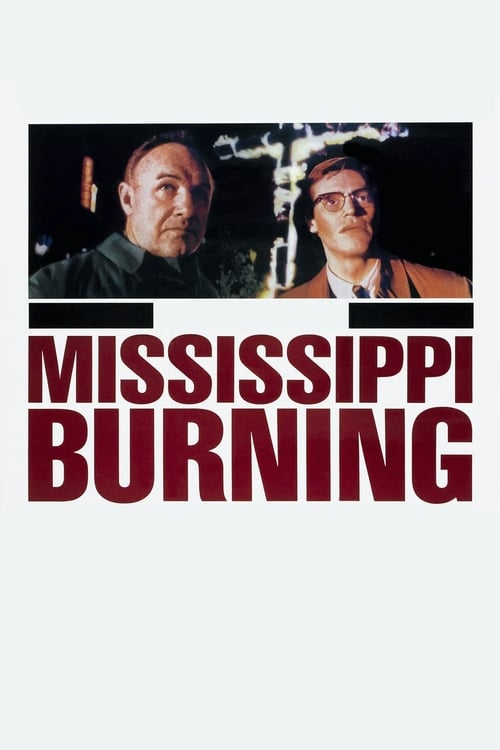
Mississippi Burning (1988)
Directed by Alan Parker
No — Mississippi Burning is not especially woke, scoring 22 out of 100 on our wokeness meter.
Mississippi Burning arrives in 1988 with the weight of real corpses behind it, loosely tracking the 1964 investigation into the murders of Chaney, Goodman, and Schwerner.
Consciousness Markers
The film directly confronts racism, segregation, and KKK violence, but it centers white FBI agents and was criticized for a white-savior narrative that sidelines Black perspectives.
The cast is predominantly white, with Black actors in supporting roles as victims or a single FBI operative; the film was criticized for marginalizing Black activists in favor of white leads.
The film delivers a moral condemnation of racism through dramatic tension rather than direct lecturing, though its historical subject matter carries inherent moral weight.
Frances McDormand's Mrs. Pell is a key female character with agency and a domestic violence arc, but the film does not advance a feminist agenda.
No LGBTQ+ themes or characters are present.
No environmental or climate themes are present.
No critique of capitalism or economic inequality; a business executive is among the Klansmen, but the film does not explore economic structures.
No body positivity themes are present.
No neurodivergence themes are present.
While the film takes liberties with historical events, it does not revise history to fit a modern progressive narrative; its fictionalizations were criticized as centering white saviors.
Why it received this score
Mississippi Burning arrives in 1988 with the weight of real corpses behind it, loosely tracking the 1964 investigation into the murders of Chaney, Goodman, and Schwerner. Alan Parker gives us two FBI men: Dafoe's by-the-book northerner and Hackman's former Mississippi sheriff, a man who knows how the town chews. The film's revulsion at segregation is sincere, and its staging of Klan violence retains its chill. It also arranges that revulsion around two white faces. Black characters arrive as the murdered, the mourned, and in one case a federal operative wheeled out to frighten a mayor in a shack. The conscience is real. The camera's allegiance sits elsewhere.
Frances McDormand's Mrs. Pell is the film's one woman of consequence. She confesses, she is beaten for it, she stays to rebuild the house her husband's friends wrecked. That is a character with a spine, not a thesis. Elsewhere the film prefers pressure to preaching. A staged lynching, a barbershop thrashing, a burning cross on a nervous man's lawn. It condemns racism by dramatizing it, and it never turns to address the audience.
The rest of the ledger is bare. No queer lives. No climate anxiety. No economic reading of the Klansmen, though one of them is a business executive and the film lets that fact sit there unexamined. No body politics, no neurodivergent interiority. The history is bent, as Hollywood history always is, toward cleaner drama and a satisfying indictment, not toward any contemporary political program. This is a handsomely made film about an atrocity that decided the story belonged to the men who arrived after it. That decision drew fire in 1988 for good reason, and it has not aged into wisdom.
Analysis generated by our Consciousness Algorithm


Synopsis
Two FBI agents investigating the murder of civil rights workers during the 60s seek to breach the conspiracy of silence in a small Southern town where segregation divides black and white. The younger agent trained in FBI school runs up against the small town ways of his partner, a former sheriff.
Questions about Mississippi Burning
Is Mississippi Burning woke?
No — Mississippi Burning is not especially woke, scoring 22 out of 100 on our wokeness meter. That earns it a verdict of Based.
Does Mississippi Burning have any woke elements?
1 of the 10 markers register at 30 or above, led by Racial Consciousness (50). On Racial Consciousness: The film directly confronts racism, segregation, and KKK violence, but it centers white FBI agents and was criticized for a white-savior narrative that sidelines Black perspectives.
How does Mississippi Burning compare to other 1988 movies?
It ranks #9 of the 73 films from 1988 we've scored; their average is 10. The wokest is Stand and Deliver (58).
How is the Woke Score calculated?
An AI-assisted process researches the film and its reception, scores it 0–100 on ten markers, then combines those into one 0–100 Woke Score. It measures a specific set of 2020s cultural themes, not film quality.