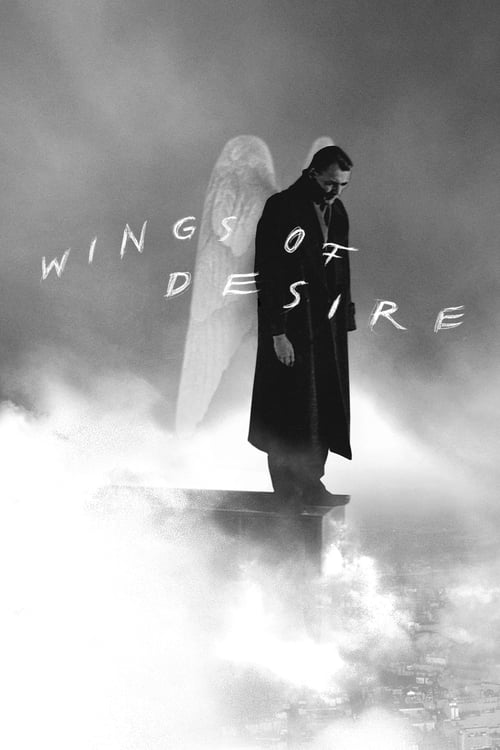
Wings of Desire (1987)
Directed by Wim Wenders
No — Wings of Desire is not woke, scoring 6 out of 100 on our wokeness meter.
Wings of Desire arrives from 1987, a year when an art film could still be about angels, Berlin, and the texture of human longing without a syllabus attached.
Consciousness Markers
The film is philosophical and poetic, with voice-over musings on mortality and childhood, but it never lectures the audience on social justice.
Marion is a self-reliant trapeze artist with an introspective monologue about love and wholeness, but the film is fundamentally a male angel's journey toward her, not a feminist statement.
The cast is almost entirely white European actors, with no diverse casting choices made as a statement or otherwise.
There are no LGBTQ+ characters or themes anywhere in the film.
Race is not a subject or presence in the film's Berlin.
No environmental or climate themes appear.
The circus's closure and the film's melancholy about modernity are atmospheric, not a critique of capitalism.
No body-positivity themes are present.
No neurodivergence themes are present.
The film references Berlin's Nazi past and the Wall, but as historical texture and elegy, not as a revisionist reframing of history.
Why it received this score
Wings of Desire arrives from 1987, a year when an art film could still be about angels, Berlin, and the texture of human longing without a syllabus attached. Wim Wenders gives us Damiel and Cassiel, immortal observers in overcoats, drifting through a divided city in monochrome and listening to the thoughts of strangers. The camera moves like a sigh. The palette is gray, then color when mortality intrudes. It is a beautiful object, and it is almost entirely unconcerned with the questions that occupy our current cultural machinery. The cast is white European, and the film makes no apology or announcement about it. Race does not enter the frame, and neither does the climate, the body, or the spectrum of neurological difference. Berlin here is a city of the soul, not a demographic chart.
Solveig Dommartin's Marion is the closest the film comes to a statement. She is a trapeze artist who lives alone, trains alone, and delivers a monologue about love and wholeness that a contemporary screenwriter might envy. She is self-reliant. She is also, structurally, the destination. The film belongs to Damiel's desire to fall, to bleed, to taste coffee, and Marion exists so that his descent has a landing place. This is a male reverie with a woman at the end of it. Elsewhere, the shuttered circus and the elegiac mood read as nostalgia for a vanishing world, not as an argument about capital. Peter Falk's film-within-the-film about the Nazi past is historical texture, a ghost at the edge of the frame, never a revision of the record.
The film's voice-over muses on childhood, mortality, and the ache of eternity, and it does so without once instructing the audience on how to behave. It trusts us to feel something. That is a rare and slightly antique quality now. We are left with a picture that is philosophical, sentimental, and wholly uninterested in our approval.
Analysis generated by our Consciousness Algorithm


Synopsis
Two angels, Damiel and Cassiel, glide through the streets of Berlin, observing the bustling population, providing invisible rays of hope to the distressed but never interacting with them. When Damiel falls in love with lonely trapeze artist Marion, the angel longs to experience life in the physical world, and finds — with some words of wisdom from actor Peter Falk — that it might be possible for him to take human form.
Questions about Wings of Desire
Is Wings of Desire woke?
No — Wings of Desire is not woke, scoring 6 out of 100 on our wokeness meter. That earns it a verdict of Ultra Based.
Does Wings of Desire have any woke elements?
Very few. None of the 10 markers reaches 30, the level where a marker counts as present; the highest is Lecture Energy at 10.
How does Wings of Desire compare to other 1987 movies?
It ranks #26 of the 59 films from 1987 we've scored; their average is 8. The wokest is Maurice (68).
How is the Woke Score calculated?
An AI-assisted process researches the film and its reception, scores it 0–100 on ten markers, then combines those into one 0–100 Woke Score. It measures a specific set of 2020s cultural themes, not film quality.