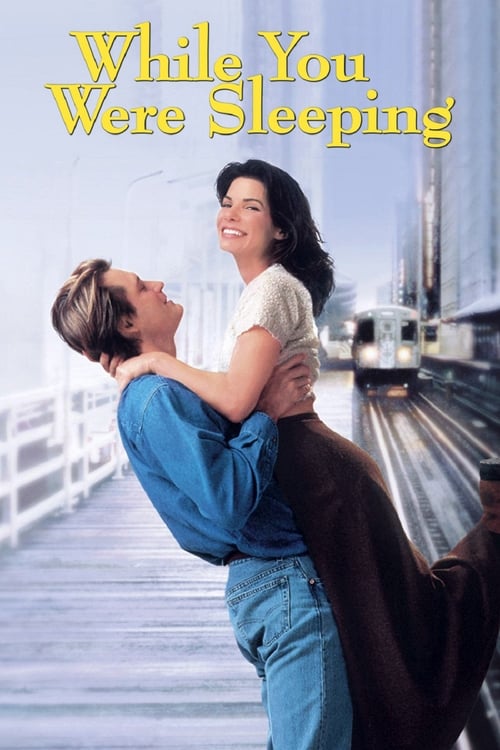
While You Were Sleeping (1995)
Directed by Jon Turteltaub
No — While You Were Sleeping is not woke, scoring 6 out of 100 on our wokeness meter.
While You Were Sleeping arrives from 1995 as a specimen of the conventional romantic comedy in its natural habitat, and it conducts itself with the polite efficiency of a film that knows exactly which buttons it intends to press.
Consciousness Markers
The cast is overwhelmingly white, with one notable Black supporting actor as Lucy's boss; diversity is incidental rather than a deliberate modern representation statement.
Lucy is a working-class female protagonist with romantic agency, but the film is a conventional 1990s romcom rather than a feminist statement.
There are no LGBTQ+ characters, themes, or subtext in the film.
Race is not a subject of the film, and no racial consciousness or commentary is present.
The film has no environmental or climate-related themes.
Jack's preference for making his own furniture over inheriting the family business is personal fulfillment, not an anti-capitalist critique.
The film does not engage with body positivity or related themes.
There is no exploration or representation of neurodivergence.
The film is a contemporary romantic comedy with no historical revisionism.
The film is a warm romantic comedy and does not lecture the audience on social or political issues.
Why it received this score
While You Were Sleeping arrives from 1995 as a specimen of the conventional romantic comedy in its natural habitat, and it conducts itself with the polite efficiency of a film that knows exactly which buttons it intends to press. Sandra Bullock's Lucy is a transit worker with a lonely apartment and a fantasy life, and the plot asks her to impersonate a fiancee for a family that is warm, eccentric, and overwhelmingly white. A single Black supporting figure, Lucy's boss, passes through the film with the functional brevity of a man who has been issued a desk and a handful of dry lines. This is not a modern representation statement. It is casting as furniture arrangement.
The film has no interest in LGBTQ+ lives, racial consciousness, climate, body positivity, neurodivergence, or historical revisionism. None of these absences is a scandal; the film is a Christmas-adjacent Chicago romance about a coma, a token booth, and a family that mistakes kindness for engagement. Jack's desire to build his own furniture instead of inheriting the family business is treated as a young man's search for selfhood, not as a critique of capital. Lucy has romantic agency and a job, and the film grants her a measure of dignity, but this is the ordinary arithmetic of a 1990s studio romance, not a feminist thesis.
The film also declines to lecture. It wants us to feel warmly about snow globes, hospital corridors, and the Callaghans' cluttered living room. Its social consciousness is the soft-focus kind, the sort that believes loneliness is cured by a large family and a last-minute proposal in a token booth. As a piece of cultural classification, it is nearly blank: amiable, well-made, and content to be liked. We are left with a film that does not push an agenda so much as it arranges a modest bouquet of familiar comforts. The bouquet is pleasant. The vase is white.
Analysis generated by our Consciousness Algorithm


Synopsis
A transit worker pulls commuter Peter off railway tracks after he's mugged, but—while he's in a coma—his family mistakenly thinks she's Peter's fiancée, and she doesn't correct them. Things get more complicated when she falls for his brother, who's not quite sure that she's who she claims to be.
Questions about While You Were Sleeping
Is While You Were Sleeping woke?
No — While You Were Sleeping is not woke, scoring 6 out of 100 on our wokeness meter. That earns it a verdict of Ultra Based.
Does While You Were Sleeping have any woke elements?
Very few. None of the 10 markers reaches 30, the level where a marker counts as present; the highest is Feminist Agenda at 10.
How does While You Were Sleeping compare to other 1995 movies?
It ranks #60 of the 108 films from 1995 we've scored; their average is 12. The wokest is Total Eclipse (60).
How is the Woke Score calculated?
An AI-assisted process researches the film and its reception, scores it 0–100 on ten markers, then combines those into one 0–100 Woke Score. It measures a specific set of 2020s cultural themes, not film quality.