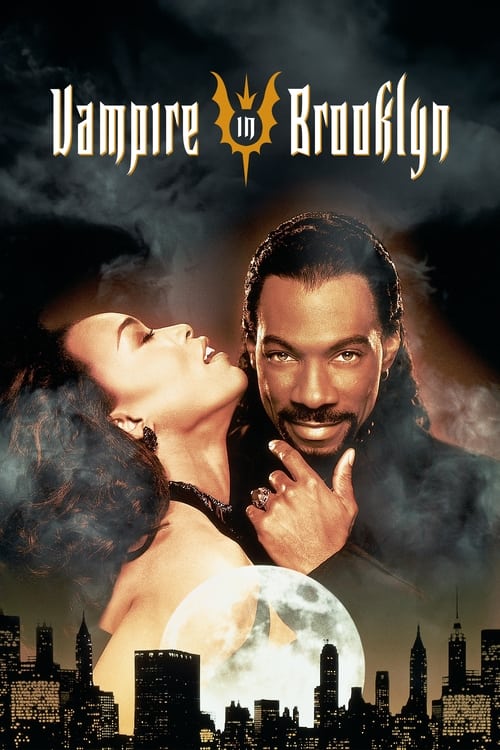
Vampire in Brooklyn (1995)
Directed by Wes Craven
No — Vampire in Brooklyn is not woke, scoring 13 out of 100 on our wokeness meter.
Vampire in Brooklyn arrived in 1995 as the final entry in Eddie Murphy's exclusive Paramount contract, a document that had previously produced 48 Hrs.
Consciousness Markers
Led by Eddie Murphy and Angela Bassett with a predominantly Black principal cast, including a Black vampire and Black police detective, though the film treats this as commercial casting rather than a representational statement.
Angela Bassett's Rita is a capable detective and ultimately rejects vampiric submission to kill the male antagonist, but the film frames this as genre convention rather than feminist argument.
The film is culturally specific as an African American vampire comedy set in Brooklyn, but it does not interrogate race, racism, or Black identity in any substantive way.
No LGBTQ+ characters, themes, or subtext.
No environmental or climate-related themes.
No critique of capitalism, wealth, or class hierarchy.
No body-positive messaging or body-diversity themes.
Rita's visions and her mother's mental illness are treated as supernatural/tragic plot devices, not as neurodivergent representation or advocacy.
No historical revisionism or reimagining of real events.
A horror-comedy vehicle with no preachy or didactic social messaging.
Why it received this score
Vampire in Brooklyn arrived in 1995 as the final entry in Eddie Murphy's exclusive Paramount contract, a document that had previously produced 48 Hrs. and the Beverly Hills Cop franchise. Wes Craven was brought aboard to direct, and what followed was a production caught between three competing appetites: the studio wanted Axel Foley with fangs, Murphy wanted a Shakespearean dramatic debut, and Craven wanted something closer to The Serpent and the Rainbow. The result is a horror comedy that never settles on a register, though it has settled into a cult afterlife, which is more than most contractual obligations manage.
The film is led by Murphy and Angela Bassett, with a Black principal cast that includes a Black vampire, a Black detective, and a Brooklyn that is culturally specific without being culturally argumentative. Bassett's Rita Veder is competent, haunted, and ultimately the one who drives a stake through the male antagonist, refusing the vampiric inheritance he offers. That reads as genre convention, not thesis. The film has no interest in interrogating race, no interest in the politics of its own casting, and no interest in anything resembling a message. Rita's visions and her mother's madness function as supernatural plot mechanics, not as advocacy for any diagnosis.
For a film with so much on its mind about nothing, the ledger is remarkably clean. There is no environmental sermon, no class warfare, no body-diverse casting, no LGBTQ subtext, no revisionist history, no lecture. The most radical gesture here is letting Eddie Murphy play three roles under heavy makeup and then get impaled. It is a strange, uneven, occasionally charming vampire picture, and it asks nothing of the audience beyond ninety minutes of patience and a tolerance for tonal drift. The classification is straightforward: this is a studio vehicle with fangs, and the fangs are decorative.
Thematic tags: none apply. The film is not a sequel, remake, adaptation, superhero entry, Oscar winner, true story, or domestic box office champion. It is a curiosity, and it is filed accordingly.
Analysis generated by our Consciousness Algorithm
Part of


Synopsis
Detective Rita Veder is assigned to a baffling serial murder case. After examining the crime scene — a corpse-filled ship found adrift at sea — she meets Maximilian, a smooth-talking Caribbean playboy determined to romance her.
Questions about Vampire in Brooklyn
Is Vampire in Brooklyn woke?
No — Vampire in Brooklyn is not woke, scoring 13 out of 100 on our wokeness meter. That earns it a verdict of Ultra Based.
Does Vampire in Brooklyn have any woke elements?
1 of the 10 markers register at 30 or above, led by Representation Casting (45). On Representation Casting: Led by Eddie Murphy and Angela Bassett with a predominantly Black principal cast, including a Black vampire and Black police detective, though the film treats this as commercial casting rather than a representational statement.
How does Vampire in Brooklyn compare to other 1995 movies?
It ranks #31 of the 108 films from 1995 we've scored; their average is 12. The wokest is Total Eclipse (60).
How is the Woke Score calculated?
An AI-assisted process researches the film and its reception, scores it 0–100 on ten markers, then combines those into one 0–100 Woke Score. It measures a specific set of 2020s cultural themes, not film quality.