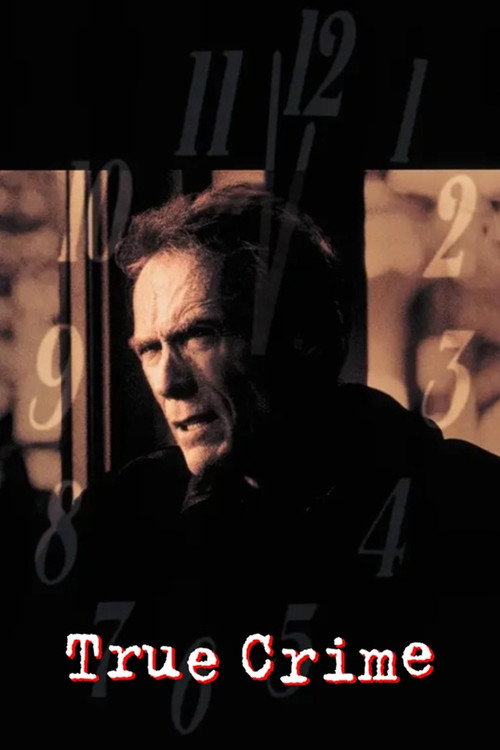
True Crime (1999)
Directed by Clint Eastwood
No — True Crime is not woke, scoring 13 out of 100 on our wokeness meter.
The late nineties were a generous time for the socially minded studio thriller, and Clint Eastwood's True Crime arrives with a conscience tucked inside its trench coat.
Consciousness Markers
Isaiah Washington and LisaGay Hamilton carry significant, dignified roles as the wrongly convicted Frank Beechum and his wife, but the film remains anchored by Eastwood's white protagonist, so representation is present without being a driving thesis.
The condemned man is African American and his grandmother notes the press's indifference to the death of a poor black youth, gesturing at racial inequity in the justice system, though the film never explicitly thematizes race.
The death-penalty message is present but delivered through a conventional ticking-clock thriller rather than explicit moralizing monologues.
A female district attorney and a few women in the newsroom exist in the story, but none of them advance any feminist argument or critique of patriarchy.
The film critiques the death penalty and a cynical newsroom, but frames these as moral and institutional failures rather than economic class warfare.
No LGBTQ+ characters, subtext, or themes appear anywhere in the film.
No environmental or climate themes whatsoever.
No body-positive themes or messaging.
Everett's alcoholism is a character flaw in a redemption arc, not framed as neurodivergence.
No historical re-narration or revisionist reframing of past events.
Why it received this score
The late nineties were a generous time for the socially minded studio thriller, and Clint Eastwood's True Crime arrives with a conscience tucked inside its trench coat. It treats the condemned Frank Beechum with genuine dignity, and Isaiah Washington and LisaGay Hamilton supply a quiet moral center. Yet the camera belongs to Eastwood's Steve Everett, a white savior with a notebook, so representation is present without becoming the organizing principle. The film notices that a poor black man sits on death row while the press chases other stories. Angela Russel's rebuke about the indifference to her grandson's death lands with force. It is a gesture toward racial inequity, not a sustained argument about it.
Elsewhere the film's progressive instincts are modest. A female district attorney and a few women in the newsroom occupy professional space, but the story never examines patriarchy or grants them interiority enough to turn their presence into a thesis. The death penalty is clearly the villain, and the newsroom is depicted as cynical and careerist, but the critique remains moral and institutional. Nobody is organizing a rent strike. The film's anger is aimed at a flawed justice system and a ratings-driven press, not at capital itself. There is no environmental sermon, no body-positive rejoicing, no neurodivergent framing of Everett's alcoholism, and no attempt to revise the historical record. His drinking is a flaw in a redemption arc, nothing more.
As a message delivery system, True Crime is surprisingly restrained. The ticking-clock structure keeps the sermonizing at bay, and the film prefers a chase to a lecture. That restraint may be its most admirable quality. It wants us to feel the horror of executing an innocent man, and it mostly does, even if the machinery is creaky and the ending arrives with the subtlety of a governor's phone call. The result is a film with a social conscience that predates the more strident cultural vocabulary of later decades. It is earnest, slightly musty, and never quite as urgent as it believes itself to be. A respectable vintage, if not a bold one.
Analysis generated by our Consciousness Algorithm
Part of


Synopsis
Boozer, skirt chaser, careless father. You could create your own list of reporter Steve Everett's faults but there's no time. A San Quentin Death Row prisoner is slated to die at midnight – a man Everett has suddenly realized is innocent.
Questions about True Crime
Is True Crime woke?
No — True Crime is not woke, scoring 13 out of 100 on our wokeness meter. That earns it a verdict of Ultra Based.
Does True Crime have any woke elements?
1 of the 10 markers register at 30 or above, led by Representation Casting (30). On Representation Casting: Isaiah Washington and LisaGay Hamilton carry significant, dignified roles as the wrongly convicted Frank Beechum and his wife, but the film remains anchored by Eastwood's white protagonist, so representation is present without being a driving thesis.
How does True Crime compare to other 1999 movies?
It ranks #36 of the 103 films from 1999 we've scored; their average is 14. The wokest is Boys Don't Cry (60).
How is the Woke Score calculated?
An AI-assisted process researches the film and its reception, scores it 0–100 on ten markers, then combines those into one 0–100 Woke Score. It measures a specific set of 2020s cultural themes, not film quality.