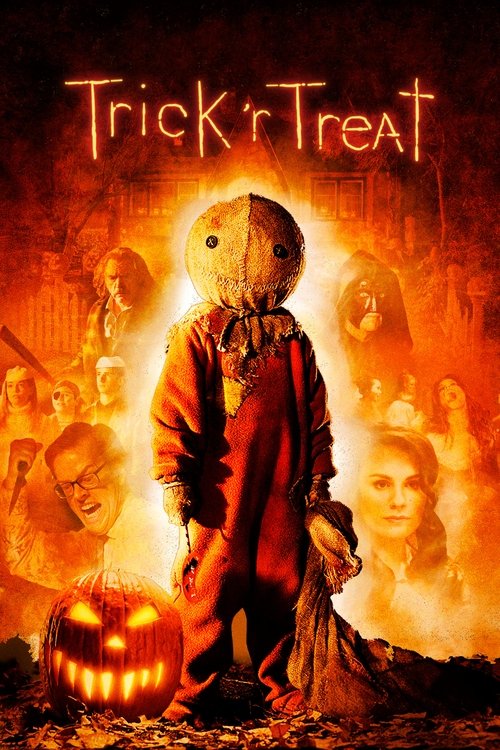
Trick 'r Treat (2007)
Directed by Michael Dougherty
No — Trick 'r Treat is not woke, scoring 10 out of 100 on our wokeness meter.
Trick 'r Treat arrives as a relic from a more innocent era of horror, which is to say 2007, when a filmmaker could assemble four interlocking stories about poisoned candy, drowned children, and werewolves without anyone demanding a thesis statement.
Consciousness Markers
The cast is modestly diverse (Rochelle Aytes, Tahmoh Penikett) but the film makes zero comment on race or identity; characters simply exist as horror archetypes without any representational framing.
The 'Surprise Party' segment has women transforming into predators who slaughter their male dates, and Laurie's 'first kill' subverts the virgin trope, but this is generic horror role-reversal rather than a feminist thesis.
The only didacticism on offer is Sam enforcing the 'rules of Halloween' — respecting jack-o'-lanterns and handing out candy — which is folklore policing, not social instruction.
There are no LGBTQ+ characters, themes, subtext, or relationships anywhere in the four interwoven stories.
No engagement with racial consciousness or racial justice themes; the film is entirely occupied with Halloween tradition violations.
No environmental or climate themes whatsoever.
No critique of capitalism, class, or wealth; the antagonists are a serial killer, undead children, and a holiday demon, not economic structures.
No body-positive messaging; bodies are dismembered, devoured, and displayed as ghoulish props.
The 'mentally disabled children' of the School Bus Massacre are depicted as pitiable victims of a disposal plot, not as an affirmative or advocacy-oriented portrayal of neurodivergence.
The film is a genre anthology with no historical narrative to revise or reinterpret.
Why it received this score
Trick 'r Treat arrives as a relic from a more innocent era of horror, which is to say 2007, when a filmmaker could assemble four interlocking stories about poisoned candy, drowned children, and werewolves without anyone demanding a thesis statement. Michael Dougherty's anthology concerns itself almost entirely with the enforcement of Halloween etiquette, a subject carrying no discernible social freight. Sam, the burlap-sacked enforcer in orange footie pajamas, punishes those who blow out jack-o'-lanterns early or withhold candy from strangers. This is folklore policing, not moral instruction, and the film seems content to leave it there.
The cast includes a few performers of color, who drift through the proceedings as serial killers, werewolves, and assorted victims without the screenplay ever acknowledging them as anything but horror archetypes. There is no romantic or thematic space for anyone outside a conventional heterosexual arrangement. The werewolf segment, in which a group of women shed their skin and devour their male dates, offers a flicker of inversion, though it reads as genre mechanics more than argument. Bodies here are dismembered, devoured, and arranged as decoration, which is to say the film holds no position on bodily acceptance beyond the position that bodies make excellent props for mayhem.
A segment invokes institutional cruelty toward disabled children, then uses them as lake-dwelling zombies, a choice that resists any affirmative reading. The film has no interest in climate, capital, or the reinterpretation of history. The remainder is a tight, playful tribute to seasonal dread, competently assembled and entirely unconcerned with the cultural questions of a decade it did not live to see. We classify it accordingly, with the mild respect owed to any artifact that knows precisely what it is.
Analysis generated by our Consciousness Algorithm
Part of


Synopsis
Four interwoven stories that occur on Halloween: an everyday high school principal has a secret life as a serial killer; a college virgin might have just met the one guy for her; a group of teenagers pull a mean prank, and a bitter old recluse receives an uninvited guest.
Questions about Trick 'r Treat
Is Trick 'r Treat woke?
No — Trick 'r Treat is not woke, scoring 10 out of 100 on our wokeness meter. That earns it a verdict of Ultra Based.
Does Trick 'r Treat have any woke elements?
Very few. None of the 10 markers reaches 30, the level where a marker counts as present; the highest is Representation Casting at 18.
How does Trick 'r Treat compare to other 2007 movies?
It ranks #80 of the 201 films from 2007 we've scored; their average is 12. The wokest is Like Stars on Earth (92).
How is the Woke Score calculated?
An AI-assisted process researches the film and its reception, scores it 0–100 on ten markers, then combines those into one 0–100 Woke Score. It measures a specific set of 2020s cultural themes, not film quality.