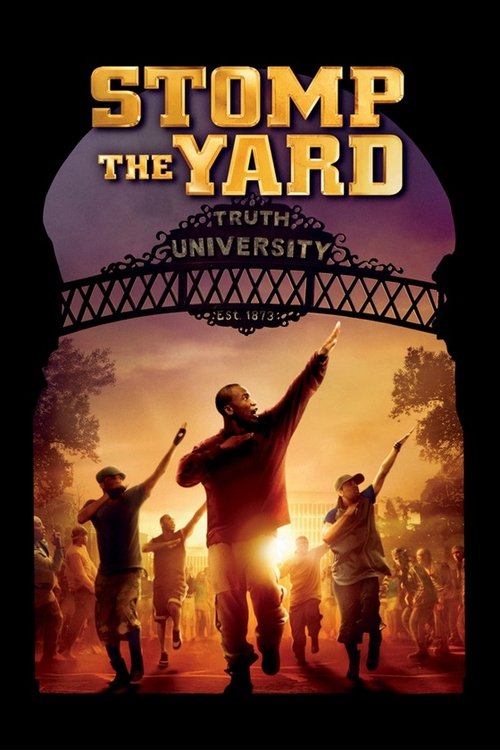
Stomp the Yard (2007)
Directed by Sylvain White
Partly — Stomp the Yard is somewhat woke, scoring 51 out of 100 on our wokeness meter.
Stomp the Yard arrived in 2007 with a modest budget, a fictional university, and a dance competition, and it departed with the number one spot at the domestic box office.
Consciousness Markers
The film explicitly celebrates Black Greek-letter organizations, HBCU heritage, and African-American historical figures, making racial identity and institutional pride central themes.
Features a predominantly Black cast and centers on an HBCU and Black Greek life, though this is intrinsic to the story rather than a modern diversity mandate.
Includes didactic moments explaining the significance of Black fraternities and Heritage Hall, but these are brief and not preachy about social justice.
No LGBTQ+ characters or themes are present.
Female characters are primarily romantic interests; no feminist agenda or gender-equity themes are developed.
No environmental or climate-related themes.
No critique of capitalism or wealth inequality; the narrative focuses on dance competition and personal redemption.
No body-positivity themes or diverse body representation as a message.
No neurodivergent characters or themes.
Presents a fictional HBCU and fraternities, but does not revise or reinterpret historical events.
Why it received this score
Stomp the Yard arrived in 2007 with a modest budget, a fictional university, and a dance competition, and it departed with the number one spot at the domestic box office. The plot concerns DJ Williams, a Los Angeles street dancer who loses his brother to gunfire, avoids juvenile detention, and lands at Truth University in Atlanta, where two fraternities court his feet. The film is a sports movie with step routines in place of free throws, and it executes that formula with professional indifference. Critics were unmoved. Audiences were not.
Where the film does carry weight is in its treatment of Black Greek life and the institutional memory of the historically Black college. Heritage Hall, the wall of distinguished alumni, the conversations about what these organizations have meant to African-American achievement: these sit at the center of the story and are handled with reverence. The film pauses to explain the significance of the fraternities, and those pauses are brief and rooted in character, so the sermonizing never overtakes the dancing. The cast is almost entirely Black, and the setting is authentic in its details, though the film treats this as the world it inhabits instead of a statement about casting.
The remaining cultural ledger comes up empty, and the film seems untroubled by the omission. Its women exist to be won. Its concerns are personal, not structural: no reckoning with wealth, no environmental conscience, no interest in bodies outside the conventional, no neurodivergent presence, no revision of the historical record. The story is invented and stays invented. What remains is a serviceable dance drama with a strong sense of institutional pride and a weak sense of everything else. It knows exactly what it is, and it is content with that.
Analysis generated by our Consciousness Algorithm


Synopsis
After the death of his younger brother, a troubled 19-year-old street dancer from Los Angeles is able to bypass juvenile hall by enrolling in the historically black, Truth University in Atlanta, Georgia. But his efforts to get an education and woo the girl he likes are sidelined when he is courted by the top two campus fraternities, both of which want and need his fierce street-style dance moves to win the highly coveted national step show competition.
Questions about Stomp the Yard
Is Stomp the Yard woke?
Partly — Stomp the Yard is somewhat woke, scoring 51 out of 100 on our wokeness meter. That earns it a verdict of Woke-Adjacent.
What makes Stomp the Yard woke?
2 of the 10 markers register at 30 or above, led by Racial Consciousness (75) and Representation Casting (65). On Racial Consciousness: The film explicitly celebrates Black Greek-letter organizations, HBCU heritage, and African-American historical figures, making racial identity and institutional pride central themes.
How does Stomp the Yard compare to other 2007 movies?
It ranks #7 of the 201 films from 2007 we've scored; their average is 12. The wokest is Like Stars on Earth (92).
How is the Woke Score calculated?
An AI-assisted process researches the film and its reception, scores it 0–100 on ten markers, then combines those into one 0–100 Woke Score. It measures a specific set of 2020s cultural themes, not film quality.