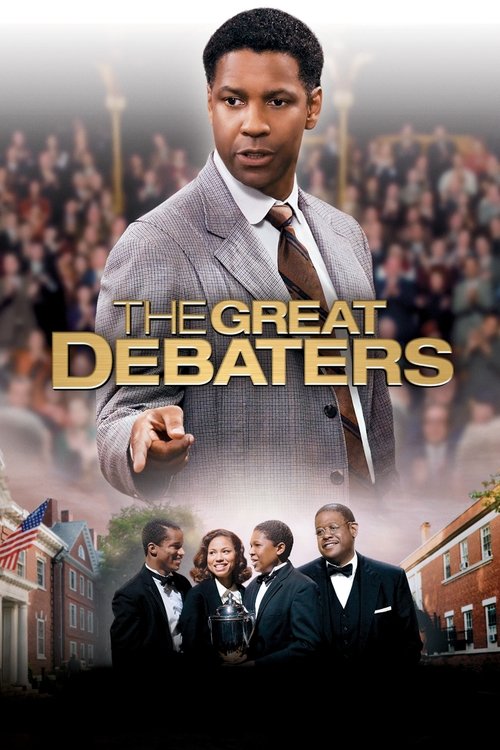
The Great Debaters (2007)
Directed by Denzel Washington
Yes — The Great Debaters is woke, scoring 60 out of 100 on our wokeness meter.
The Great Debaters arrives from 2007, a period piece about the Wiley College debate team in 1935 Texas.
Consciousness Markers
The film directly addresses racism, Jim Crow laws, lynchings, and white supremacy in 1930s Texas, making racial consciousness a central theme.
The film features a predominantly Black cast and centers on a historically Black college, reflecting the story's inherent demographics, but not necessarily a modern diversity casting initiative.
The film features debate scenes and speeches about justice and equality, delivering its inspirational message with some didactic energy.
The film takes historical liberties, such as changing the debate opponent from USC to Harvard, but its core narrative of Black achievement is rooted in true events.
A female character, Samantha Booke, is a member of the debate team and faces sexism, but the film's primary focus is racial struggle rather than a feminist agenda.
There are no LGBTQ+ themes or characters in the film.
No climate change or environmental themes are present.
The film does not critique capitalism or economic inequality.
No body positivity themes are present.
No neurodivergence themes are present.
Why it received this score
The Great Debaters arrives from 2007, a period piece about the Wiley College debate team in 1935 Texas. Denzel Washington directs with sober craftsmanship. It is an inspirational historical drama. Its social consciousness is not decorative; racism is the engine. Jim Crow, lynchings, white supremacy. The cast is predominantly Black, and the HBCU setting is intrinsic. But this is not a modern diversity exercise. It is simply the story's demographic truth. The representation is organic, not engineered.
The film has a mild feminist thread through Samantha Booke, the lone woman on the team, who endures sexism. But the movie treats this as one more obstacle in a racial struggle, not a parallel crusade. The historical record gets a gentle massage: Wiley debated USC, not Harvard. That upgrade serves dramatic symmetry. Otherwise, the film avoids contemporary hobbyhorses. No LGBTQ subplot. No climate sermon. No anti-capitalist rage. No body positivity arc. No neurodivergence. These absences are not flaws, just evidence of a narrower cultural moment.
Where the film leans into lecture energy, it does so through debate speeches and uplift. The film's central axiom, an unjust law is no law at all, lands with intended gravity. The film wants us to feel noble about eloquence and education. It is preachy in the way award-season prestige dramas often are, but the preaching is about racial justice and personal discipline, not the modern intersectional checklist. The result is a respectable, somewhat safe film. It plays the facts for inspiration and mostly gets away with it. We classify it as a product of its era: earnest, racial-conscious, mildly feminist, historically flexible, and otherwise content to let the 1930s speak for themselves. It is not a radical text. It is a well-tailored history lesson with a good cast.
Analysis generated by our Consciousness Algorithm


Synopsis
The true story of a brilliant but politically radical debate team coach who uses the power of words to transform a group of underdog African-American college students into a historical powerhouse that took on the Harvard elite.
Questions about The Great Debaters
Is The Great Debaters woke?
Yes — The Great Debaters is woke, scoring 60 out of 100 on our wokeness meter. That earns it a verdict of Woke.
What makes The Great Debaters woke?
4 of the 10 markers register at 30 or above, led by Racial Consciousness (80), Representation Casting (65) and Lecture Energy (50). On Racial Consciousness: The film directly addresses racism, Jim Crow laws, lynchings, and white supremacy in 1930s Texas, making racial consciousness a central theme.
How does The Great Debaters compare to other 2007 movies?
It ranks #4 of the 201 films from 2007 we've scored; their average is 12. The wokest is Like Stars on Earth (92).
How is the Woke Score calculated?
An AI-assisted process researches the film and its reception, scores it 0–100 on ten markers, then combines those into one 0–100 Woke Score. It measures a specific set of 2020s cultural themes, not film quality.