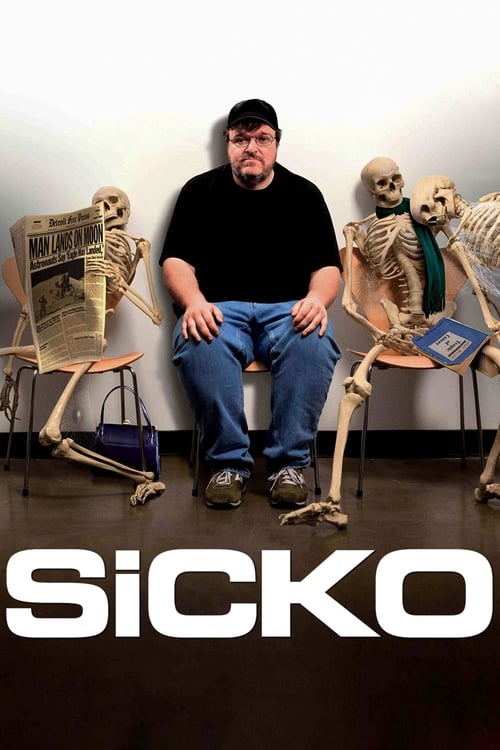
Sicko (2007)
Directed by Michael Moore
Yes — Sicko is woke, scoring 61 out of 100 on our wokeness meter.
Sicko arrives from 2007, a year when Michael Moore could still command a multiplex and a Capitol Hill press conference in the same week.
Consciousness Markers
The film explicitly attacks the for-profit healthcare industry, arguing that insurance companies deny care to maximize profits, and advocates for non-profit universal healthcare.
Michael Moore's direct advocacy, narration, and call to action make the film highly didactic and lecture-driven.
The film presents a counter-narrative of U.S. healthcare history, exposing corporate influence and suppressed facts, but it is primarily contemporary investigative journalism rather than a historical revision.
Documentary subjects are real people, not a casting decision; no deliberate inclusive casting agenda is present.
No LGBTQ+ themes or characters are present.
The film mentions Hillary Clinton's healthcare reform efforts and a women's suffrage analogy, but does not advance a feminist agenda.
The film does not address racial disparities or racial justice themes.
No climate or environmental themes.
No body positivity themes.
PTSD is mentioned among 9/11 rescue workers, but neurodivergence as a social identity is not a theme.
Why it received this score
Sicko arrives from 2007, a year when Michael Moore could still command a multiplex and a Capitol Hill press conference in the same week. The subject is American health insurance, which the film treats as a machine for converting denied claims into shareholder value. Moore tours Canada, the United Kingdom, France and Cuba, collecting testimony from people whose coverage evaporated at the moment they needed it, and contrasts those systems with the wreckage at home. The argument is not subtle. It is not meant to be. The film's economic position is unambiguous: profit and care are incompatible, and the insurance industry has chosen profit every time.
The lecture energy here is total. Moore narrates, editorializes, ambushes, and finally sails three speedboats toward Guantanamo Bay with a megaphone to demand that 9/11 rescue workers receive the same treatment as detainees. When that fails, he takes them to Havana, where they are treated for free and honored by a fire station. He closes by walking toward the Capitol with a basket of laundry, offering to let the government do his washing until the sick receive care. The film ends as it began: as an argument, delivered at volume, with the audience expected to nod.
Elsewhere the ledger is quiet. The documentary subjects are real people, not a casting statement, and their stories are told through the lens of class and profit, not race, gender, or identity. There is no environmental thread, no body politics, no attention to neurodivergence as a social category. The history it excavates, the Nixon tape, the Reagan record for the American Medical Association, the collapse of the Clinton reform effort and its aftermath, functions as a counter-narrative, though the film is chiefly contemporary advocacy with a long memory. It remains a potent artifact of a specific moment, and a reminder that a documentary can be persuasive and exhausting in equal measure.
Analysis generated by our Consciousness Algorithm


Synopsis
A documentary about the corrupt health care system in The United States whose main goal is to make profit even if it means losing people’s lives. "The more people you deny health insurance, the more money we make" is the business model for health care providers in America.
Questions about Sicko
Is Sicko woke?
Yes — Sicko is woke, scoring 61 out of 100 on our wokeness meter. That earns it a verdict of Woke.
What makes Sicko woke?
2 of the 10 markers register at 30 or above, led by Eat the Rich (90) and Lecture Energy (90). On Eat the Rich: The film explicitly attacks the for-profit healthcare industry, arguing that insurance companies deny care to maximize profits, and advocates for non-profit universal healthcare.
How does Sicko compare to other 2007 movies?
It ranks #3 of the 201 films from 2007 we've scored; their average is 12. The wokest is Like Stars on Earth (92).
How is the Woke Score calculated?
An AI-assisted process researches the film and its reception, scores it 0–100 on ten markers, then combines those into one 0–100 Woke Score. It measures a specific set of 2020s cultural themes, not film quality.