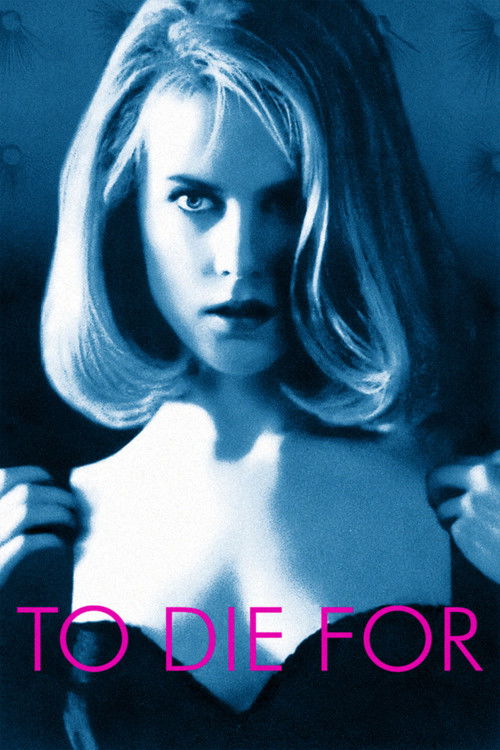
To Die For (1995)
Directed by Gus Van Sant
No — To Die For is not woke, scoring 3 out of 100 on our wokeness meter.
Gus Van Sant's To Die For arrives from 1995, a black comedy about a New Hampshire weather girl who arranges her husband's murder and then enjoys the coverage.
Consciousness Markers
The film satirizes tabloid media and celebrity obsession, which brushes against media-capitalism critique, but it never frames an eat-the-rich economic argument.
The cast is largely white and assembled for talent rather than representational quotas; Italian-American characters and teen delinquents exist organically without commentary.
Suzanne Stone is a satirical monster whose ambition is skewered rather than valorized; the film's femme-fatale framing is a critique of narcissism, not a feminist manifesto.
Van Sant and Buck Henry deliver acid satire rather than sermons; the film trusts the audience to draw conclusions without moralizing direct address.
Italian-American mafia undertones and a small-town New Hampshire setting provide faint cultural texture, but race is never a thematic concern.
No LGBTQ+ characters or themes appear in the narrative, despite director Gus Van Sant's own identity.
No environmental themes whatsoever; the frozen lake is a venue for murder, not a climate statement.
No body-positive themes; the film is indifferent to body image as a subject.
Suzanne's narcissistic and antisocial traits are treated as villainous pathology, not as neurodivergence to be celebrated or destigmatized.
Loose adaptation of the Pamela Smart case, but it dramatizes rather than revises historical record or reframes established narratives for ideological ends.
Why it received this score
Gus Van Sant's To Die For arrives from 1995, a black comedy about a New Hampshire weather girl who arranges her husband's murder and then enjoys the coverage. Nicole Kidman plays Suzanne Stone with a bright, terrible vacancy, and the film surrounds her with mockumentary interviews and direct-to-camera confessions. It is a cold piece of work, and it knows it.
Our classification apparatus finds little to occupy itself here. The cast is white and chosen for aptitude. Suzanne is a narcissist rendered as a monster, not a heroine, so the femme fatale machinery critiques vanity instead of advancing a program. Race appears only as faint Italian-American texture around the Maretto family restaurant and its implied mafia obligations. There is no environmental concern, no body-image discourse, no neurological reframing of Suzanne's antisocial instincts, and no revision of the Pamela Smart record beyond dramatization. The film does glance at media capitalism: tabloid cameras, the Laura Show, a weather girl commodified into a headline. But it never reaches for an economic thesis. It settles for showing us the appetite.
Where the film could sermonize, it declines. Buck Henry's script trusts the audience to notice that Suzanne belongs on camera and that this is the problem. Van Sant lets Joaquin Phoenix stand still and register hurt, and lets Illeana Douglas skate over a frozen lake in the final shot without underlining the irony. The result is mean, funny, and unusually clean of instruction. Almost thirty years on, its restraint reads as a period detail.
Analysis generated by our Consciousness Algorithm


Synopsis
Suzanne Stone wants to be a world-famous news anchor and she is willing to do anything to get what she wants. What she lacks in intelligence, she makes up for in cold determination and diabolical wiles. As she pursues her goal with relentless focus, she is forced to destroy anything and anyone that may stand in her way, regardless of the ultimate cost or means necessary.
Questions about To Die For
Is To Die For woke?
No — To Die For is not woke, scoring 3 out of 100 on our wokeness meter. That earns it a verdict of Ultra Based.
Does To Die For have any woke elements?
Very few. None of the 10 markers reaches 30, the level where a marker counts as present; the highest is Eat the Rich at 15.
How does To Die For compare to other 1995 movies?
It ranks #94 of the 108 films from 1995 we've scored; their average is 12. The wokest is Total Eclipse (60).
How is the Woke Score calculated?
An AI-assisted process researches the film and its reception, scores it 0–100 on ten markers, then combines those into one 0–100 Woke Score. It measures a specific set of 2020s cultural themes, not film quality.