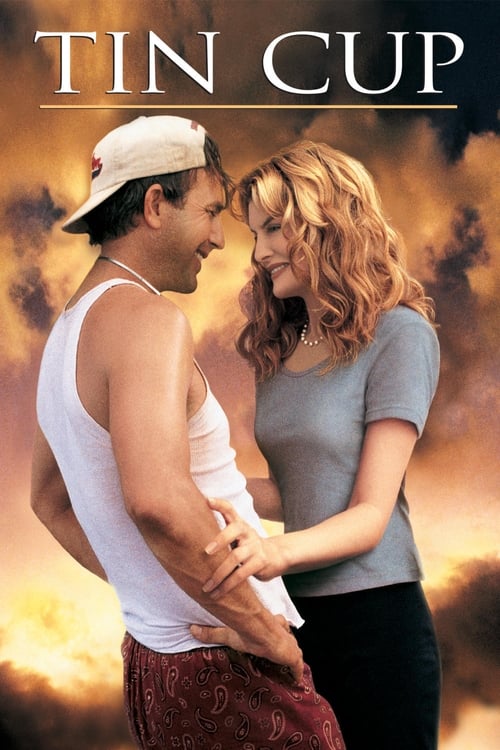
Tin Cup (1996)
Directed by Ron Shelton
No — Tin Cup is not woke, scoring 4 out of 100 on our wokeness meter.
Tin Cup arrives from 1996 with the easy confidence of a sports comedy that knows exactly what it is: a likable vehicle for Kevin Costner's grin, a romantic triangle on a golf course, and a final act built around a water hazard.
Consciousness Markers
The cast is overwhelmingly white, with Cheech Marin as the loyal caddie sidekick and Lou Myers in a small supporting role; these are natural, unremarked presences rather than any deliberate representational program.
Rene Russo's Molly is a credentialed clinical psychologist with her own career, but the film frames her chiefly as the prize in a love triangle between two male golfers, and her professional insight exists to fix Roy's game.
No LGBTQ+ characters, themes, or subtext of any kind appear in this 1996 golf romantic comedy.
Race is never a subject of the film; the West Texas golf milieu is presented without any engagement with racial dynamics or inequality.
No environmental themes whatsoever; the water hazard is a golf obstacle, not a metaphor for ecological crisis.
The film's rebellious streak is purely personal — Roy's disdain for laying up safely — and it happily features PGA branding and Taylor Made product placement rather than critiquing wealth or commerce.
No body-positivity themes; the film's physical concerns are limited to golf swings and hangovers.
No neurodivergent characters or themes; Roy's self-destructive recklessness is framed as a character flaw, not a neurological condition.
A wholly fictional story, albeit with a climactic sequence inspired by a real Gary McCord incident; it makes no historical claims to revise.
The film is a breezy, amiable sports comedy that never pauses to instruct the audience on social or political matters.
Why it received this score
Tin Cup arrives from 1996 with the easy confidence of a sports comedy that knows exactly what it is: a likable vehicle for Kevin Costner's grin, a romantic triangle on a golf course, and a final act built around a water hazard. The cultural inventory is thin. Cheech Marin supplies the loyal caddie and Lou Myers appears in support, but the cast remains overwhelmingly white and the film treats these presences as ordinary texture, not a representational project. No LGBTQ material surfaces. Race is not a subject. The environment is not a subject. The water hazard is simply water.
The film's gender politics are modest. Rene Russo's Molly has a clinical practice and a sharp tongue, yet the screenplay positions her as the prize between two male golfers. Her psychological expertise is used to repair Roy's game and his confidence. This is a career woman in the 1990s studio sense, not a sustained argument about gender. The film's rebellious streak is personal, not economic. Roy refuses to lay up. He does not refuse the PGA, the sponsors, or the Taylor Made clubs in his bag. Commerce is embraced as set dressing.
Questions of body image do not arise. No character is framed through a neurological condition. The story is fiction, with a climactic sequence borrowed from a real golfing incident, and it makes no historical claims to revise. Most telling, the film never stops to lecture. It has no sermon to deliver on social or political matters. It wants us to admire the reckless shot and the man who takes it. That is a modest ambition, and the film meets it without apology. The result is a pleasant afternoon at the movies, culturally weightless and content to remain so.
Analysis generated by our Consciousness Algorithm
Part of


Synopsis
A washed up golf pro working at a driving range tries to qualify for the US Open in order to win the heart of his succesful rival's girlfriend.
Questions about Tin Cup
Is Tin Cup woke?
No — Tin Cup is not woke, scoring 4 out of 100 on our wokeness meter. That earns it a verdict of Ultra Based.
Does Tin Cup have any woke elements?
Very few. None of the 10 markers reaches 30, the level where a marker counts as present; the highest is Representation Casting at 15.
How does Tin Cup compare to other 1996 movies?
It ranks #66 of the 93 films from 1996 we've scored; their average is 11. The wokest is Bound (60).
How is the Woke Score calculated?
An AI-assisted process researches the film and its reception, scores it 0–100 on ten markers, then combines those into one 0–100 Woke Score. It measures a specific set of 2020s cultural themes, not film quality.