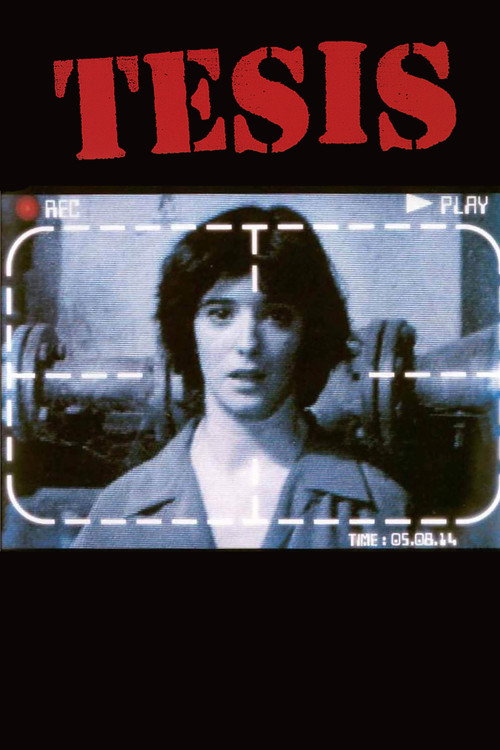
Thesis (1996)
Directed by Alejandro Amenábar
No — Thesis is not woke, scoring 7 out of 100 on our wokeness meter.
Alejandro Amenábar's debut arrives from 1996 Madrid with a film student, a stolen videotape, and a dead professor, and it conducts itself with the tidy cruelty of a genre picture that knows exactly what it is doing.
Consciousness Markers
The film is metafilmic and carries an implicit 'thesis' about humanity's attraction to violent images, but this commentary is embedded in a genre thriller rather than delivered as a preachy lecture.
Ángela functions as a resourceful 'Final Girl' who survives and kills her attacker, but this is a well-worn horror convention rather than a modern feminist statement, and the film's voyeuristic treatment of its female victim undercuts any such reading.
The cast is entirely Spanish, which reflects the film's natural Madrid setting rather than any deliberate diversity initiative. No casting choices are made with representational intent.
There are no LGBTQ+ characters or themes anywhere in the film; the plot concerns a heterosexual obsession and a snuff-film investigation.
Race is entirely absent as a theme; the film is a Spanish-language thriller with no engagement with racial identity or politics.
No environmental or climate themes appear in the film whatsoever.
The film critiques media voyeurism and the public's appetite for violent imagery, but this is a cultural/media critique, not an economic or anti-capitalist one.
No body-positivity themes; the film's treatment of the female body is exploitative horror imagery rather than affirming.
No neurodivergence themes are present; characters' psychological traits are framed as villainy or obsession, not as neurodivergent identity.
The film is a contemporary fictional thriller with no historical subject matter to revise.
Why it received this score
Alejandro Amenábar's debut arrives from 1996 Madrid with a film student, a stolen videotape, and a dead professor, and it conducts itself with the tidy cruelty of a genre picture that knows exactly what it is doing. Ángela is writing a thesis on audiovisual violence, stumbles into a snuff film, and spends the rest of the running time being watched. The camera is the villain here. Everyone in the film is complicit in looking, the audience included, and Amenábar makes sure we feel the seat beneath us.
On the matter of contemporary social consciousness, the ledger is nearly blank. The cast is uniformly Spanish because the film is set in Spain, and no representational arithmetic was performed in the casting office. Race, sexuality, climate, body politics, and economic grievance are absent, not suppressed but simply outside the film's interests. Ángela survives, outwits, and eventually shoots her attacker, which satisfies a longstanding horror convention about resourceful women; the film's leering use of its female victim complicates any claim that this amounts to a statement of principle. The metafilmic commentary on our appetite for violent images is genuine, but it arrives as plot mechanics, not as a sermon. Nobody stops the thriller to explain the thriller.
What remains is a lean, effective machine from a director who would go on to grander and more self-important work. It has a thesis, as the critics never tire of saying, and the thesis is about us. That is a moral observation of the old school, delivered without a checklist. The film is unsettling, and it earns the unease honestly. There is nothing here that would trouble a modern sensitivity reader, largely because the modern sensitivity reader had not yet been invented.
Analysis generated by our Consciousness Algorithm


Synopsis
While working on a thesis about audiovisual violence, film student Ángela finds a snuff video where a girl is tortured until death. Soon she discovers that she was a former student in her university, and that the authors of the video are not very far either.
Questions about Thesis
Is Thesis woke?
No — Thesis is not woke, scoring 7 out of 100 on our wokeness meter. That earns it a verdict of Ultra Based.
Does Thesis have any woke elements?
Very few. None of the 10 markers reaches 30, the level where a marker counts as present; the highest is Lecture Energy at 12.
How does Thesis compare to other 1996 movies?
It ranks #46 of the 93 films from 1996 we've scored; their average is 11. The wokest is Bound (60).
How is the Woke Score calculated?
An AI-assisted process researches the film and its reception, scores it 0–100 on ten markers, then combines those into one 0–100 Woke Score. It measures a specific set of 2020s cultural themes, not film quality.