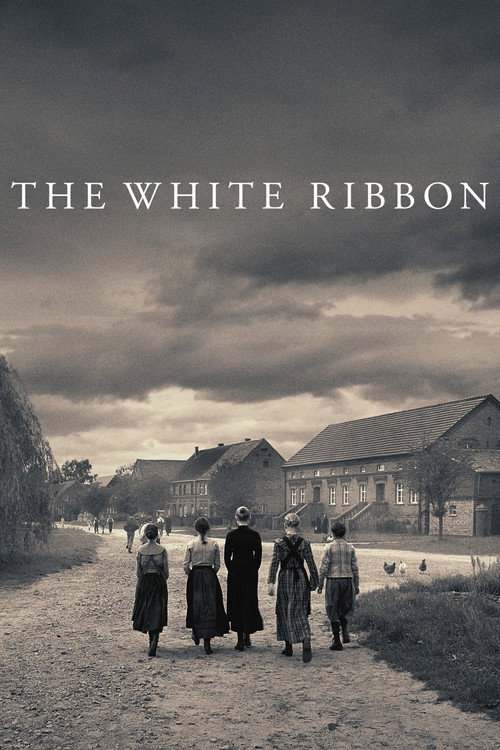
The White Ribbon (2009)
Directed by Michael Haneke
No — The White Ribbon is not woke, scoring 0 out of 100 on our wokeness meter.
Michael Haneke's The White Ribbon arrives in black and white, as though the past could only be trusted in monochrome.
Consciousness Markers
The cast is entirely white European, with no attempt at diverse or inclusive casting.
No LGBTQ+ characters, themes, or subtext are present.
The film depicts patriarchal abuse and repression but offers no feminist agenda or empowerment narrative.
Race is not a theme; the setting is an all-white pre-WWI German village.
No environmental or climate-related themes appear.
It critiques feudal and authoritarian power structures, not capitalism or wealth inequality in a modern sense.
No body-positive messaging or diverse body representation is present.
A handicapped child appears as a victim, but neurodivergence is not explored as a theme.
It is a fictional parable about pre-WWI Germany, not a revisionist historical account.
The film has a moral thesis about authoritarianism, but it is not delivered as modern social justice lecturing.
Why it received this score
Michael Haneke's The White Ribbon arrives in black and white, as though the past could only be trusted in monochrome. The setting is Eichwald, a Protestant village in eastern Germany, and the year is 1913. A schoolteacher narrates what he witnessed as a young man: a wire strung between two trees, a doctor thrown from his horse, a barn burned, a child caned in a sawmill, a parakeet impaled on a desk in the shape of a cross. The pastor ties his son's hands to the bed frame for impure touching. The baron owns the land and the people standing on it. Haneke has said the film concerns the roots of evil, meaning religious and political terrorism as a single germ. It won the Palme d'Or and was nominated for two Academy Awards, which it did not win.
For the purposes of a contemporary social audit, the film offers almost nothing to work with. The cast is entirely white European, and the village is a sealed ethnic loop with no interest in remarking on that fact. There are no LGBTQ characters or subtext. Women are humiliated, abused, and dismissed, and the film declines to convert their suffering into an empowerment narrative. Race is absent as a theme. So is the climate. The baron's cruelties read as feudal and authoritarian, which is not an argument about modern capital. A handicapped child is attacked and nearly blinded, but the film treats him as a casualty of malice, not as a study in neurodivergence. The story is fiction, a parable, so no historical revision is on offer.
The moral thesis is genuine and grim: violence is learned in the home and reproduced by authority. Haneke delivers it coldly, through composition and withheld resolution, not through sermonizing. Nobody in Eichwald explains the lesson aloud. That restraint is why the film lands. A sommelier might call it austere. We call it a film with nothing to prove to the present moment, and it is better for that.
Analysis generated by our Consciousness Algorithm


Synopsis
An aged tailor recalls his life as the schoolteacher of a small village in Northern Germany that was struck by a series of strange events in the year leading up to WWI.
Questions about The White Ribbon
Is The White Ribbon woke?
No — The White Ribbon is not woke, scoring 0 out of 100 on our wokeness meter. That earns it a verdict of Ultra Based.
Does The White Ribbon have any woke elements?
No. All 10 markers score zero.
How does The White Ribbon compare to other 2009 movies?
It ranks #208 of the 230 films from 2009 we've scored; their average is 14. The wokest is Home (79).
How is the Woke Score calculated?
An AI-assisted process researches the film and its reception, scores it 0–100 on ten markers, then combines those into one 0–100 Woke Score. It measures a specific set of 2020s cultural themes, not film quality.