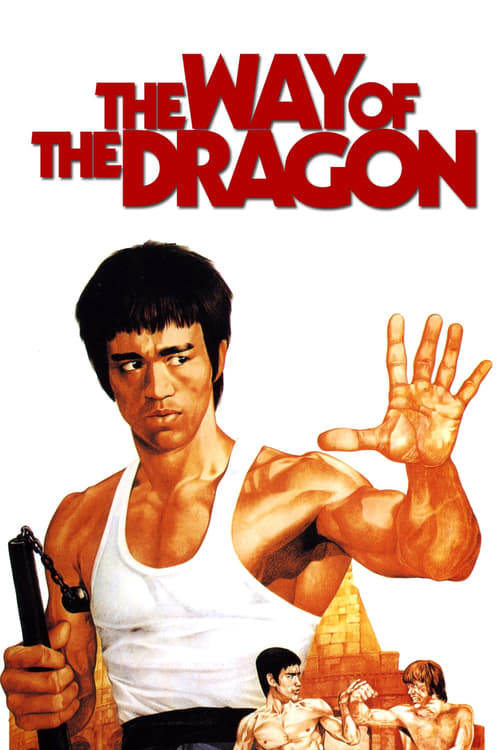
The Way of the Dragon (1972)
Directed by Bruce Lee
No — The Way of the Dragon is not woke, scoring 8 out of 100 on our wokeness meter.
Bruce Lee's only complete directorial effort arrives with a premise of admirable economy: a Hong Kong martial artist lands in Rome to defend a family restaurant from gangsters who covet the property.
Consciousness Markers
A Hong Kong production with an entirely East Asian principal cast and an East Asian lead, but this is natural, unremarked casting for the market and era rather than a deliberate representational statement. Western fighters (Norris, Wall) appear as antagonists, not as diversity gestures.
The film plays on a Chinese-versus-Western culture clash and a fish-out-of-water Hong Kong hero in Rome, but this is comedic and nationalistic rather than a modern racial-consciousness critique.
Nora Miao's Chen is a competent restaurant owner who ultimately leads the police arrest, but she is largely a damsel and the film's ethos is a 1972 martial-arts boys' club. No feminist argument is made.
The villains are gangsters seeking to seize a family restaurant's property; the film is a defense of small proprietors, not a critique of capital. No eat-the-rich sentiment.
Tang offers a brief open-minded maxim about martial arts styles ('use anything that works'), but the film preaches nothing and is content to be magnificently silly entertainment.
No LGBTQ+ characters, themes, or subtext of any kind.
No environmental themes whatsoever.
No body-positivity themes or messaging.
No neurodivergence themes or characters.
No historical revisionism; the film is a contemporary (1972) fictional crime story.
Why it received this score
Bruce Lee's only complete directorial effort arrives with a premise of admirable economy: a Hong Kong martial artist lands in Rome to defend a family restaurant from gangsters who covet the property. The picture was made by and for the Asian market, and its principal cast is entirely East Asian without a syllable of comment on the fact. Western fighters, Chuck Norris and Robert Wall among them, are imported as antagonists to be dismantled, which reads as a gesture of national pride and box office calculation, not an argument about representation. The film has no thesis. It has a restaurant, some thugs, and a man who can kick.
Its claims on modern social consciousness are faint and largely accidental. Nora Miao's Chen runs the establishment and ultimately leads the police to arrest the crime boss, a competent woman in a story that otherwise belongs to a 1972 boys' club. The villains want a small proprietor's property, so the film sides with the little guy against the syndicate, which is a defense of the shopkeeper and nothing more sweeping. Tang advises a colleague to borrow whatever fighting style works, a maxim of open-mindedness that survives roughly four seconds before the next brawl. Beyond this, the picture has no interest in the questions a contemporary audience might bring to it. No interiority, no message, no lesson waiting to be extracted.
What remains is magnificently silly, and Lee never pretended otherwise. The culture clash is played for comedy, the hero is a bumpkin who cannot appreciate the Colosseum until he is punching a man inside it, and the ten-minute duel with Norris is staged with a patience and clarity that most modern action cannot approach. The film preaches nothing, which is its great advantage. It wants to entertain, and it does, at a ratio of roughly a thousand to one against its budget. We are left to classify it as a relic of uncomplicated pleasure, a thing that could not be made now without somebody attaching a lesson to it.
{"thematic_tags": ["box_office_number_one"]}
Analysis generated by our Consciousness Algorithm


Synopsis
After a Chinese restaurant in Rome is threatened by the mafia, who will stop at nothing to acquire the property, the owner recruits a family friend in Hong Kong, kung fu expert Tang Lung, to help them defend their business.
Questions about The Way of the Dragon
Is The Way of the Dragon woke?
No — The Way of the Dragon is not woke, scoring 8 out of 100 on our wokeness meter. That earns it a verdict of Ultra Based.
Does The Way of the Dragon have any woke elements?
Very few. None of the 10 markers reaches 30, the level where a marker counts as present; the highest is Representation Casting at 25.
How does The Way of the Dragon compare to other 1972 movies?
It ranks #10 of the 24 films from 1972 we've scored; their average is 14. The wokest is Silent Running (69).
How is the Woke Score calculated?
An AI-assisted process researches the film and its reception, scores it 0–100 on ten markers, then combines those into one 0–100 Woke Score. It measures a specific set of 2020s cultural themes, not film quality.