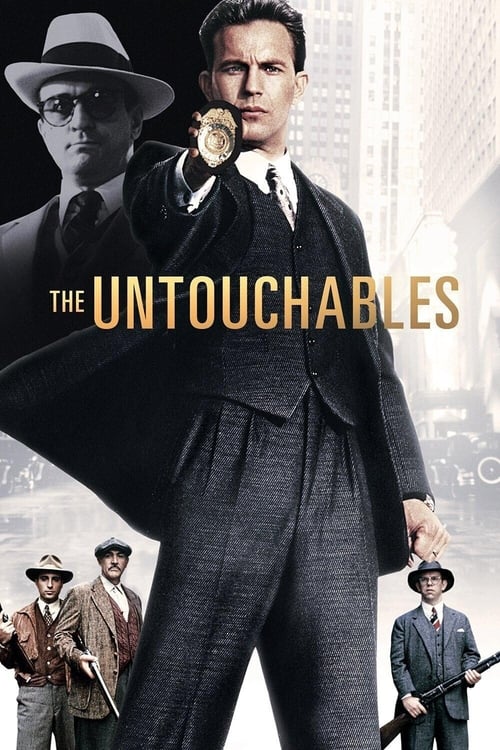
The Untouchables (1987)
Directed by Brian De Palma
No — The Untouchables is not woke, scoring 0 out of 100 on our wokeness meter.
The Untouchables arrives from 1987, a year in which a director could still make a gangster picture about tax law and call it entertainment.
Consciousness Markers
The cast is overwhelmingly white and male, with Andy Garcia as the only notable minority actor, but he plays an Italian-American character; no modern representation-casting intent is evident.
No LGBTQ+ characters, themes, or subtext.
Women appear only as wives, mothers, or bystanders; the film's concerns are entirely male-driven law enforcement and gangsterism.
Ethnic tensions among Irish, Italian, and other white immigrant groups are present but not framed through modern racial-justice consciousness.
No environmental or climate themes.
The film critiques gangster corruption and Prohibition-era crime, not capitalism or wealth inequality in a modern eat-the-rich sense.
No body-positivity themes or diverse body representation.
No neurodivergent characters or themes.
The film fictionalizes historical events, but not in service of a modern progressive revisionist agenda.
The film offers period moralizing about law and order, but no modern social-justice lecture.
Why it received this score
The Untouchables arrives from 1987, a year in which a director could still make a gangster picture about tax law and call it entertainment. Brian De Palma stages David Mamet's script with elegance and a certain cold precision. The film's moral instruction concerns Prohibition, corruption, and the virtue of never stopping until the fight is done. It lectures, yes, but the sermon is about duty and the income tax code. No contemporary cultural curriculum is on offer, and none is needed.
On matters of casting, the picture is a monument to the demographic assumptions of its era. Andy Garcia, born in Cuba, plays George Stone, an Italian-American sharpshooter, which stands as the film's lone gesture toward a broader ensemble and is not really a gesture at all. Women appear as wives, mothers, and bystanders. Patricia Clarkson, in her debut, waits at a safe house while the men settle matters with shotguns. The Union Station sequence pauses for a mother and her baby on the stairs, a moment of sentiment that flatters the hero without granting the woman a name worth remembering.
The historical record is treated with cheerful contempt: the border raid never happened, Frank Nitti did not fall from any roof, and Ness had little to do with the conviction that made him famous. These liberties serve pulp, not a modern social argument. Capone is a brute in a white suit, not an indictment of capital. We are left with a well-crafted thriller whose cultural politics belong entirely to another century, which is either a relief or a disappointment depending on the inventory of the viewer.
Analysis generated by our Consciousness Algorithm
Part of


Synopsis
Elliot Ness, an ambitious prohibition agent, is determined to take down Al Capone. In order to achieve this goal, he forms a group given the nickname “The Untouchables”.
Questions about The Untouchables
Is The Untouchables woke?
No — The Untouchables is not woke, scoring 0 out of 100 on our wokeness meter. That earns it a verdict of Ultra Based.
Does The Untouchables have any woke elements?
No. All 10 markers score zero.
How does The Untouchables compare to other 1987 movies?
It ranks #50 of the 59 films from 1987 we've scored; their average is 8. The wokest is Maurice (68).
How is the Woke Score calculated?
An AI-assisted process researches the film and its reception, scores it 0–100 on ten markers, then combines those into one 0–100 Woke Score. It measures a specific set of 2020s cultural themes, not film quality.