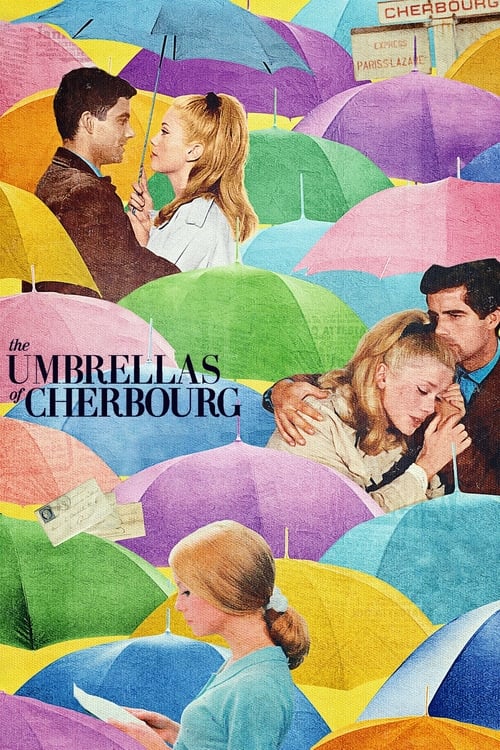
The Umbrellas of Cherbourg (1964)
Directed by Jacques Demy
No — The Umbrellas of Cherbourg is not woke, scoring 6 out of 100 on our wokeness meter.
The Umbrellas of Cherbourg arrives from 1964 as a sung-through romantic tragedy, every casual greeting and heartbroken farewell delivered in recitative over Michel Legrand's score.
Consciousness Markers
The film focuses on a young woman's romantic and economic dilemmas, but it presents a traditional romantic tragedy rather than a modern feminist critique of patriarchy.
The cast is entirely white French actors, with no deliberate ethnic or racial diversity in casting.
There are no LGBTQ+ characters, themes, or subtext in the film.
The film does not engage with racial issues or racial consciousness; its characters and setting are racially homogeneous.
There are no environmental or climate-related themes in the film.
The film depicts wealth and class differences as personal circumstances rather than as a systemic critique of capitalism.
There is no body positivity messaging or focus on diverse body types.
The film does not feature neurodivergent characters or themes.
The film is a fictional romantic drama set during the Algerian War but does not attempt to revise or reinterpret historical events.
The film is an emotional musical romance and does not contain preachy or lecture-like messaging.
Why it received this score
The Umbrellas of Cherbourg arrives from 1964 as a sung-through romantic tragedy, every casual greeting and heartbroken farewell delivered in recitative over Michel Legrand's score. It is a triumph of artifice, all candy-colored storefronts and rain-slicked melancholy. The story is simple: Guy and Genevieve love each other, war and pregnancy intervene, and money decides what love cannot. For our purposes, the film carries almost none of the modern social consciousness we are asked to catalog. The cast is white, French, and homogeneous. There is no racial commentary, no LGBTQ subtext, no climate sermon, no body positivity, no neurodivergent framing. The film is not failing at these things. It is simply not attempting them.
The one area where a faint signal registers is the position of Genevieve. She is at the center, her pregnancy, her economic vulnerability, her mother's pragmatic push toward a wealthy jeweler. Yet the film treats this as personal tragic circumstance, not as an indictment of patriarchy. She chooses security and later returns wealthy and subdued, and the narrative asks us to feel the weight of time, not to organize against the system that constrained her. This is a woman's story told through traditional romantic melodrama. The sadness comes from chance, class, and the Algerian War as backdrop, not from a program of social reform.
Elsewhere, the film is a museum piece of mid-century humanism. It notices class differences, the struggling umbrella shop against the diamond merchant's ease, but it does not eat the rich. It does not revise history. It does not lecture. The songs are about waiting, longing, and loss, and the film's final Christmas Eve meeting is devastating precisely because it refuses to explain itself. As a vehicle for contemporary progressive sensibilities, it is virtually inert. The sommelier finds no modern vintage here, only an old bottle that still tastes of rain and regret. It is beautiful, and it is not ours.
Analysis generated by our Consciousness Algorithm


Synopsis
This simple romantic tragedy begins in 1957. Guy Foucher, a 20-year-old French auto mechanic, has fallen in love with 17-year-old Geneviève Emery, an employee in her widowed mother's chic but financially embattled umbrella shop. On the evening before Guy is to leave for a two-year tour of combat in Algeria, he and Geneviève make love. She becomes pregnant and must choose between waiting for Guy's return or accepting an offer of marriage from a wealthy diamond merchant.
Questions about The Umbrellas of Cherbourg
Is The Umbrellas of Cherbourg woke?
No — The Umbrellas of Cherbourg is not woke, scoring 6 out of 100 on our wokeness meter. That earns it a verdict of Ultra Based.
Does The Umbrellas of Cherbourg have any woke elements?
Very few. None of the 10 markers reaches 30, the level where a marker counts as present; the highest is Feminist Agenda at 10.
How does The Umbrellas of Cherbourg compare to other 1964 movies?
It ranks #7 of the 17 films from 1964 we've scored; their average is 5. The wokest is Mary Poppins (17).
How is the Woke Score calculated?
An AI-assisted process researches the film and its reception, scores it 0–100 on ten markers, then combines those into one 0–100 Woke Score. It measures a specific set of 2020s cultural themes, not film quality.